
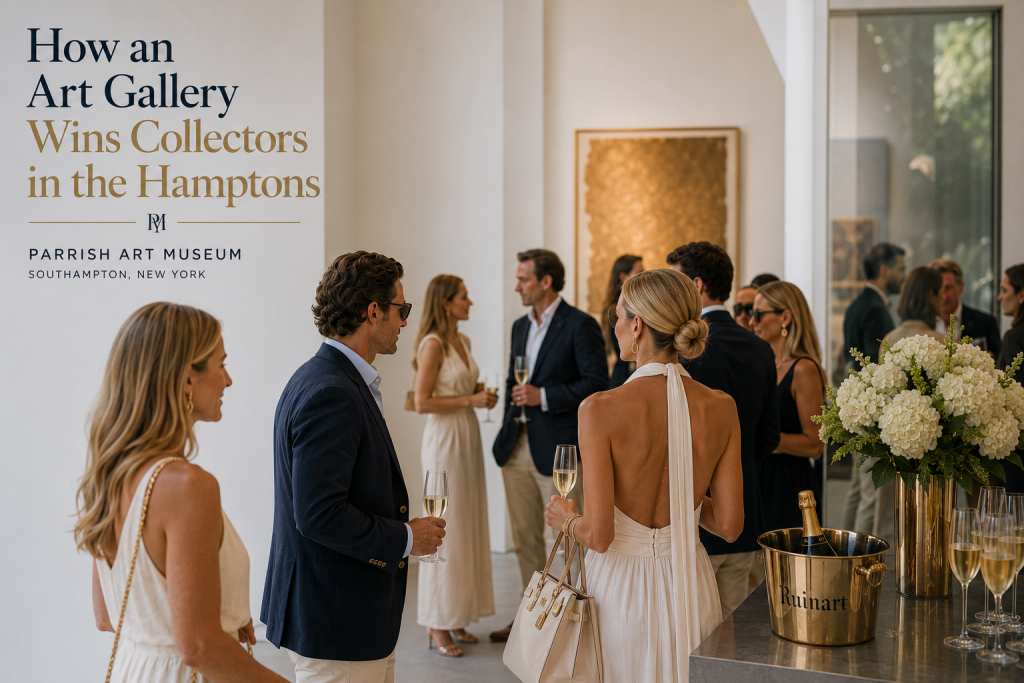
Most art gallery marketing misfires in the same place. A gallery spent its season budget on fair listings and glossy ads last year. The placements were prestigious. The collectors were unmoved, since serious buyers do not pick a gallery off a page. By fall the gallery had spent a fortune to be admired by people who would never walk in.
A smaller gallery did the opposite. It skipped the ads. Instead it took a quiet seat field-side at the polo, among the collectors who actually buy out here. By fall its name was the one those collectors trusted when they wanted a real eye and not a sales pitch.
This is the truth the ad budget hides. A gallery is not sold by a listing. It is sold by trust in an eye. Nobody buys serious work because a page told them to. They buy because someone they respect vouched for the person choosing the work.
So the question is not how many people see your roster. The question is which collectors trust your eye. Get that right and the relationships compound for decades. Get it wrong and you are a beautiful ad nobody answered.
Read this as a buyer’s guide to a market most galleries misplay. The right room is for sale. The only question is whether you are sitting in it.
Get this right and the relationships compound for decades. Get it wrong and you are a prestigious ad nobody answered. The difference is not budget. The difference is which collectors trust your eye.
So treat this as the most efficient buy in your whole calendar. One afternoon among the right collectors can do what a year of listings cannot. The room is small. The right people are all in it.
Art Is a Relationship Business, Not a Reach Business
Nobody builds a collection from an ad. They build it with a dealer they trust over years. So reach does almost nothing in this business, while one trusted relationship does everything.
This is why the best galleries stopped shouting. They learned a quiet truth. A collector’s trust beats a season of ads. By contrast, the loud campaign reads as hungry, and hungry is the last thing a serious collector wants in the person guiding their taste.
So the goal is not to be seen by everyone. The goal is to be trusted by the few who actually buy. Because trust moves through that small world, one real relationship opens a dozen collections no campaign could.
This is the same logic that runs every curated room out here. The full case for why the right people beat the big numbers gets made in the guest list is the product. A gallery is that case hung on a wall.
The Collectors You Want Are Already Field-Side
Here is the part that makes the polo field unfair in your favor. The collectors who shape the market out here are already there. You do not have to find them, since they found their own way to the boards.
These are exactly the people a gallery wants. They buy real work, they fund the institutions, and their taste sets the room. So reaching them is worth more than a thousand fair listings, because each one travels with a circle that follows the eye.
This is why a presence at the field is a relationship engine. The right neighbor becomes a conversation, and the conversation becomes a studio visit. Since the trust is earned in person, it holds in a way no ad ever could.
So you are not buying impressions. You are buying the specific collectors whose trust the market turns on. That is the purchase worth making, and the only one that pays here.
So stop measuring this in impressions. Measure it in the collectors you could sit beside. A handful of the right ones is worth more than every fair listing a gallery ever bought.
You Sell the Eye Before You Sell the Work
Collectors do not really buy paintings from a gallery. They buy the judgment of the person choosing them. So the thing for sale is the eye, and the eye is sold only in person.
This is why a pitch backfires. Push the work and you look like a dealer moving inventory. By contrast, talk about the work the way only a real eye can, and the collector starts to trust the judgment behind it.
So the field is where the eye gets shown, not the roster. A few real conversations do more than a year of fair booths. Because the collector meets the person, not the price list, the relationship begins on the right footing.
Where a gallery should actually sit, and why, gets taken apart in the cabana index. A gallery belongs on one of its most cultured, discreet rungs.
The Introduction Is the Whole Channel
Think about how a collector actually finds a gallery. Someone they trust makes an introduction. That single introduction does more than a decade of advertising, since it arrives wrapped in trust.
So the whole channel is the introduction. Everything else is noise. Because the referral comes from a peer, the collector arrives open rather than guarded, and an open collector is the only kind worth pursuing.
This is why proximity beats reach in art. You do not need a million viewers. You need the handful of collectors whose introduction carries weight, since each one can hand you a relationship that lasts a generation.
So the move is simple. Get into the room where those introductions happen. Be the easy, generous presence collectors are glad to vouch for. The introduction does the rest, and it never sends a bill.
Why an Art-Fair Ad Is the Wrong Buy
It helps to name the ad’s exact mistake. It chases visibility, when art runs on trust. So it counts impressions, a number that means nothing here, while ignoring whether a single real collector ever made an introduction.
The ad also flattens the gallery. A roster pushed at everyone signals it is selling to anyone. And selling to anyone is the wrong message for people building serious collections. By contrast, the quietly present gallery signals it already has the collectors it wants.
So the ad wins the metric and loses the market. It feels productive, since the listing looks prestigious. Yet the prestige of the page is the problem, not the proof. Because chasing everyone reads as needing anyone, the loud buy quietly lowers the standing it came to raise.
Discretion Is the Whole Game
Art runs on discretion, and discretion itself signals seriousness. The real collector does not want a loud booth and a hard close. He wants a calm presence that clearly is not desperate to sell.
So the move is restraint. A quiet preview, a real conversation, no pressure, since pressure is what gives the desperation away. By contrast, the gallery that simply belongs reads as the one worth knowing.
This is where most galleries overreach. They treat the afternoon as a sales floor. Because the hard sell breaks the spell, it marks them as the wrong kind of dealer in a single move.
So spend on the setting and the conversation, not the signage. Let the encounter feel like the start of a long relationship. After all, a long relationship is exactly what a gallery is selling.
How a Gallery Earns the Collector
Earning the collector is not about outspending the field. It is about showing up the right way. The room respects a gallery that adds to the day over one that buys the loudest spot. So bring an eye and a generosity, not a sales script.
The galleries that rise do three things. First, they choose a calm, well-placed presence over a big loud one. Second, they treat every guest as a peer, not a prospect. Third, they return, because the field rewards the familiar face the way a regular earns the warm greeting.
So treat the first summer as a deposit, not a campaign. You are buying a place in the room’s memory. That memory compounds across seasons. Because the climb is cumulative, the patient gallery passes the splashy one within a year.
This grammar of rank sits inside the broader map of the region. The full read on how status gets sorted lives in luxury status codes. What hangs on the wall is one of its purest tells.
The same play runs for the brands beside you. A fine hotel earns the recommendation the same way. The jewelry house earns the wrist the same way. Your neighbor the fashion label earns the look the same way. The field rewards every category that reads it right.
What the Right Presence Returns
Here is the part the numbers will like. A field-side presence does not pay off the day of the match. It pays off over years, when one collector has become a patron and three introductions besides.
So the return is not measured in impressions. It is the relationships that mature, the introductions that compound, the collectors who arrive already trusting your eye. Because referred collectors cost almost nothing to win, they are the most valuable a gallery can hold.
The afternoon also compounds into the next one. The collector who met you this July expects to see you next July. So the presence is less a campaign than a standing relationship that pays out for a generation.
This is the math that separates lasting galleries from the rest. The loud one chases visibility and burns the budget by fall. By contrast, the lasting one earns the trust, banks the relationships, and lets the room do the selling.
Reading the 2026 Field
The 2026 field sets up on two Saturdays, July 18 and 25, in Bridgehampton. So the season’s most-watched afternoon runs twice. The galleries that read it early get the presence that matters.
The room is curated before you arrive. Christie Brinkley hosts. The crowd skews toward exactly the collectors a serious gallery wants. Because the room is pre-sorted, your presence borrows that standing the moment it opens.
So the move is simple and the timing is now. Decide what kind of presence your gallery can honestly hold. Then claim it before the field-side spots are gone. The earlier you commit, the more the afternoon works for you.
Last season the field-side spots were gone by June. So the galleries that win are the ones reading this now, not the ones calling in July.
A presence at this July’s matches is the fastest way to sit beside the collectors you want. And those are the people whose trust the whole market runs on.
Where the Conversation Continues
A fish does not notice the water. The ad-buying gallery never notices it is paying for the one thing the room ignores. The present gallery crossed that water and stopped buying listings nobody answers. Reading the difference is the whole game, and it is the one we play for a living.
If you want to sit beside the collectors you want, start with the contact page. We place galleries where the people who set the market already sit.
For the version that puts your gallery inside the magazine as well as on the field, look at a paid feature. Because it is editorial, it earns a trust a listing never could.
Want the placements before they close? Get on the insider list. So far it is the earliest read on the field we share.
For the field-side presence itself, there is Polo Hamptons on July 18 and 25 in Bridgehampton. Since the best spots go first, the early gallery wins the season.
Readers who want the season decoded all year can take a subscription. After all, the field is easier to read once someone hands you the map.
And if you have ever run a flawless listing and heard nothing back, you can support the work. Of course the room still decides. We just want your eye in front of the right collector when it does.
Author

Written by
Recent Posts

Jetsetter Style: Castello del Sole

The First Decision After a Collision Can Be the Most Important One
Two Weeks in Rome and Beyond: Turkish Airlines Itineraries from Boston, Chicago and Onward to India

Top 10 Hair Transplant Clinics in Turkey 2026
Artist Alley to Online Store: How Convention Artists Can Keep Selling After the Event
Categories
- Art
- Articles
- Business of Luxury
- Celebrities
- Culture
- Entertainment
- Events
- Faces of Summer 2026
- Fashion
- Fashion & Style
- Featured
- Finance
- Food, Spirits, Wine
- Hamptons
- Hamptons Celebrities
- Health
- Health & Beauty
- Lifestyle
- Luxury Lifestyle
- Press
- Profiles
- Real Estate
- Technology
- The Chronicles
- Travel
- Uncategorized
- Weddings