
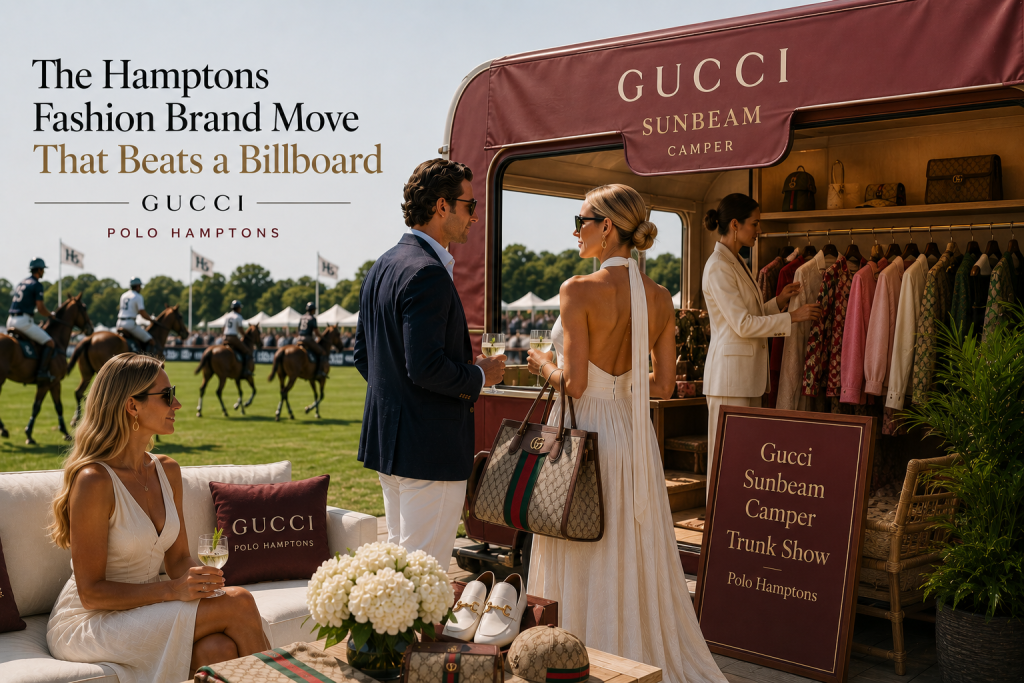
A Hamptons fashion brand bought a billboard on Montauk Highway last June. It cost a fortune. Thousands of cars passed it, and not one driver remembered the name by dinner. The brand had reach and nothing else.
A smaller Hamptons fashion brand did the opposite. It dressed the right ten people for one polo afternoon. No billboard, no banner, no press release. By Labor Day those ten outfits had been seen, photographed, and copied across the whole East End.
This is the lesson fashion keeps relearning out here. Nobody buys a look from a sign. They buy it off a person they want to be. So the clothes have to be worn into the room, not advertised at it.
The billboard brand spent on strangers. The cabana brand spent on the few. One bought traffic. The other bought the season, because the season copies what it sees on the right shoulders.
So read this as a buyer’s guide to a market most labels never see. The afternoon is a runway. The only question is who is wearing you on it.
Get this right and the season works for you for years. Get it wrong and you are the billboard nobody recalls. The difference is not budget. The difference is who wears you, since a look only ever lives on the right body.
Fashion Is Worn Into the Room, Not Advertised Into It
Fashion is the most social purchase there is. Nobody picks a look from a billboard. They pick it off the person they admire. So reach does almost nothing here, while the right shoulder does everything.
This is why the great houses stopped shouting. They learned a quiet truth. The woman in front of you sells more than the ad above you. By contrast, the loud campaign reads as trying, and trying is the one tell fashion cannot afford.
So the goal is not to be seen by everyone. The goal is to be worn by the few everyone watches. Influence flows downhill from those few. The look they wear today is the look the rest chase by fall.
This is the same logic that runs every curated room out here. The full case for why the right people beat the big numbers gets made in the guest list is the product. Fashion is that case worn in public.
Dress the Right Ten People
Here is the move, stated plainly. Find the ten people the room already watches. Dress them. Then step back and let the afternoon do the rest.
These are not the loudest people at the event. They are the ones whose friends quietly ask where they got it. So ten of them outweigh a thousand impressions, because each one carries a circle that copies her taste.
The trick is restraint. Dress them well, not heavily. One perfect piece reads as taste, while head-to-toe logo reads as a costume. Because the room rewards ease, the lightest touch travels the farthest.
So you are not buying ad space. You are casting the people the season will imitate. That is a different purchase entirely, and it is the only one fashion should make out here.
So picture the same dollar two ways. Spent on a billboard, it buys a glance from a stranger in traffic. Spent on the right ten, it buys a look the whole room copies, because a look only spreads from a person, never from a sign.
The Field Is the Front Row
Every fashion brand wants a front row. The polo field is one, and it sets itself up for free. The people you would fly to a show are already here, by the boards, dressed and watching.
So you do not have to build an audience. You have to dress the one that showed up. Because the crowd is pre-sorted, a single field-side placement reaches the exact people a runway tries to reach.
This is why a cabana out here is a casting call you get to win. The right neighbor becomes your model without a fee. Since the look is unpaid, it reads as real, and real is the only thing that converts in fashion.
This is exactly what a field-side spot is built to do. The whole ladder of placement gets taken apart in the cabana index. Fashion sits near the top of it.
The Collaboration That Outlives the Day
The smartest labels do more than show up. They weave themselves into the day. So they dress the staff, gift the host, or build a small capsule tied to the afternoon.
Because the brand becomes part of the event, it stops reading as a sponsor. It reads as a host. And a host is trusted in a way a sponsor never is.
So the collaboration outlives the match. The capsule sells after the day ends. The gifted piece gets worn all summer, since a gift carries a story a purchase does not.
This is the move that turns one afternoon into a season. The brand is no longer at the event. It is of the event, and the room remembers it that way.
The Outfit That Travels
There is always a photo, and in fashion the photo is the whole return. The right woman wears your piece and posts it without a caption. Because she was not paid, it reads as taste, not an ad. Taste is what her followers act on.
So the afternoon is a shoot you never have to produce. The brand supplies the look. The guests supply the images. By contrast, the billboard produces no photo worth keeping, because nobody frames a highway sign.
The math favors you all summer. One unpaid post from a trusted face beats a paid campaign. Her circle trusts her and tunes the campaign out. So a single field-side day seeds weeks of reach you never bought.
This is why labels fight for the photogenic rung. The look that photographs best is the look that travels. And the travel is the product, since the outfit people remember is the one they saw on someone they envied.
The Quiet Piece Beats the Logo
There is a temptation to make the logo loud. Resist it. The quiet piece travels farther than the monogram out here.
So the room reads restraint as confidence. A visible logo asks for credit, while a perfect cut earns it. Because the East End prizes ease, the understated piece wins the photograph.
This is the stealth move great labels know. Dress the right woman in something only the initiated recognize. So the piece becomes a password, and a password is worth more than a billboard.
The loud logo dates fast. The quiet cut does not. So the brand that whispers out here outlasts the brand that shouts.
Why a Billboard Is the Wrong Buy
It helps to name the billboard’s exact mistake. It chases volume, when fashion runs on verdict. So it counts cars, a number that means nothing, while ignoring who actually wanted the look.
The billboard also flattens the brand. A look pushed at everyone signals it is for everyone. And for everyone is the death of desire out here. By contrast, a piece seen on the right few signals it is for the few, which is what the rest aspire to.
So the billboard wins the metric and loses the market. It feels productive, since the reach numbers look big. Yet the bigness is the problem, not the proof. Because shouting reads as needing, the loud buy quietly lowers the brand it meant to lift.
So run the comparison honestly. One billboard, gone by fall, against ten outfits the season copied. Framed that way, the cheap-looking placement is the asset, while the expensive billboard is the throwaway.
How a Brand Earns the Look
Earning the right placement is not about spending the most. It is about spending in the right order. The room respects a brand that climbs over one that buys the top on day one. So start where you honestly belong.
The labels that rise do three things. First, they pick placement over size every time. Second, they show up restrained, not loud. Third, they return, because the field rewards the familiar name the way a regular earns the warm greeting.
So treat the first summer as a deposit, not a campaign. You are buying a place in the room’s memory. That memory compounds across seasons. Because the climb is cumulative, the patient label passes the splashy one within a year.
This grammar of rank sits inside the broader map of the region. The full read on how status gets sorted lives in luxury status codes. Fashion is one of its loudest pages.
The same play runs for your neighbors. A medspa earns the whisper this way. A wealth firm earns the introduction this way. The field rewards every category that reads it right.
What the Right Placement Returns
Here is the part the numbers people will like. A field-side placement does not pay off the day of the match. It pays off in September, when the right woman still wears your piece and still tells people where she found it.
So the return is not measured in impressions. It is the reorders, the editorial pickups, the friends a guest sent your way. Because referred buyers cost nothing to acquire, they are the most profitable customers a label owns.
The afternoon also compounds into the next one. The face that wore you this July expects to see you next July. So the placement is less a campaign than a standing relationship that pays out for years.
This is the math that separates lasting labels from flares. The flare chases reach and burns the budget by fall. By contrast, the lasting label buys the rung, banks the loyalty, and lets the season sell for it.
Reading the 2026 Field
The 2026 field sets up on two Saturdays, July 18 and 25, in Bridgehampton. So the season’s most-watched afternoon runs twice. The labels that read it early get the spots that matter.
Last season the field-side spots were gone by June. So the labels that win are the ones reading this now, not the ones calling in July.
The room is curated before you arrive. Christie Brinkley hosts. The crowd skews toward exactly the people a label wants on its clothes. Because the room is pre-sorted, your placement borrows that standing the moment it opens.
So the move is simple and the timing is now. Decide which rung your brand can honestly hold. Then claim it before the field-side spots are gone. The earlier you commit, the more the afternoon works for you.
A field-side placement at this July’s matches is the fastest way to put your look on the right shoulders. And those shoulders are the ones the whole season copies.
Where the Conversation Continues
A fish does not notice the water. The billboard brand never notices it is buying the one thing the room ignores. The cabana brand crossed that water and stopped paying for reach it could not use. Reading the difference is the whole game, and it is the one we play for a living.
If you want your look on the right shoulders this season, start with the contact page. We place fashion where the people who set the look already sit.
For the version that puts your brand inside the magazine as well as on the field, look at a paid feature. Because it is editorial, it earns a trust a billboard never could.
Want the placements before they close? Get on the insider list. So far it is the earliest read on the field we share.
For the field-side placements themselves, there is Polo Hamptons on July 18 and 25 in Bridgehampton. Since the best spots go first, the early brand wins the season.
Readers who want the season decoded all year can take a subscription. After all, the field is easier to read once someone hands you the map.
And if you have ever watched a great look die on a billboard, you can support the work. Of course the room still decides. We just want you on the right shoulders when it does.
Author

Written by
Recent Posts
The Skincare Habits That Make a Real Difference Over Time
Hamptons-Ready Beauty: Polished Makeup for Long Summer Days
Is Now a Good Time to Sell a Home in NJ?
The Hidden Work Behind a Seamless Hotel Weekend
Choosing Scratching Furniture for a British Shorthair
Categories
- Art
- Articles
- Business of Luxury
- Celebrities
- Culture
- Entertainment
- Events
- Faces of Summer 2026
- Fashion
- Fashion & Style
- Featured
- Finance
- Food, Spirits, Wine
- Hamptons
- Hamptons Celebrities
- Health
- Health & Beauty
- Lifestyle
- Luxury Lifestyle
- Press
- Profiles
- Real Estate
- Technology
- The Chronicles
- Travel
- Uncategorized
- Weddings