
Camille Paglia spent decades making academics furious by stating what anthropologists already knew: human beings are status animals, and status display is not a social construction. It is biology dressed in Loro Piana.
Her 1990 book “Sexual Personae” landed like a grenade in a faculty lounge. The cultural establishment wanted her gone before cancellation had a name. But what she had done was simple, correct, and worth millions to anyone selling luxury goods. She argued that art, beauty, and status were inseparable from the biological realities of sex and power. The male drive to build, accumulate, and conquer. The female drive to cultivate, curate, and define what is desirable. Both ancient and rational. Both operating at full volume in every luxury market on earth.
Specifically, in the market that runs from Westhampton to Montauk every summer.
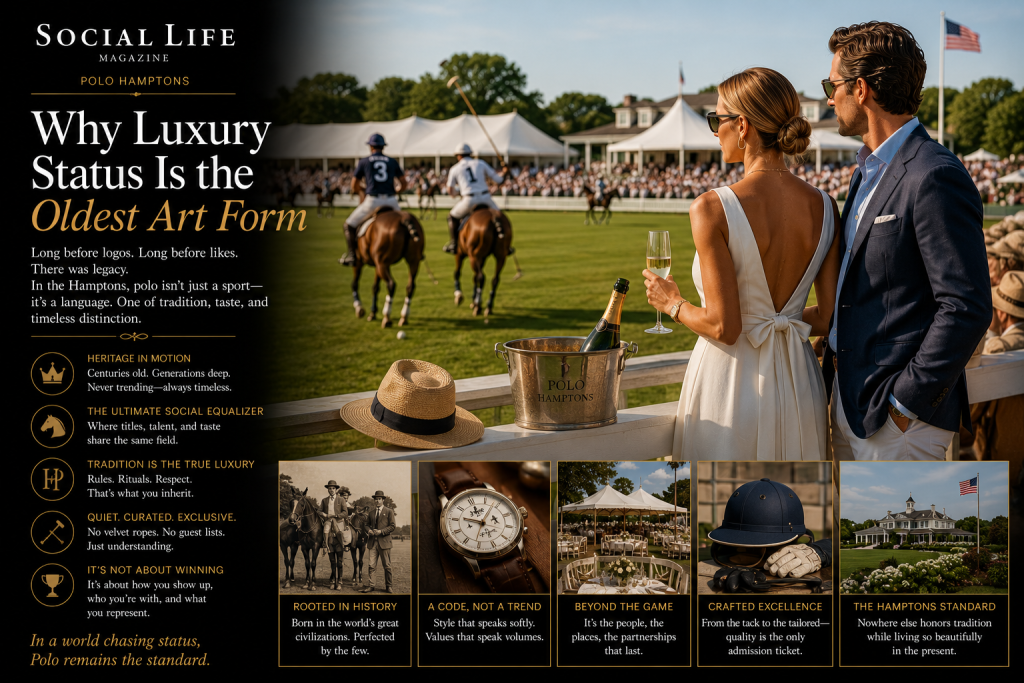
The Hamptons is not a place. It is a status theater. Every party, every property, every bottle of Billecart-Salmon opened at a polo match on Hayground Road is a performance in a script written before civilization had a word for it. Paglia’s framework explains why the script works. It explains why it has always worked. And it explains precisely what luxury brands that understand it stand to win.
The Biology Behind the Buy
Here is the basic Paglia argument, stripped of academic scaffolding. Men and women approach status differently because they are biologically different. This is not a provocation. It is a fact so obvious that every successful luxury marketer has been working from it for decades without naming it.
Male status capital runs through conquest. Acquisition. Scale. The 10,000-square-foot compound on Further Lane in East Hampton signals dominance in the same register as a lion marking territory. The Porsche parked outside the Bathing Corporation at Southampton signals speed, aggression, and competitive fitness. Finance industry sponsors at Polo Hamptons are not buying media impressions. They are buying association with a social arena where masculine capital is performed publicly and rewarded visibly.
Female status capital runs through curation. Refinement. The ability to define what is beautiful, what is worth having, and who gets invited. This is, in Paglia’s reading, a form of power that men cannot replicate. The woman who sets the aesthetic standard for a Hamptons dinner table is exercising cultural authority as real as any boardroom. A beauty brand sponsors a Social Life Magazine cover not because it is selling a product. It is selling a passport to the curation class.
Both drives are ancient. Both are real. And critically, both are addressable with the right creative strategy.
For the complete marketing application of this framework across five Hamptons luxury categories, see The Gender Capital of Luxury.
The Hamptons as Status Laboratory
No geography in America makes the Paglia dynamic more legible than the East End in July.
Watch who is building. The new spec compound going up on Meadow Lane is almost always a male capital project, a statement of resources acquired and dominance asserted. The parties thrown inside it, the flowers chosen, the caterer hired, the guest list curated: these are predominantly female capital operations. The two systems operate simultaneously and interdependently. Neither is subordinate to the other. Together they produce what sociologist Pierre Bourdieu called the social field, the arena where capital gets converted into prestige, and prestige gets converted into more capital.
Social Life Magazine has operated inside this field for twenty-three years. The publication reaches 25,000 print readers per issue across five summer editions distributed from Westhampton to Montauk. It reaches 15,000 more through fall and winter issues delivered to doorman buildings on the Upper East Side. In addition, 82,000 email subscribers receive its editorial in their inboxes, a number that has grown organically through content that treats status as the serious subject it is.
These are not passive readers. They are active participants in the status theater Paglia describes, and they know the script cold.
What Brands Get Wrong
The most common mistake in Hamptons luxury marketing is gender capital confusion, and it is more expensive than most brand managers realize.
A wellness brand pitches its product using conquest language: biggest, strongest, most powerful. A finance firm runs soft aesthetic imagery to reach a demographic that respects aggression and scale. Both are misfires. Both signal to the audience that the brand does not understand the room it is trying to enter.
Paglia’s framework cuts through this cleanly. It asks a single question: which status drive are you feeding? If you are selling real estate, private aviation, or high-performance vehicles, you are in the conquest arena. Your creative should feel like winning. Specific. Hard. Aspirational in the direction of scale and dominance, a dynamic covered in depth in the luxury real estate and wealth management verticals.
If you are selling beauty, fashion, interior design, or hospitality, you are in the curation arena. Your creative should feel like access to a refined world that most people cannot enter. Your brand is not a product in this register. It is membership in a taste class that the reader aches to belong to, as explored in depth for Hamptons medspas and luxury fashion brands.
Polo Hamptons activates both simultaneously. On July 18 and July 25 at the Bridgehampton Polo Club, Christie Brinkley hosts an afternoon where male capital (horses, open-field competition, BMW performance) and female capital (fashion, social orchestration, aesthetic authority) operate in the same arena at the same time. The brands that sponsor it reach both drives in a single activation. That is rare. That is why the placement performs.
Status as the Original Art Form
Paglia’s most radical claim is also her most useful for luxury marketers. Status display is not vanity. It is art. It is the original human art form, predating painting, predating architecture, predating writing itself. The desire to be seen as powerful, refined, tasteful, and worthy of admiration is the same impulse that built the Parthenon.
The Hamptons is a living version of that monument. It is a concentrated, legible, and annually recurring performance of status at its most visible. Every summer, the same script plays out across the same geography, with the same archetypes in updated wardrobe. The conqueror with the new oceanfront compound. The taste arbiter with the perfect dinner table. The brand with the right editorial placement.
The brand that earns a seat inside this theater wins something no digital impression can replicate: cultural adjacency to real status. Not aspirational proximity to it. Actual adjacency. The kind that moves product, builds brand equity, and closes clients.
That is what Paglia understood about art, power, and desire. And it is what Social Life Magazine has been delivering to the right buyers since 2002.
Where The Conversation Continues
Social Life Magazine reaches the Hamptons luxury audience at full strength across five summer issues, 25,000 print copies per issue, 82,000 email subscribers, and twenty-three years of editorial authority inside the status field Paglia described.
If your brand belongs in this conversation, now is the time to claim the seat. Editorial partnerships, full-page advertising, sponsored features, and Polo Hamptons sponsorships are available for the 2026 summer season. Space is limited and the season opens July 18.
Author

Written by
Recent Posts
Vanderbilt & Seewald
Alberto Luzzi Opening of Fine Jewelry Room
The Victor dE Souza 2027 Spring Summer Collection
Malan Breton Presents “Garden of a Thousand Tomorrows”
What to Wear to a Summer Wedding as a Guest: A Hamptons Dress Code Guide
Categories
- Art
- Articles
- Business of Luxury
- Celebrities
- Culture
- Entertainment
- Events
- Faces of Summer 2026
- Fashion
- Fashion & Style
- Featured
- Finance
- Food, Spirits, Wine
- Hamptons
- Hamptons Celebrities
- Health
- Health & Beauty
- Lifestyle
- Luxury Lifestyle
- Press
- Profiles
- Real Estate
- Technology
- The Chronicles
- Travel
- Uncategorized
- Weddings