
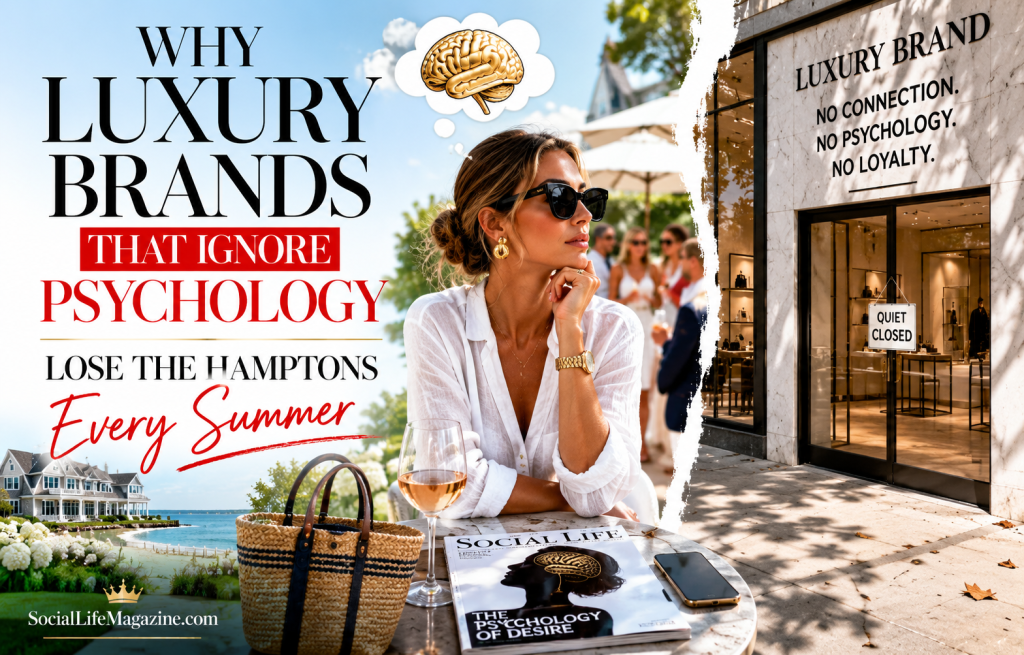
There is a woman standing in a boutique on Job’s Lane in Southampton. She has a house on Meadow Lane. She spent $6,200 last week at a trunk show in East Hampton. In her left hand is a magazine — specifically, a copy of Social Life Magazine she picked up from the counter near the door — and she is looking at a full-page ad for a skincare brand she has never heard of.
She will not read the ad. The QR code will go unscanned. She will not note the website. But she will remember the brand. She will remember it specifically because it appeared in this magazine, in this boutique, in the town where she spends every summer without exception.
That memory is worth more than any digital impression her agency could have served her. And yet most luxury brands spending money in the Hamptons this summer will never create it. They will buy reach. CPM will get optimized. They will run a retargeting campaign that follows her from Sag Harbor to her SoHo apartment in September. And they will wonder why their Hamptons season didn’t convert.
The answer is not in the media plan. The answer is in the psychology.
The Hamptons Is a Perception Market, Not a Reach Market
Rory Sutherland, the vice chairman of Ogilvy and the behavioral scientist behind *Alchemy: The Dark Art and Curious Science of Creating Magic in Brands, Business, and Life*, has spent thirty years studying why the most effective marketing often makes no rational sense. His central argument is blunt: perception is the product. Not the product itself. Not the features. Price is not even the point. The feeling the product creates in the mind of the buyer is the thing being sold.
In the Hamptons, this principle is not theory. It is operating infrastructure.
Every summer, roughly 25,000 copies of Social Life Magazine distribute across Westhampton Beach to Montauk. They sit in boutiques, hotels, restaurants, and fitness studios in Southampton, Bridgehampton, Sag Harbor, East Hampton, and Montauk. These are not magazines that get glanced at. They are held. On coffee tables in houses that cost $8 million to rent for the season, they sit for the length of the season. They travel back to Manhattan in tote bags alongside Loro Piana linen and bottles of Hampton Water rosé.
A brand in those pages is not just advertising. It is occupying a perception environment. And perception environments, Sutherland would tell you, are the only environments that actually change behavior.
The luxury brand psychology that drives Hamptons marketing decisions is not complicated. But it requires accepting one uncomfortable fact: the logical approach to Hamptons marketing gets you exactly where every other brand finishes.
Why Logic Gets You to Last Place
Sutherland’s most useful rule for anyone spending money in a luxury market: it does not pay to be logical if everyone else is being logical. Because if you do what the data tells you to do, and your competitor does what the data tells them to do, you both arrive at the same place. You both serve the same retargeting ads. The same programmatic placements go into the same dashboards. You both measure the same metrics and report the same mediocre results to the same quarterly review.
The Hamptons luxury market runs on a different logic entirely. It runs on what Sutherland calls “psycho-logic” — the internal, often irrational rules by which high-net-worth consumers actually make decisions. She does not choose a brand because it has the best ingredient list. A brand seen in a place confirming her self-image as a person of discernment — that is the one she chooses. An event is not attended because the activation was strategically placed. She attends because someone she trusts told her it was the only place to be.
The Psycho-Logic of the East End
Specifically, this matters for the brands investing in the Hamptons right now. The 2026 summer season is not a reach campaign. It is a status election. Every brand competing for attention in Bridgehampton, Southampton, and Sag Harbor this July is asking the same question without realizing it: *am I the kind of brand that belongs here?*
The brands that answer yes convincingly do not answer it with a media kit. They answer it with presence, association, and what Sutherland calls costly signaling — the commitment of real resources to a real environment, in a way that cannot be faked or cheaply replicated.
Understanding how costly signaling creates luxury brand credibility is the first step toward building a Hamptons season that compounds rather than evaporates.
The Signal That Money Cannot Simply Buy
In the summer of 2026, Polo Hamptons returns to the Fishel Estate at 900 Lumber Lane in Bridgehampton on July 18 and July 25. BMW is the title sponsor. Christie Brinkley is hosting.
These three facts are not a press release. They are a costly signal of the highest order.
When a brand with a global supply chain and a $5 billion marketing budget says yes to a specific event in a specific field in Bridgehampton, it is not making a reach decision. It is making a declaration about where it belongs. Christie Brinkley’s name — forty years of Hamptons summers, Sports Illustrated, BeautyCounter, a presence so consistent in this geography that it borders on geographic — costs something to earn. Not in dollars. In social capital. In the careful cultivation of a personal brand that has meant something on the East End of Long Island for longer than most luxury marketers have been alive.
That signal changes the decision calculus for every brand that considers a Polo Hamptons sponsorship afterward. Not because of what BMW or Christie Brinkley say about the event. Because of what their participation implies. In behavioral economics, this is called social proof. In the Hamptons, it is called reading the room.
Still, the mechanics of signaling go deeper than a famous name. Sutherland’s research identifies what makes a signal credible: it must be genuinely costly. An easy yes means nothing. A yes that requires real commitment — financial, reputational, logistical — means everything. And crucially, a signal that anyone could make is worth nothing. The exclusivity of the signal is the signal.
Two sponsorship positions remain for Polo Hamptons 2026. Not because of poor sales management. Because that is exactly the right number for the signal to hold its value.
Design for the Outlier, Not the Average
In the early 1950s, the United States Air Force asked a lieutenant named Gilbert Daniels to design the standard cockpit for high-performance aircraft. The assumption, standard at the time, was to design for the average pilot. Daniels measured 4,163 pilots across ten physical dimensions. Not one of them was average across all ten. Not a single person.
Designing for average, in other words, means designing for nobody.
Sutherland builds an entire chapter of *Alchemy* around this insight. The innovation in any market, he argues, comes from the outlier — the extreme user, the obsessive buyer, the person whose needs look bizarre until you realize they are simply ahead of everyone else. The Earl of Sandwich, as Sutherland tells it, invented the sandwich because he was an obsessive gambler who needed food he could eat at the card table without putting down his hand. His extreme constraint created a product that billions of people now eat every day.
The Outlier as First Mover
The Hamptons luxury consumer is not average. She is not a demographic. A psychographic so specific that she makes most brand targeting models useless is what she is. Her household income rounds to a number most agency media planners type once and then pause. She has been spending summers on the East End for fifteen years. She already knows which brands belong in her life. Your job is not to reach her. Your job is to be recognized by her.
Specifically, this means your marketing should not be designed for the broad summer Hamptons population. It should be designed for the woman who attends Polo Hamptons every year and then tells twelve other people about it in September.
The psychology of the outlier luxury buyer in the Hamptons is not a niche topic. It is the only topic that matters when you are asking why some brands become cultural fixtures on the East End while others run the same campaign three years in a row and wonder why their numbers have not moved.
Why the Ad That Doesn’t Look Like an Ad Is the Most Powerful One
There is a principle in Sutherland’s work that sounds, at first, like a mistake. The opposite of a good idea, he argues, can also be a good idea. Not sometimes. Often. In psychology, unlike in physics, opposing solutions can both work.
Applied to Hamptons luxury marketing, this principle produces one of the most reliably effective strategies in the category: the editorial-style paid feature. Not a display ad. No banner. Not a sponsored post with a disclosure tag. A 2,000-word article, written in the voice of the publication, that tells the story of a brand the way a trusted editor would tell it.
Social Life Magazine has been running paid features alongside its editorial content for years. The format works because it occupies the same perception environment as the editorial itself. A reader encounters a story about a brand the same way she encounters a story about Jean Shafiroff or the Bridgehampton Historical Society or the new restaurant on Main Street in East Hampton. That trust architecture is identical. So is the cognitive processing. The brand, as a result, receives the same quality of attention that editorial content receives.
This is not deceptive. It is intelligent. In fact, the same logic Sutherland identifies as the mechanism behind every successful luxury brand applies here: the thing being sold is not the product. Context is what the product inhabits.
The counterintuitive Hamptons marketing strategies that luxury brands miss share a common structure. They all require accepting that what works in a mass market often works in reverse in a luxury one. Less advertising, more presence. Reach gives way to resonance. Less noise, more signal.
The Trivial Detail That Closes the Deal
Best Buy, in 2012, discovered that a single change to its online checkout process — removing the mandatory account creation step and replacing it with a guest checkout option — increased purchase completion by 45%. The revenue gain was $15 million per month.
One step removed. Fifteen million dollars.
Sutherland calls this “daring to be trivial.” The assumption in most organizations is that large effects require large inputs. That a campaign that moves the needle requires a massive budget, a complex execution, a six-month lead time. In reality, the most consequential changes in consumer behavior are often produced by the smallest adjustments to the experience of saying yes.
For luxury brands evaluating the Hamptons market, this principle has a direct application. The decision to sponsor Polo Hamptons, to buy a feature in Social Life Magazine, to activate at a Sag Harbor property event — these decisions are not slow because of budget. They are slow because of friction. Too many meetings. Multiple versions of the deck, each requiring sign-off. Too many people in the approval chain who need to understand what the Hamptons summer actually feels like before they can authorize a commitment.
Social Life Magazine’s paid feature submission process exists at a single URL: sociallifemagazine.com/submit-a-paid-feature. One page. One decision. Packages from $3,500. Not because the product is simple. Because removing friction from a yes is the single most effective thing you can do for conversion.
The friction points killing luxury sponsorship decisions in the Hamptons are not about price. They are almost never about price. They are about the distance between seeing an opportunity and being able to act on it cleanly. Every brand that acts fast in this market — that says yes before the season locks — gets positioning. Every brand that waits gets scraps.
What 23 Summers Actually Buys You
In 2001, Social Life Magazine distributed its first issue in the Hamptons. Instagram did not exist. TikTok would not exist for another fifteen years. Google had been a company for three years. The phrase “content marketing” was not in use.
In the summers since, the publication has produced five issues per season, distributed to 25,000 print recipients from Westhampton Beach to Montauk, expanded to 82,000 email subscribers, built an SEO-optimized archive of thousands of articles, and added a fall/winter edition distributed to 15,000 doorman buildings on the Upper East Side of Manhattan.
That is not a media buy. That is compound interest on twenty-three summers of trust.
The Legacy Premium
Sutherland’s clearest argument against pure logic in marketing is this: if there were a logical answer to the problem, someone would have found it already. The valuable discoveries, the ones that create lasting brand equity, are the ones that do not make obvious sense at first. They are the ones that require betting on a feeling, a relationship, a cultural signal that cannot be reverse-engineered by a competitor with a larger budget.
Social Life Magazine’s position in the Hamptons luxury market is exactly this kind of irreplaceable asset. Not because of its size. Because of its duration. A brand that has appeared in its pages for three consecutive summers is not just an advertiser. It is part of the summer. It has been seen, held, and remembered in the same geography, season after season, by the same audience that does not forget where it encountered something worth remembering.
In particular, the compounding nature of this relationship means that the value of a third summer is not equal to the value of the first. It is worth more. Much more. Because by the third summer, the brand is no longer being introduced. It is being recognized. And in the Hamptons luxury market, recognition is the only currency that converts at a premium.
The compound brand value of a multi-season Hamptons presence is not a theoretical argument. It is the reason that the brands with the most loyal Hamptons audiences — in beauty, spirits, fashion, wellness — are the ones that committed early and stayed.
The Six Principles That Separate Winning Brands From the Rest
The six principles that follow are not a checklist. They are a diagnostic. Read through them and ask honestly which of them your current Hamptons strategy is violating.
Perception is the product. The feeling your brand creates in the moment of encounter matters more than the message you intend to send. Where you appear, and in what company, is the communication. The ad is secondary.
Costly signals create credibility. If your Hamptons presence costs you nothing, it signals nothing. The commitment — financial, reputational, relational — is the thing that makes the signal worth reading.
Design for the outlier, not the average. Your best Hamptons customer is not your average one. She is the extreme buyer, the loyal returner, the woman who tells twelve people about your brand after one encounter. Design every activation for her, and you get everyone else as a byproduct.
Applying the Framework
The opposite can also work. An ad that doesn’t look like an ad. An event that doesn’t advertise its exclusivity. The brand that pulls back when its competitors push forward. In a luxury market, restraint is often the loudest statement available.
Dare to be trivial. Remove one step from the decision process. Make it easier to say yes than to say maybe. The brands that close fast are the ones that have removed every unnecessary friction between the opportunity and the commitment.
Logic is a commodity. Magic isn’t. Every regional luxury publication can show you a media kit. Not one of them can show you twenty-three summers of Hamptons trust. The irreplaceable asset is not built from logic. It is built from presence, consistency, and the kind of cultural credibility that no budget can replicate in a single season.
Collectively, these six principles are explored in depth across a cluster of reporting on luxury brand psychology, Hamptons marketing strategy, and the behavioral science of status consumption. Each hub article below examines one principle in full:
– The Perception Economy: What Hamptons Luxury Brands Are Really Selling (FUTURE) – The Signal Economy: Why the Most Powerful Luxury Marketing Looks Like It Isn’t Marketing (FUTURE) – The Outlier Buyer: Why Hamptons Luxury Brands That Chase the Average Customer Finish Last (FUTURE) – The Counterintuitive Hamptons: Why the Luxury Brands That Break the Rules Win the Season (FUTURE) – The One-Click Summer: Why Small Frictions Are Killing Luxury Brand ROI in the Hamptons (FUTURE) – The Irreplaceable Asset: Why 23 Summers of Hamptons Trust Cannot Be Bought on a Media Plan (FUTURE)
Where the Conversation Continues
The 2026 Hamptons summer season is not waiting for your Q3 planning cycle. Polo Hamptons runs on July 18 and July 25 at the Fishel Estate in Bridgehampton. Two sponsorship positions remain. Social Life Magazine’s summer editorial calendar closes well before Memorial Day weekend.
The brands that will be part of the Hamptons story this summer have already started the conversation. The ones that are still optimizing their media plans will be watching from the outside.
If your brand belongs in the Hamptons summer, the next step is a single page: sociallifemagazine.com/submit-a-paid-feature.
For Polo Hamptons sponsorships, event activations, and multi-platform summer packages, Social Life Magazine’s business development team is available now.
Yes means you are in the room. No means you are reading about it later.
Author

Written by
Recent Posts
What Goes Into Planning a Professional Furnace Installation?
Why Sports Card Collecting Is More Than Just a Hobby
From Signature Scents to Scent Wardrobes: The Evolution of Personal Fragrance

Beyond the Booth: How Exhibition Design Is Creating New Brand Experiences
Trading the Hamptons for Hvar: A Summer on Croatia’s Most Glamorous Island
Categories
- Art
- Articles
- Business of Luxury
- Celebrities
- Culture
- Entertainment
- Events
- Faces of Summer 2026
- Fashion
- Fashion & Style
- Featured
- Finance
- Food, Spirits, Wine
- Hamptons
- Hamptons Celebrities
- Health
- Health & Beauty
- Lifestyle
- Luxury Lifestyle
- Press
- Profiles
- Real Estate
- Technology
- The Chronicles
- Travel
- Uncategorized
- Weddings