
The Counter That Changed the Conversation
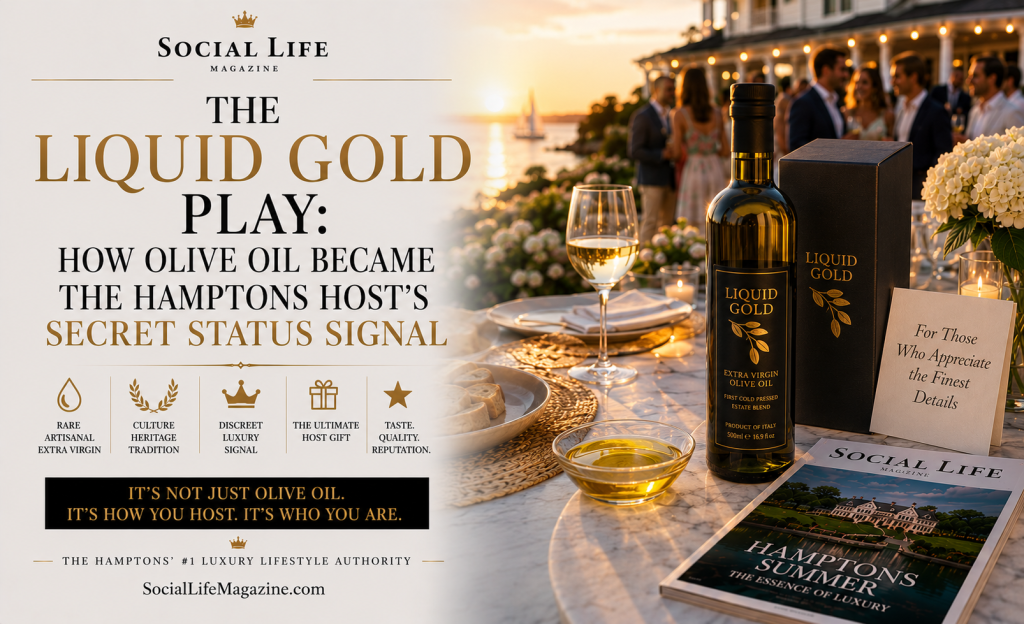
There is a bottle sitting on the counter at a Meadow Lane kitchen right now. It cost $84. In fact, it holds only 200 milliliters. Notably, the host has not hidden it. That is the entire point. Premium olive oil has spent 7,000 years being the most essential ingredient in civilization. Today, it is doing something new: becoming the luxury consumer’s most legible status signal on the East End.
Yet this is not a passing trend. Specifically, the Hamptons is ground zero for exactly that repositioning. The newly-minted VC who owns a spec house in Water Mill no longer wants to signal wealth with obvious moves. Wine cellars are expected. Instead, kitchen counters are now the arena, specifically because they are visible to every guest who walks through the door. And the bottle you drizzle on the burrata before guests arrive says more about your cultural capital than the car in the driveway.
From Athena’s Gift to Gourmet Counter Theater: 7,000 Years of Status
Olive cultivation began around 5000 BCE on the Carmel coast of ancient Israel, where simple olive presses have been excavated at Neolithic sites. But it was the Greeks who turned a fruit into a civilization. For instance, Mycenaean palace tablets written in Linear B record the term “e-ra-wo,” meaning oil, one of the earliest written Greek words. Specifically, palace authorities controlled perfumers who boiled herbs with oil to create prized ointments traded among elites. That early system, therefore, tied olive oil to wealth and craftsmanship from the very start.
According to Greek mythology, the olive tree was a gift from Athena, symbolizing wisdom, peace, and prosperity. Ancient Greece also embedded olive oil deeply in religious and social practices. Rituals required it. Lamps burned it. Even cosmetics and medicines relied on it. Beyond its spiritual role, olive oil symbolized athletic victory, and priests anointed athletes with it before competition.
Across the ancient Mediterranean, civilizations indeed treated olive oil as liquid gold. It was a cornerstone of the Greek economy, valued so highly that it often served as currency. Merchants, farmers, and athletes also traded in olive oil, using it to pay for goods or as prizes worth years of wages. In ancient Syria, olive oil cost up to five times more than wine. Eventually, by the Roman Empire, the logic had scaled globally. For example, Septimius Severus collected olive oil as part of provincial taxes and redistributed it to the populace of Rome. That democratization of Roman olive oil is precisely what today’s luxury market is reversing. What Caesar made civic, premium brands are making exclusive again.
The Economics: A $3 Billion Market Becoming $6 Billion Fast
The numbers are still not subtle. Analysts valued the U.S. market at $2.99 billion in 2024 and project it will reach $6.04 billion by 2033, growing at a CAGR of 8.14% between 2025 and 2033. Certainly, that growth is not coming from the Bertolli aisle at Stop and Shop. Rising consumer awareness, demand for premium and organic varieties, and the popularity of Mediterranean diets in American households are all driving the expansion.
America’s position in this story is especially significant. For the first time in 2023, the U.S. overtook Spain to become the second-largest consumer of olive oil globally. That is a country that once poured canola oil into everything now buying single-estate Tuscan EVOO as a pantry staple. Overall, that shift took about fifteen years and a lot of wellness content to accomplish.
Health, Trust, and the Premium Shift
The global olive oil market is experiencing a significant transformation. Once driven by price and basic culinary use, the industry is now shaped by a more educated consumer base demanding products that align with values of health, sustainability, and authenticity. Notably, the highest-growth vector in the category is not cooking oil. It is prestige finishing oil, a product meant to be tasted, displayed, and discussed at the table.
Perhaps the most significant 2025 olive oil trend is the focus on phenolic content. Consumers are learning that not all fats are created equal, and the bioactive compounds in premium olive oil are what make it a true superfood. Researchers have studied key compounds like oleocanthal and hydroxytyrosol for their positive effects, particularly for inflammation support. When a product can cite a university study and a sommelier in the same pitch, the price ceiling simply disappears.
The Adulteration Scandal That Built a Luxury Market
Here is the scandal that quietly created the luxury tier. In 2010, specifically, researchers at the UC Davis Olive Center tested 186 bottles of extra virgin olive oil from California grocery stores. Results were shocking: 69% of imported olive oils and 10% of California oils failed to meet international standards for extra virgin classification. Some had oxidized entirely. Producers had adulterated others with cheaper oils. Many were simply old, having lost the health compounds that make fresh olive oil valuable.
That single study is, in fact, the founding myth of the premium EVOO movement. Essentially, it told a health-obsessed, trust-deficit consumer class that the cheap stuff was a lie. And it handed luxury brands their entire positioning on a ceramic bottle. True luxury is no longer simply about a fancy label. Consumers are tired of vague claims and demand traceable olive oil sourcing. Forward-thinking brands now publish lab results for every batch as a result.
Ultimately, this is not just food marketing. It is the same consumer logic driving $400 Dyson vacuums and $200 probiotic supplements. The aesthetic is proof. In other words, the packaging is the thesis statement. And in the Hamptons, where the counter is a stage, proof that sits beautifully in the light wins every time.
The Brand Ladder: Who Makes It, Who Buys It, and Why
Premium olive oil now runs from about $15 to $120 per bottle, with each tier serving a distinct consumer psychology. This is not a price ladder. Rather, it is a social one. Each tier, therefore, maps to a different kind of status claim, a different kind of buyer, and a different kind of counter theater.
Tier One: The Accessible Prestige Play ($15 to $30)
Graza has successfully disrupted the premium olive oil market through innovation, consumer-focused product segmentation, and accessible pricing. Using 100% Picual olives from Spain’s renowned Jaén region, Graza prices its Sizzle (750ml) at $15 and its Drizzle (500ml) at $20. The squeeze bottle is the clearest tell. It says: I know about good olive oil, but I am still cooking with it.
Kosterina expanded into 600 Target stores, which tells you exactly where the brand sits culturally. It is, essentially, the Lululemon of olive oil: wellness-coded, accessible price point, heavy Greek heritage branding. The consumer is the SoulCycle regular with a marble island and a longevity podcast. Household income: $150K to $300K. Address: Park Slope, Westport, or a Hamptons rental. She follows functional medicine doctors on Instagram, has a Vitamix, and buys this at Whole Foods alongside collagen peptides. She is not yet at the level where the bottle needs to cost more than the wine it accompanies. Still, she is getting there fast.
Tier Two: The Design Object ($30 to $50)
Brightland launched in 2018 with a California olive oil in an elegant ceramic bottle, eventually snagging $6.83 million in VC funding to spur growth. This is precisely where olive oil stopped being a pantry staple and became counter jewelry. Brightland founder Aishwarya Iyer positioned her products as luxuries from the start. She saw food brands falling into three categories: good, better, and best. Most emerging wellness brands fell, instead, into the “better” bucket. She wanted Brightland to be considered the “best.”
The business model borrowed directly from fashion. Brightland is available at Whole Foods, Amazon, Erewhon, and Bloomingdale’s. Bloomingdale’s. That is certainly not a grocery store decision. That is a lifestyle brand decision. The consumer here is creative class, upper-middle to wealthy, female-skewing. She lives in a design-forward home in Tribeca, East Hampton, or Brentwood. She buys Brightland as a hostess gift because it looks like it cost more than it did, which is, in fact, the point. Household income: $300K to $750K.
Tier Three: The Collector Tier ($50 to $120+)
Here, specifically, is where olive oil exits the food category entirely and enters fine art economics. Manni commands prices ranging from €45 to over €120 per 500ml, more than many fine wines. Unlike wine, where prestige pricing often reflects scarcity or reputation alone, Manni’s cost is anchored in verifiable inputs: ultra-low yield harvesting, hand-picked Frantoio and Leccino olives, same-day cold extraction below 23°C, and rigorous third-party certification.
Inspired by the birth of his son Lorenzo in 1997, Armando Manni set out to create the perfect organic Tuscan extra virgin olive oil with the scientific support of the University of Florence. In 2001, he launched the global luxury brand Manni, which was promptly recognized by world-renowned chefs. The origin story does a lot of work here: a father making something perfect for his child, backed by academic science, produced in Tuscany from single-varietal olives. This is not food. This is an heirloom object with a polyphenol count.
The Manni Luxury Box is made of elegant black cardboard and velvet and contains a single bottle. Manni designed the packaging for storage and reuse as an object in itself. When a brand designs packaging for reuse, it is no longer selling food. You are selling a relic. The buyer here has a net worth of $5M+, financially confident enough to not need the brand to be widely recognized. These are people who know what oleocanthal is and have opinions about harvest timing. Address: Upper East Side co-op, Sagaponack compound, or Palm Beach second home.
The Cultural Code: Why This Is the Hamptons Moment
The Hamptons consumer sits at the exact intersection of every driver in this market: health-obsessed, design-literate, social-proof-hungry, and possessed of the particular anxiety that comes with new wealth in a setting thick with old money. First, consider who is actually in the room. A medspa client who just spent $1,200 on a NAD+ drip is not going home to cook with seed oil. A finance founder who just closed a Series B and rented in Bridgehampton for the summer is not letting guests see a Costco bottle.
Three distinct buyer types converge here, however. Health buyers want the polyphenols, above all. Status buyers want the counter theater. Cultural buyers, instead, want the provenance story. The overlap across all three, which is the most valuable consumer in the room, wants all of it simultaneously. That overlap is especially dense in this zip code, at this price point, in this season.
Oleotourism, a term for travel organized around olive oil estates and harvest experiences, is also growing in this demographic. Trends like oleotourism and the kilometre-zero movement emphasize local production and authentic experiences, echoing the values that once made olive oil a treasured commodity. The Hamptons consumer who already drives to the North Fork for wine is now a candidate for that trip to Tuscany specifically for the harvest.
The Buyer’s Guide: Choosing by Consumer Identity
The right bottle depends entirely on who you are, who is watching, and what you want the bottle to say. Graza at $15 to $20 speaks to the wellness millennial who has a Theragun and a Dry Farm Wines subscription. Kosterina at $28 speaks to the functional medicine devotee who takes the polyphenol shot seriously and has the lab results bookmarked on her phone.
Brightland at $38 to $45 speaks to the design-forward creative where the bottle is on the counter because it belongs there. Hoji and Round Pond at $60 to $80 speak to the wealthy wine person crossing over, the one who knows the olive varietal the way they know the grape. Finally, Manni at $85 to $120 speaks to old money and new money fluent in old money culture. That buyer does not, of course, explain the price. Indeed, that silence is the entire signal.
The hostess gift economy here is real. At a certain price point, a bottle of Manni in a velvet box says exactly what a bottle of Screaming Eagle once said: I know something you might not, and I wanted you to have it. Choose your bottle accordingly. Indeed, your guests are reading the label before they read the menu.
Where The Conversation Continues
Social Life Magazine covers the luxury brands, the cultural shifts, and the prestige products defining life on the East End. For editorial features, partnership opportunities, and print placement inquiries, visit sociallifemagazine.com.
Subscribe to our newsletter for weekly dispatches from the Hamptons luxury world, and follow us on Instagram for real-time coverage of the brands, people, and moments shaping the East End.
Author

Written by
Recent Posts

Vanderbilt & Seewald
Alberto Luzzi Opening of Fine Jewelry Room
The Victor dE Souza 2027 Spring Summer Collection

Malan Breton Presents “Garden of a Thousand Tomorrows”
What to Wear to a Summer Wedding as a Guest: A Hamptons Dress Code Guide
Categories
- Art
- Articles
- Business of Luxury
- Celebrities
- Culture
- Entertainment
- Events
- Faces of Summer 2026
- Fashion
- Fashion & Style
- Featured
- Finance
- Food, Spirits, Wine
- Hamptons
- Hamptons Celebrities
- Health
- Health & Beauty
- Lifestyle
- Luxury Lifestyle
- Press
- Profiles
- Real Estate
- Technology
- The Chronicles
- Travel
- Uncategorized
- Weddings