
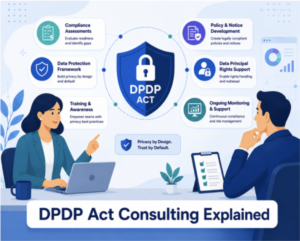
The Digital Personal Data Protection Act has changed the tone of privacy conversations inside Indian organisations. Earlier, data protection was often treated as a legal checkbox or a policy exercise that stayed within compliance teams. That approach no longer holds up.
The Act pushes organisations to look at how personal data actually moves through systems, teams, vendors and customer interactions. Consent mechanisms, breach reporting processes, and data mapping practices now sit much closer to operational risk than before.
What makes this difficult is not the law itself. Most businesses already collect, store, share and process personal data at scale. The challenge is alignment. Systems were built at different times, by different vendors, often without a common governance structure. Consent sits on one platform. Incident response lives elsewhere. Data inventories are outdated within months.
This is where organisations begin to struggle with how to align your consent flows, breach reporting, and data mapping with the digital personal data protection act in a practical way.
Why Alignment Matters
A scattered privacy programme creates blind spots very quickly. A consent form may capture user approval correctly, but the backend systems could still retain data longer than necessary. A security team may detect a breach in time yet fail to identify affected data subjects because no reliable data map exists. Legal teams may draft strong policies while operational teams continue using old workflows.
The Digital Personal Data Protection Act expects consistency between what organisations say and what they actually do.
That consistency depends on three connected areas:
- Consent flows
- Breach reporting
- Data mapping
Treating them separately usually creates more risk.
Consent Flows Need Operational Context
Many organisations still rely on generic consent banners and lengthy privacy notices copied from older frameworks. Those approaches rarely reflect the actual data processing activities taking place behind the scenes.
Consent under the Digital Personal Data Protection Act must be clear, specific, and tied to legitimate processing purposes. Users should understand what data is being collected and why. The issue becomes more complex in environments where multiple applications, third-party integrations, and customer touchpoints are involved.
A bank, for example, may collect customer data through:
- Mobile apps
- Web portals
- CRM systems
- Marketing platforms
- Customer support channels
If consent language differs across these systems, or if data continues flowing after consent withdrawal, compliance gaps emerge quickly. Strong consent governance usually involves:
| Area | What Needs Attention |
| Collection Points | Identify every interface collecting personal data |
| Consent Language | Keep wording consistent across channels |
| Withdrawal Handling | Ensure revocation updates downstream systems |
| Vendor Alignment | Confirm third parties honour consent conditions |
| Audit Trails | Maintain records of consent activity |
The organisations handling this well tend to simplify consent experiences instead of adding more complexity. Shorter notices. Clearer options. Fewer dark patterns. That often improves customer trust alongside compliance outcomes.
Data Mapping is Usually the Weakest Link
Most organisations underestimate how difficult data mapping becomes once systems grow over time. Data rarely stays where it was first collected. It moves across cloud services, analytics tools, backup environments, collaboration platforms, and external processors. Some datasets become duplicated repeatedly without clear ownership.
Without a current data map, several problems appear at once:
- Incident response slows down
- Retention policies fail
- Subject rights requests become difficult
- Risk assessments lose accuracy
The Digital Personal Data Protection Act increases the importance of maintaining visibility into personal data movement. A useful data map should answer basic operational questions:
- What personal data exists?
- Where is it stored?
- Who can access it?
- Why is it being processed?
- Which vendors receive it?
- How long is it retained?
Many organisations still rely on spreadsheet-based inventories that become outdated almost immediately. That creates a false sense of readiness. More mature privacy programmes treat data mapping as an ongoing governance activity rather than a one-time project.
The Alignment Model
The following framework breaks down the operational relationship between consent, security response and data governance.
- Map Data Sources: Identify every point where personal data enters the organisation. Include customer portals, HR systems, marketing tools, mobile applications, and vendor integrations.
- Connect Consent Records: Link consent collection mechanisms directly to the datasets and processing activities they authorise.
- Classify Sensitive Data: Determine which datasets carry higher regulatory or business risk. Prioritise monitoring and protection around them.
- Align Incident Workflows: Ensure breach reporting teams can quickly identify impacted systems, affected individuals, and reporting obligations.
- Review Vendor Exposure: Map how third-party providers process or store personal data. Validate contractual and operational safeguards.
- Maintain Continuous Updates: Data environments change constantly. Mapping and consent governance cannot remain static exercises. This is usually where organisations realise the gap is operational, not legal.
Breach Reporting Requires Faster Coordination
The Digital Personal Data Protection Act places a stronger focus on breach notification obligations. That creates pressure on organisations to improve response timelines and internal coordination. The difficult part is understanding the impact quickly enough.
Security teams may detect unusual activity immediately, but several operational questions follow:
- Was personal data involved?
- Which systems were affected?
- Which individuals may be impacted?
- Was consent scope exceeded?
- Did third parties receive the compromised data?
Without reliable data mapping and governance visibility, those answers take longer than expected. Incident response plans should therefore include privacy and compliance functions much earlier in the process.
A practical breach reporting structure often includes:
| Function | Responsibility |
| Security Teams | Detect and contain incidents |
| Privacy Teams | Assess data protection impact |
| Legal Teams | Evaluate notification obligations |
| IT Operations | Restore affected systems |
| Communications Teams | Coordinate stakeholder messaging |
Vendor Ecosystems Need Closer Scrutiny
Third-party exposure has become one of the most difficult parts of compliance under the Digital Personal Data Protection Act.
Many organisations no longer process data entirely within internal infrastructure. Cloud providers, SaaS vendors, analytics firms, support platforms, and outsourced service providers all participate in data handling activities. This expands risk considerably.
Consent obligations do not disappear once data moves externally. Neither do breach reporting expectations. Vendor assessments should move beyond procurement questionnaires and basic certifications. Organisations need visibility into:
- Data storage locations
- Sub-processor usage
- Retention practices
- Incident escalation timelines
- Access controls
- Cross-border data transfers
Some businesses only discover vendor-related data exposure during incident investigations. By then, response timelines become harder to manage.
Compliance Becomes Easier When Governance is Centralised
The organisations adapting more smoothly to the Digital Personal Data Protection Act are not necessarily the largest or most heavily funded. They usually share one characteristic.
Privacy governance is centralised enough to create operational visibility. That does not mean every process sits within one department. It means teams work from consistent data inventories, aligned policies, shared reporting structures, and coordinated workflows.
When consent flows, breach response, and data mapping operate independently, gaps multiply quietly over time. Eventually those gaps surface during audits, investigations, incidents, or customer complaints.
Conclusion
Understanding how to align your consent flows, breach reporting, and data mapping with the Digital Personal Data Protection Act requires more than policy updates. The real challenge sits within operational alignment across systems, vendors and internal teams.
Consent records should reflect actual processing activities. Breach response workflows should connect directly to accurate data inventories. Data mapping should remain continuously updated as environments evolve. This is not a one-time compliance task. It becomes part of broader governance maturity.
CyberNX works with organisations to strengthen privacy governance, improve data visibility, align operational controls and support Digital Personal Data Protection Act readiness through specialised consulting services. For businesses looking to improve consent governance, breach preparedness and data mapping practices under the Digital Personal Data Protection Act, explore their DPDP Consulting Services and connect with our experts.
Author

Written by
Recent Posts

Jetsetter Style: Castello del Sole

The First Decision After a Collision Can Be the Most Important One
Two Weeks in Rome and Beyond: Turkish Airlines Itineraries from Boston, Chicago and Onward to India

Top 10 Hair Transplant Clinics in Turkey 2026

Artist Alley to Online Store: How Convention Artists Can Keep Selling After the Event
Categories
- Art
- Articles
- Business of Luxury
- Celebrities
- Culture
- Entertainment
- Events
- Faces of Summer 2026
- Fashion
- Fashion & Style
- Featured
- Finance
- Food, Spirits, Wine
- Hamptons
- Hamptons Celebrities
- Health
- Health & Beauty
- Lifestyle
- Luxury Lifestyle
- Press
- Profiles
- Real Estate
- Technology
- The Chronicles
- Travel
- Uncategorized
- Weddings