
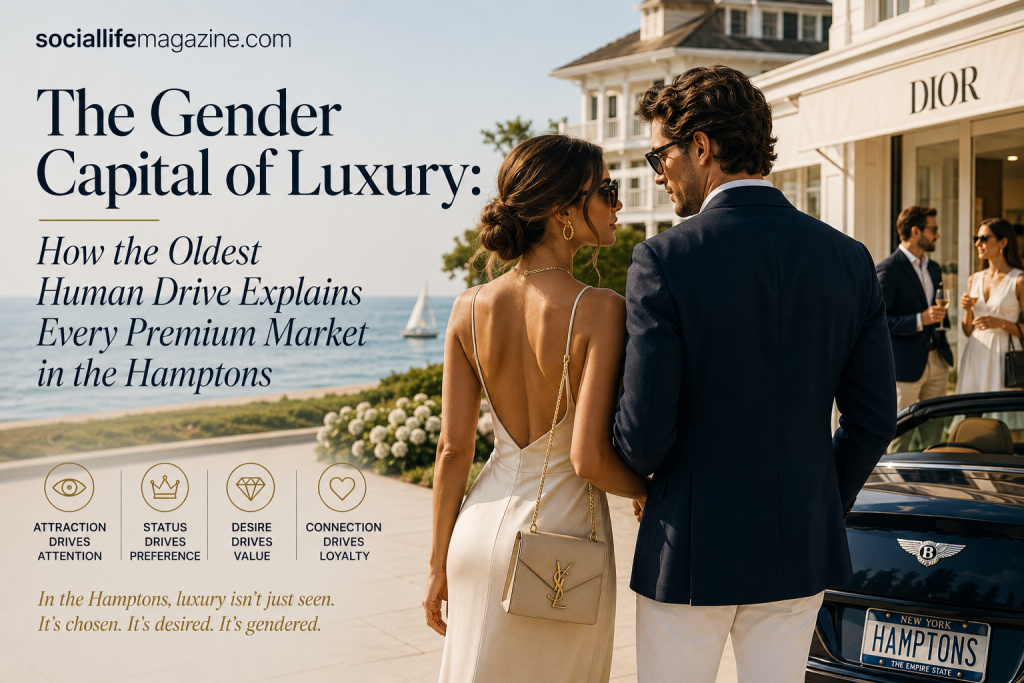
In 1990, Camille Paglia published a 700-page argument that the entire history of Western art was a battle between two biological drives. The male drive to impose form on chaos. The female drive to embody nature’s mystery and authority. Academic feminism hated the book. The market loved everything it described. For anyone doing luxury marketing in the Hamptons, the book remains essential reading.
“Sexual Personae” was not a marketing manual. But it might as well have been. Paglia’s central argument, that human beings are status animals operating from deep biological programming, explains more about luxury consumer behavior than any focus group report produced in the last thirty years. Specifically, it explains why a hedge fund manager spends $28 million on an oceanfront compound in East Hampton he visits eleven weekends a year. It also explains why a woman in the Hamptons will spend four hours selecting the right table arrangement for a dinner party attended by twelve people. And it explains why both of them are reading Social Life Magazine.
Specifically, the luxury market on the East End runs from Memorial Day to Labor Day across a geography stretching from Westhampton to Montauk. Consequently, it generates billions in real estate transactions, retail sales, hospitality revenue, and brand activations every summer. Yet most brands marketing into this arena operate on instinct. And they copy competitors. And they chase demographic data. In fact, these firms optimize for impressions in a market where impressions are invisible and cultural positioning is everything.
The actual engine driving every purchase decision in this market runs deeper than any spreadsheet can reach. That engine is gender capital. And Paglia mapped it decades before luxury marketing existed as a discipline.
The Paglia Thesis
Paglia’s core argument starts with biology and refuses to apologize for it. Men and women are different. Indeed, social construction plays no part in it. Not conditioned into difference by patriarchal institutions. Actually, measurably, and cross-culturally different in how they orient toward status, power, and social competition.
This is the part that made the faculty lounge erupt in 1990. But it is also the part that every successful luxury brand has been acting on without articulating it. Indeed, Paglia spent her career naming a mechanism that marketers had been exploiting on instinct for decades, the same instinct that puts conquest language in a Range Rover ad and curation authority in a Chanel campaign.
The male drive, in Paglia’s reading, is Apollonian. It imposes structure on nature. It builds, accumulates, conquers, and claims. This is the father of architectural monuments, financial empires, and oceanfront compounds. Male status capital needs to win publicly. It needs the win to be visible. And it needs the scale of the win to communicate the magnitude of the man behind it.
The female drive is Dionysian. It embodies nature rather than conquering it. It cultivates, refines, selects, and defines what is worth having. This is not a passive drive. In Paglia’s argument, it is ultimately the more powerful of the two, because it sets the aesthetic standard that the male drive is trying to meet. The woman who decides what is beautiful decides what is worth fighting for.
Both drives predate civilization. Both are operating in every luxury transaction in the Hamptons right now. And brands that understand which one they are feeding will always outperform brands that do not.
Male Capital: The Conquest Architecture
Call it conquest capital. The male status drive in luxury markets expresses itself through acquisition at scale, dominance in competitive arenas, and the public display of resources accumulated through risk and aggression.
In the Hamptons, this drive shows up most visibly in real estate. Specifically, the compound on Further Lane in East Hampton is not housing. Indeed, it is a trophy, a monument to conquest as legible as any Roman arch. The address matters because hierarchy matters. Further Lane. Meadow Lane. Lily Pond Lane. Streets they are not. These are rankings in a dominance hierarchy that every serious buyer in this market understands on sight.
But conquest capital shows up across every luxury vertical on the East End. The BMW parked outside the Bridgehampton Polo Club on a July Saturday signals performance and competitive fitness. Still, the table at Nick and Toni’s secured without a reservation signals social dominance. That yacht moored in Sag Harbor signals the scale of resources accumulated. Each of these is a public performance of male capital, a declaration of competitive standing directed at other men and at the women who evaluate those standings.
The language of conquest capital is specific and consistent. Scale. Exclusivity. Access. Performance. Dominance. That said, these words are not metaphors in this market. Specifically, they are the actual claims the buyer is making when he writes the check. That said, a brand that speaks this language fluently converts at a rate that soft, lifestyle-forward messaging cannot approach. Still, the hedge fund manager buying a $30 million property is not looking for comfort. He is looking for confirmation that he won.
Female Capital: The Curation Architecture
The female status drive in luxury markets is equally ancient and, in Paglia’s reading, ultimately more authoritative. Specifically, it expresses itself through the cultivation of taste, the gatekeeping of aesthetic standards, and the social orchestration that determines who belongs and who does not.
Call it curation capital. The woman setting the aesthetic standard for a Hamptons dinner party is not decorating a table. She is exercising cultural authority. Her ability to select the right caterer, the right flowers, the right table setting, the right guest list, constitutes a form of power that shapes the entire social field around her. In turn, the luxury brands she chooses become part of her statement. Her endorsement elevates them. Her rejection removes them from consideration.
This is why beauty brands, fashion houses, wellness companies, and interior designers fight for editorial coverage in publications like Social Life Magazine. That said, the magazine’s female readership does not consume editorial passively. Indeed, they use it as a reference for curation decisions, a guide to what belongs in the taste class they inhabit or aspire to enter.
In Paglia’s framework, the curation drive is also a gatekeeping drive. Even so, the woman with refined taste is not just expressing preference. She is drawing a border. She is deciding which brands, which venues, which people belong inside the aesthetic world she controls. Still, luxury brands that understand this do not position themselves as available for purchase. Instead, they position themselves as worthy of inclusion in a world that most people cannot enter. The distinction is everything.
The Hamptons Status Field
Pierre Bourdieu, the sociologist whose capital theory underlies much of what Social Life Magazine has built over twenty-three years, described the social world as a field of competing capital forms. Economic capital is money. Cultural capital is taste and knowledge. Social capital is relationships and access. Symbolic capital is prestige, the recognition that the other forms of capital produce when they are sufficiently accumulated.
Indeed, the Hamptons is the most concentrated social field in America from Memorial Day to Labor Day. Economic capital flows in from Manhattan finance, technology wealth, and old money estates that have held their ground on the East End for generations. Cultural capital is performed at gallery openings in East Hampton, charity dinners in Southampton, and editorial features in luxury publications distributed across the territory.
Specifically, Paglia’s gender capital framework layers directly onto this field theory. Specifically, male capital drives the accumulation of economic and symbolic capital through conquest. Female capital drives the accumulation of cultural and social capital through curation. The two systems operate simultaneously and interdependently. Still, neither is sufficient alone. The richest man in the Hamptons still needs a woman with refined taste to make his compound worth envying. Indeed, the most sophisticated taste arbiter still needs the economic resources to operate at the level where her curation authority registers.
Together, these systems produce the status theater that luxury brands pay to enter every summer. The brands that understand the mechanics of the theater sell tickets. That said, the ones that do not buy advertising and wonder why it does not convert.
The Five Arenas
Medspas and Aesthetic Medicine
Aesthetic medicine is pure curation capital, and almost no medspa in the Hamptons markets it that way. The woman booking a filler appointment at a Southampton practice is not making a health decision. She is buying continued membership in the taste class that defines what beauty looks like this season. The medspa that markets on clinical outcomes misses the actual purchase motivation entirely. The one that markets on social authority and aesthetic gatekeeping converts at a dramatically higher rate. For the full breakdown, see Why the Best Medspas in the Hamptons Don’t Sell Procedures.
Hotels and Resorts
Hotels activate both capital systems simultaneously, and most of them do it badly because they try to speak to both audiences with a single voice. Male capital’s play is the address, the scale, and the exclusivity of access. The female capital play is the aesthetic experience at every touchpoint. The properties winning in the Hamptons understand they need to speak both languages, but in separate registers.
Luxury Real Estate
Hamptons residential real estate is the purest expression of male conquest capital in the American luxury market. The oceanfront compound is not housing. It is a flag planted in the most coveted territory on the Eastern Seaboard. Indeed, brokers and developers who lead with lifestyle language consistently underperform the ones who speak directly to the conquest drive. The buyer writing a $28 million check is not purchasing a home. He is claiming a position in a hierarchy.
Wealth Management
Finance is conquest capital’s home arena. The high-net-worth client in the Hamptons is not shopping for a fiduciary. Specifically, he is looking for confirmation that he belongs in the company of people who won at the level he won at. The firms with the strongest client bases in this market operate more like clubs than service providers. Membership is the product. The financial management is almost incidental to the positioning.
Luxury Fashion
Fashion is the most visible expression of female curation capital in the Hamptons. Still, a woman carrying a Loro Piana canvas tote at Sagg Main Beach is not displaying a product. She is making a declaration about where she sits in the taste hierarchy. The brands that win here understand that scarcity is the only currency that matters in this market. Availability is a liability.
What Brands That Miss This Leave Behind
The cost of gender capital confusion in luxury marketing is not just wasted impressions. Specifically, it is brand damage, the slow erosion of positioning that results from speaking the wrong language to an audience that can immediately identify the mistake.
A conquest brand that runs soft, aesthetic-forward creative signals insecurity. A curation brand that runs aggressive, scale-forward creative signals vulgarity. Both read as culturally illiterate in a market where cultural literacy is the primary credential. In a market as concentrated and socially interconnected as the Hamptons, a positioning error circulates through the social field faster than any earned media campaign can correct it.
Ultimately, Paglia’s framework does not require luxury marketers to study philosophy. Specifically, it requires them to be honest about what their brand actually is. Which drive does it feed? Which capital does it activate? Once those two questions are answered honestly, every creative decision, every media placement, every editorial partnership follows directly.
Indeed, Social Life Magazine has been the editorial platform sitting at the intersection of both capital systems for twenty-three years. Its print distribution reaches the Hamptons market at full concentration across five summer issues and 25,000 copies per issue. In addition, its 82,000 email subscribers represent the most consistent digital access to this audience available to any luxury advertiser in this market. Brands that understand what Paglia mapped, and what this publication delivers, do not ask whether they should be here. They ask how much space they can take.
Where The Conversation Continues
Social Life Magazine reaches the Hamptons luxury audience across five summer issues, 25,000 print copies per issue, 82,000 email subscribers, and a digital platform with year-round organic reach into the high-net-worth population that powers every vertical this cluster covers.
Editorial features, advertising partnerships, sponsored content, and Polo Hamptons sponsorships are available for the 2026 summer season. The season opens July 18. Space is limited.
Author

Written by
Recent Posts

Why the Supplement Market Is Shifting From More Products to Smarter Choices
5 Ways Engraved Custom Trophies Boost Employee Engagement
Creating Beautiful Mix-and-Match Tablescapes for Any Occasion
Is It Cheaper to Drive or Ship Your Car? We Ran the Numbers
Dear Margo: Restaurateur Dean Pashilis’ Tribute to Family, Food and Hospitality
Categories
- Art
- Articles
- Business of Luxury
- Celebrities
- Culture
- Entertainment
- Events
- Faces of Summer 2026
- Fashion
- Fashion & Style
- Featured
- Finance
- Food, Spirits, Wine
- Hamptons
- Hamptons Celebrities
- Health
- Health & Beauty
- Lifestyle
- Luxury Lifestyle
- Press
- Profiles
- Real Estate
- Technology
- The Chronicles
- Travel
- Uncategorized
- Weddings