
Private aviation promises a lot. No lines, no crowds, no compromises on who you share a cabin with. What it has never quite managed to promise is the feeling of actually being home. Most owners step onto their aircraft and find a space that is impressive but not personal. Edése Doret has spent three decades changing that.
The New York-based designer has crafted aircraft cabins for royalty, heads of state, and some of the world’s most discerning private clients. It all starts in his studio in Upper Manhattan, where every sketch, rendering, and late-night revision of his career has come to life.

Method Behind the Craft
His design process begins not with aesthetics but with drafting the floor layout.
Before any visual direction is established, Doret starts with the technical bones of the space. He drafts a floor plan mapping emergency exits, aisle clearances, and certification requirements. He needs to know which materials will or won’t work, how weight will behave over the life of the aircraft, and what the regulatory framework allows before a single design decision is made. It can be seen as unglamorous work, but it’s exactly what makes everything that follows possible.
As a Pratt Institute alumnus, Doret is highly trained across multiple disciplines including architecture, industrial and product design, and interiors. This technical and design expertise is what sets him apart. He is one of the few designers who handles every part of the process himself, from the initial concept all the way through to the finished cabin.
Client Comes First
Once the technical groundwork is laid, Doret turns his full attention to the person who will inhabit the space. This is where his approach differs most from conventional aviation design.
Doret immerses himself in how his clients actually live before a single finish is selected or material is sampled. He wants to know how they move through a room, what atmosphere surrounds them at home, and whether they travel to work, to rest, or to entertain. Every answer feeds directly into the design, shaping the space just as much as any technical requirement.
“A private jet is a home that happens to fly, and a home reflects the person who lives in it,” Doret says.
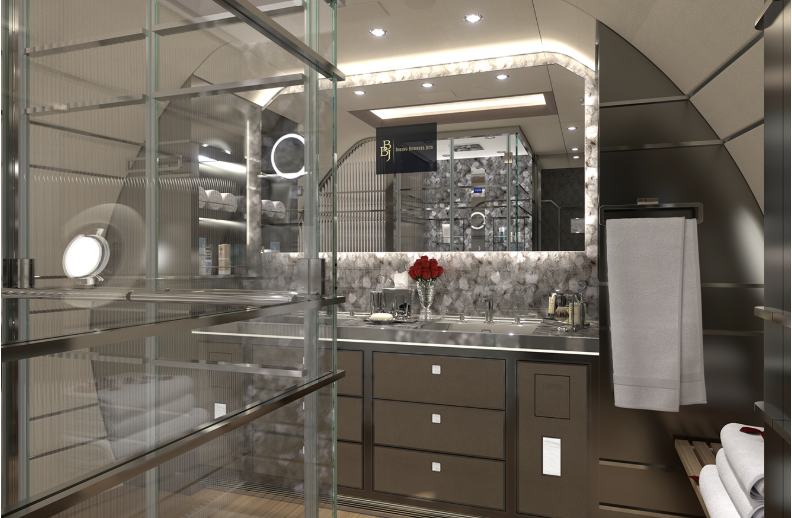
That philosophy shows up in every detail, from the materials and lighting down to the furniture and finishes. A stone from a client’s home can be sliced paper-thin, certified for aviation, and used for a cabin surface. A well-loved library turns into a reading nook at cruising altitude.
You become part of Doret’s imagination when working with him. And by the time he’s done, the cabin is unmistakably yours.
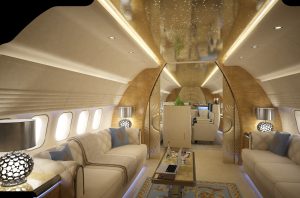
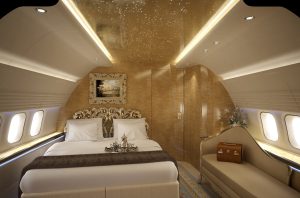
The Practical Side of Luxury
When you work with clients at this level, money is never the constraint. Time is. A CEO who boards a transatlantic flight is not escaping their life for eight hours – they’re extending it into the air. That might mean closing a deal, sleeping properly, hosting a dinner, or simply decompressing somewhere without compromise.
Doret designs with that reality at the center of every decision. Seating converts cleanly, lighting shifts to support sleep or focus, and storage sits where the client naturally reaches. Each element is part of what makes the cabin not only impressive, but equally practical.
“In my cabins, functionality and luxury are never in conflict,” Doret says. “Great design has to be both. The best spaces are as functional as they are beautiful.”
Personal Touch
What makes Doret’s interiors distinctive is not only the quality of the materials, though those are exceptional. It’s how personal each space feels. He doesn’t design around a generalized idea of what a wealthy traveler’s aircraft should look like. He designs around the person who will actually be living in it. Importantly, this extends to a new homewares range he will introduce in 2026.
Nowadays, it’s hard to come by individuality. The private aviation market has trended toward a kind of neutral opulence, interiors that communicate expense without communicating anything else.
Doret’s cabins go in the opposite direction, reflecting the cultural identity, personal history, and individual taste of the people who commissioned them. The result is something that can’t be replicated, because no two clients are the same.
Those who have worked with Doret often find that the aircraft becomes one of the most personal spaces they own, which is no small thing when the competition includes estates, superyachts, and city apartments that have been curated over decades. And unlike those spaces, this one goes everywhere they do.
In a League of His Own
Doret’s work demands a combination of skills that is difficult to find in one person: the technical fluency of an engineer, the spatial intelligence of an architect, the material knowledge of an interior designer, and the ability to listen closely enough to another person that you can build something that feels like theirs alone.
There is no shortage of private aircraft in the world, and no shortage of designers willing to fill them with expensive finishes. Doret occupies a different category, one that very few designers can claim. After thirty years, it remains the reason why his clients keep coming back.
Author

Written by
Recent Posts
Unlocking the Berkshires
Dalia Forman Design

Alberto Luzzi
How to Pick a Homecoming Dress for Your Body Type and Feel Amazing in It
How to Prepare a Home for Sale When Major Repairs Are Not Affordable
Categories
- Art
- Articles
- Business of Luxury
- Celebrities
- Culture
- Entertainment
- Events
- Faces of Summer 2026
- Fashion
- Fashion & Style
- Featured
- Finance
- Food, Spirits, Wine
- Hamptons
- Hamptons Celebrities
- Health
- Health & Beauty
- Lifestyle
- Luxury Lifestyle
- Press
- Profiles
- Real Estate
- Technology
- The Chronicles
- Travel
- Uncategorized
- Weddings