
New York finally ended fifty-three years of waiting. I don’t think the title was won on the court — I think it was built in a series of decisions that belong in a boardroom as much as a locker room. Here’s what I mean, and why I wrote a book about it.
There is a moment, in every great turnaround, that looks like luck from the outside and like discipline from the inside. I’ve spent my career on the inside of that moment — building the Bombshell Brush brand on Amazon, investing, and making the kind of high-stakes calls where the right answer and the popular answer rarely line up. So when I watched my city finally end fifty-three years of basketball heartbreak, I didn’t see a sports story. I saw a case study.
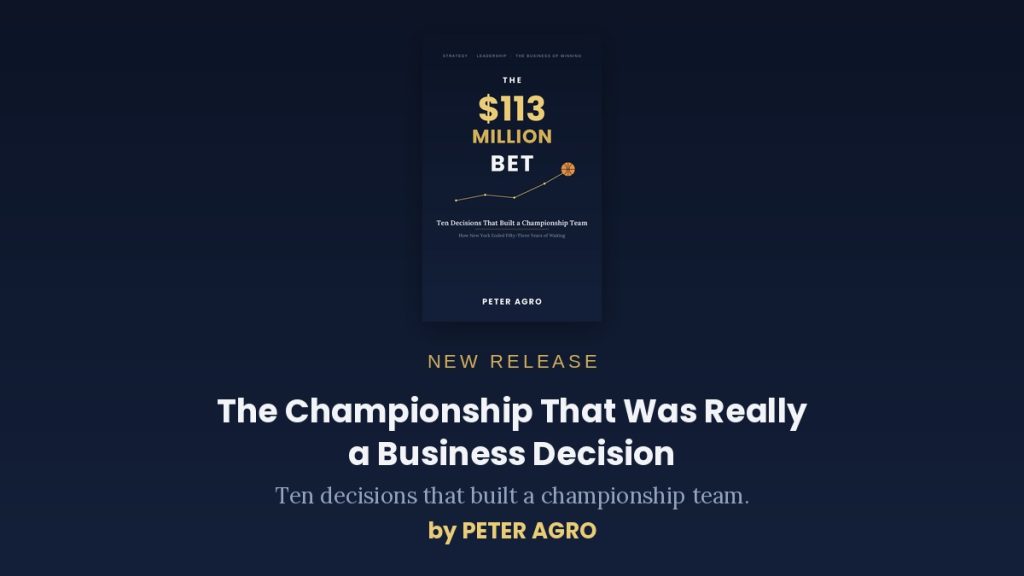
That case study became a book: The $113 Million Bet: Ten Decisions That Built a Championship Team. And its argument is simple, maybe even a little stubborn — the championship was not, fundamentally, the product of a single shot or a single superstar. It was the product of a sequence of decisions, most of them unglamorous, several of them unpopular at the time, that compounded over four years into a result the betting markets had priced as nearly impossible.
The games were how the title was won. The decisions were why it could be won at all.
The bet in the title
The $113 million refers to the decision at the heart of the book. In the summer of 2024, the team’s franchise guard — a player listed at just six foot two, a second-round draft pick who had been told his whole career that he was too small, too slow, too earthbound to be the best player on a champion — turned down the richest contract the league’s rules allowed him to sign. Had he waited one more year, he would have been eligible for a supermax extension projected at roughly $269 million. Instead he signed early, and for less: about $156.5 million. The gap was approximately $113 million — nearly twice what he had earned across his entire career to that point.
By the cold arithmetic of compensation, the choice bordered on irrational. But I don’t read it as generosity. The league’s salary rules meant a team paying one star the full supermax would have almost nothing left to build around him. By taking less, the player created the room that allowed the franchise to assemble the roster a champion actually requires. Two years later, that single act of disciplined sacrifice had become the highest-returning decision in the franchise’s modern history.
It is, in other words, a master class in opportunity cost — the recognition that the headline number is rarely the relevant one, and that what you give up can be worth more than what you take. I’ve made versions of that trade in my own businesses. Never with nine figures on the table, but the logic is the same: the move that looks like leaving money behind is sometimes the one that builds the thing the money could never buy.
A playbook, not a highlight reel
What I tried hard to avoid in the book was flattening the story into a single cause. Instead, I broke the turnaround into ten distinct decisions, each one a transferable principle:
Why paying for fit beats paying for fame. How to find undervalued talent the market has written off. When trading the future to seize the present is the discipline of a builder — and when it’s the recklessness of a gambler. The logic of concentration risk, and when betting it all is the rational move. How to change leadership without losing the mission. And maybe the hardest one of all: how to hold your nerve through the valley, when the plan is sound but the results haven’t arrived and everyone around you has concluded you were wrong.
Every lesson is drawn from a real organization that got these decisions wrong for half a century — and then got them right. Failure teaches, but it teaches in the abstract. Here we have the rare thing: the same institution, with the same fans and the same crushing history, making bad decisions for decades and then making good ones. You can see, in sharp relief, exactly what changed.
Why I had to be the one to write it
I was careful with the facts. The book draws entirely on the public record — press conferences, broadcasts, contracts, published reporting — and I’m explicit throughout that the conclusions are my analysis, not any claim to inside knowledge. But the reason the book has feeling underneath its frameworks is personal. I lived all fifty-three years of the wait.
I spent more than half a century waiting for this. It turned out to be worth studying, not just celebrating.
For founders, managers, investors — for anyone building something that has to win — that may be the most useful framing of all. The confetti falls and is swept away. The banner is raised and becomes part of the furniture. What lasts, and what travels from a basketball arena to whatever it is you’re building, is the playbook.
My new book, The $113 Million Bet: Ten Decisions That Built a Championship Team, is available now on Amazon in paperback and Kindle editions.
Author

Written by
Recent Posts
How an Emergency 24/7 Plumber Resolves Sudden Drain Backups Fast
Best Free Location Tracking Apps for Everyday Family Safety: iSharing and HeyPolo Compared
How Disney Channel Stars Become Pop Powerhouses: The Sabrina Carpenter Blueprint
What to Look for When Choosing an Online Headshop That Fits Your Lifestyle
The Invisible World Above Us: How Astrology Turned the Night Sky Into a Personal Map
Categories
- Art
- Articles
- Business of Luxury
- Celebrities
- Culture
- Entertainment
- Events
- Faces of Summer 2026
- Fashion
- Fashion & Style
- Featured
- Finance
- Food, Spirits, Wine
- Hamptons
- Hamptons Celebrities
- Health
- Health & Beauty
- Lifestyle
- Luxury Lifestyle
- Press
- Profiles
- Real Estate
- Technology
- The Chronicles
- Travel
- Uncategorized
- Weddings