
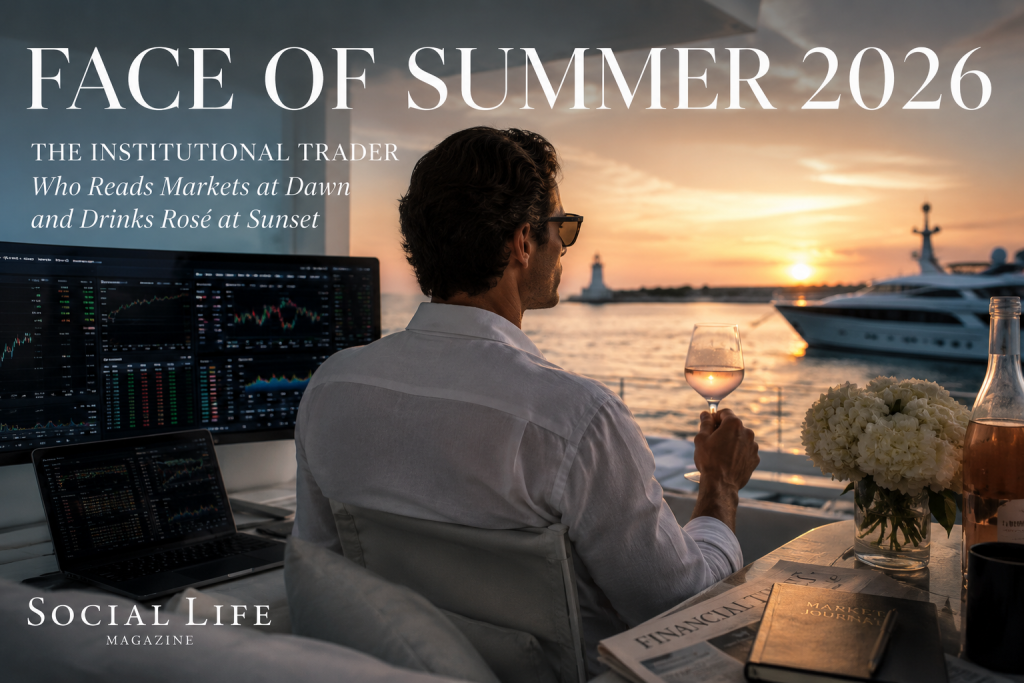
Our Face of Summer 2026 has already priced you before you’ve finished your first sentence. That is the thing about a man who trades directly with the Federal Reserve.
This is not a criticism of Adil Karim. It’s a job requirement. As an Executive Director at Nomura, he spends his days inside a firm that holds a primary dealer designation. Specifically, it belongs to a small club of institutions that transact U.S. treasuries directly with the New York Fed. The margin for a bad read is measured in real money and real time. So the reading never fully switches off, not on the trading floor and not, if we’re being honest, at a corner table at Sen on a Saturday night in July.
He’d never make you feel it. Of course, that’s the tell of the genuinely powerful person Out East. The insecure ones announce themselves. By contrast, Adil lets the room do the math.
The Credential That Doesn’t Need a Frame
Adil is a CFA charterholder. If you don’t know what that means, here is the short version. Specifically, the Chartered Financial Analyst program is a three-level gauntlet requiring roughly 900 hours of study, with pass rates that routinely humble Ivy League graduates. It is the finance world’s version of a black belt, yet nobody wears it to the party.
That last part is the point. The CFA is anti-flex. Indeed, it signals seriousness precisely by refusing to advertise itself.
“The market doesn’t care about the letters,” Adil says, and there’s no false modesty in it, just accuracy. “It cares whether your process survives a bad week.”
His does. Still, that’s not luck. Because twenty-plus years of surviving cycles, watching firms around him get buried, and continuing to show up at 5:47 a.m. builds a specific kind of person. Not an optimist. Rather, something more useful. He is a realist who has made peace with being wrong 40% of the time. As a result, he has arranged his entire life so that being right the other 60%, at the right size, compounds into a career.
Tokyo Discipline, New York Edge
Nomura is not a name that gets shouted at brunch. Goldman gets shouted. JPMorgan gets shouted. But Nomura, the largest investment bank in Japan and a serious force in global capital markets, operates at a lower volume and a higher precision. It moves institutional money for sovereign wealth funds, central banks, and pension systems that would make a family office look like a lemonade stand.
The Japanese institutional style suits Adil in a way that says something about the man. Notably, it favors long-term relationships over quarterly theater. Restraint over noise. The suit cut clean, the opinion held close, the confidence entirely interior.
By contrast, the American finance archetype is a performance of certainty. Adil has the certainty without the performance. In a Hamptons summer built almost entirely on performance, that reads as a kind of quiet luxury of the self.
He found the East End the way finance New York always finds it. First a friend, then a share, then a single weekend that metastasized into a decade. Eventually the ritual becomes the identity. “You have to earn the slowdown,” he says. Coming from someone who wakes before six by choice, it lands.
What He Knows About Your House That You Don’t
Here’s the part worth the price of the interview. Adil watches the Hamptons real estate market the exact way he watches a bond curve. With patience. With historical memory. And crucially, without the emotional need for the answer to be yes.
Everyone out here is either selling their place or convincing themselves not to. He’s doing neither. Instead, he’s just reading it. That detachment is the rarest asset in a room. In a market where every conversation is secretly a negotiation, the man who doesn’t need the trade holds all the power.
Because he knows what a rate cut does to a mortgage-dependent buyer pool. He also knows how sovereign capital repositions when the world gets nervous, and where some of it eventually lands, which is sometimes a beach two miles from where he’s sitting.
He won’t tell you what to buy. Ask him and you’ll get a smile and a redirect. Still, spend an hour with him and you leave understanding that the summer economy of the South Fork is downstream of decisions made in rooms most people will never enter. He’s been in some of those rooms.
The Rosé Hours
By 3:30 on a Friday in July, if the week has been handled, the positions are hedged and the ED becomes a civilian. Then he points the car east. Something good goes on the stereo. The market will reopen Monday, so the world can hold its questions until then.
Out here, he’s just a guy who happens to know an unreasonable amount about capital flows and looks completely at home at a polo match. Catch him at the bar at Murf’s when he wants the version of Sag Harbor that hasn’t been photographed to death, or at Lulu with a cold rosé when he wants the version that has. He takes the wine cold and the conversation sharp.
Notably, he does not narrate the markets to people who didn’t ask. In a tent full of men competing to be the most interesting person present, that restraint is itself the most interesting move available. You’ll find him at Polo Hamptons on July 18 and again on the 25th. Probably near the rosé. Certainly in a good suit, and almost certainly running a calculation nobody else at the table has thought to run yet.
Why This Is the Summer
We are at a strange moment in the money. Rates that won’t behave. Meanwhile, geopolitics keeps rewriting where capital wants to live. A generation of finance professionals earned their judgment the expensive way. As a result, they now sit on more real insight about what comes next than anyone with a podcast.
Adil is one of them. He’s not loud about it, which is exactly why you should listen when he does speak. “You can’t trade well if you can’t be present,” he says, finishing the glass as the sun holds over the harbor. “The market punishes distraction. So does a good conversation.”
The sun is still up. But the market is closed. For a few hours, the smartest guy at the table is off the clock. If you’re lucky enough to be at his table, the only thing he’s trading is small talk. Buy the dip on that one.
Where The Conversation Continues
Adil Karim is an Executive Director at Nomura and a CFA charterholder based in New York. He summers Out East. Social Life Magazine is the East End’s luxury lifestyle authority, publishing five summer issues from Memorial Day through Labor Day across the South Fork. For sponsorship, editorial partnerships, and Polo Hamptons 2026 information, visit sociallifemagazine.com.
Author

Written by
Recent Posts
Face of Summer 2026: The Institutional Trader Who Reads Markets at Dawn and Drinks Rosé at Sunset

7 Common Mistakes New Dog Owners Make (and How to Avoid Them)

A Vacation Emergency Guide: How to Ask for Help After an Unexpected Accident
Post and Beam Homes Are Having a Moment in Oregon Wine Country
Eco-Friendly Builds Are Gaining Ground Faster in Texas Than Anywhere Else in the South
Categories
- Art
- Articles
- Business of Luxury
- Celebrities
- Entertainment
- Events
- Faces of Summer 2026
- Fashion
- Fashion & Style
- Featured
- Finance
- Food, Spirits, Wine
- Hamptons
- Hamptons Celebrities
- Health
- Health & Beauty
- Lifestyle
- Luxury Lifestyle
- Press
- Profiles
- Real Estate
- Technology
- The Chronicles
- Travel
- Uncategorized
- Weddings