
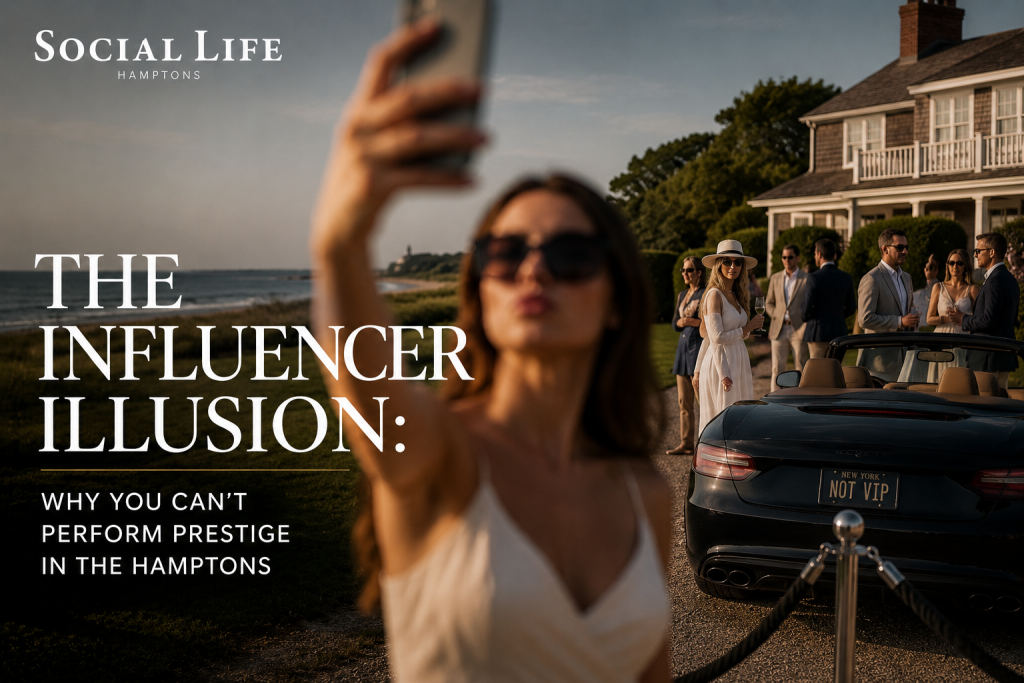
Somewhere on the East End this Saturday, a creator with seven hundred thousand followers will stage the perfect Hamptons afternoon, and the room she staged it for will quietly conclude she was never in it. That gap is the defining status story of the modern summer. Hamptons influencers command real audiences, real rates, and real reach, yet the local hierarchy keeps discounting them to zero, and the discount is not snobbery. It is physics. Prestige is a witnessed asset, and a camera changes what the witnesses see.
Camille Paglia spent a career on exactly this problem, the difference between performing a persona and possessing one. Our series hub lays out her framework in how taste becomes power in the Hamptons. This spoke applies it to the feed, and to why the codes can’t be faked no matter how good the content gets.
The Category Error
Begin with definitions, because the confusion starts there. Influence is the ability to move an audience toward a purchase. Prestige is the standing granted by a specific room over time. The first is a media asset, priced per post. The second is a social asset, priced in years, and the two are not convertible at any exchange rate the feed can offer.
Creators arrive out here holding the first asset and assuming it purchases the second. It does not, and the assumption itself is the tell. Asking a Southampton committee to be impressed by reach is like paying a Paris tailor in arcade tokens. The currency is real somewhere. Just not here.
Documentation Destroys the Asset
Here is the mechanism, stated plainly. Prestige on the East End accrues to people who behave as if no record were being kept, because unrecorded correctness is the costliest signal available. It cannot be monetized, cannot be reposted, and therefore must be genuine. The instant a phone comes out, the behavior acquires a motive, and motive is exactly what the room is screening for.
So the creator faces a structural trap. Her business model requires documentation, while the asset she is chasing requires its absence. Every post that pays her mortgage lowers her standing with the audience she moved here to join. Few professions are built on such a clean contradiction, and none photograph better while losing.
Paglia and the Persona Problem
Paglia’s sexual personae were archetypes with real power, the femme fatale, the dandy, the great hostess, roles that concentrate cultural force in a person. Yet she was precise about their source. A persona works when it emerges from nature and history, and collapses when it is merely worn. The audience always detects the seam, she argued, even when it cannot name what it detected.
The Hamptons creator is wearing the hostess persona without the underlying estate, in every sense of the word. Guests at a real Further Lane lunch are witnesses to a life. Followers of a staged one are audiences for a production, and the two groups are having entirely different experiences of the same tablescape. One confers standing. The other confers engagement, which expires by Thursday.
What the Room Sees in Four Seconds
The detection happens fast, and it happens on details the feed never taught. Arriving camera-first at the divot stomp. Angling toward the photographers at a benefit instead of away. Narrating a porch. Thanking a host publicly, by handle, for an intimacy that was supposed to be private. Each move is efficient, professional, and disqualifying, because each converts a relationship into inventory in public view.
By contrast, the guests with actual standing behave like owners rather than reporters. They photograph almost nothing, post more rarely still, and treat the best moments of the summer as unlisted assets. Scarcity discipline extends all the way into their camera rolls. That restraint is not a quirk. It is the membership fee, paid continuously.
The Algorithm Is a Bad Teacher
Worse, the feed actively mistrains its stars for this territory. Platforms reward immediacy, maximal disclosure, and constant presence, three habits that read out here as need. The algorithm teaches that silence is death, while the East End prices silence as its most reliable indicator of security. Two operating systems, perfectly opposed, running on the same lawn.
Notice also what the algorithm cannot see. It has no sensor for who declined an invitation, who left early and correctly, who was seated where at the dinner that was never posted. The entire scoring layer of the actual Hamptons is invisible to the machine, which is why feed-native strategy keeps optimizing for a game that the real players finished calibrating decades ago.
The Exceptions Prove the Mechanism
A handful of large accounts do hold genuine East End standing, and the exceptions are instructive. In every case, the standing predates the following, or was built through the slow institutional route while the following grew separately. The account documents a life that would exist unchanged without it, and the room can tell. Order of operations is everything. A life that produces content survives here. Content in search of a life does not.
Equally telling, the exceptions post least about what matters most. Their best rooms never appear. In fact, the surest read on any account’s actual standing is the gap between its access and its output, since real membership shows up precisely as withheld material.
A Brief History of the Collision
The collision has a timeline worth recording. Around 2016, the first creator wave discovered the East End as a backdrop, and the early returns were real, since the codes had never faced an audience-scale extraction attempt before. Hosts were flattered. Access flowed. For two or three summers, the arbitrage looked permanent.
Then the immune response arrived, quietly, the way everything arrives out here. Guest lists tightened, and phone baskets appeared at dinners. Soon certain houses began asking, politely, that the weekend stay off the feed, and compliance became its own loyalty test. By 2020, access and audience had fully decoupled. The rooms had learned to price the camera, and the price they set was the room itself. What looked like a new gate was actually the old gate, recalibrated in about thirty months, which is fast for an institution that thinks in decades.
The Economics of Being Discounted
Run the numbers from the creator’s side and the trap sharpens. Her Hamptons content earns premium rates precisely because the setting signals rarity, so the setting is the asset. Yet every extraction visibly cheapens the asset for the audience that controls it, and the rooms respond by withdrawing the settings. Rates hold while access thins. So the business cannibalizes its own supply chain, one tagged porch at a time.
Meanwhile, the hosts run their own ledger. Lending a house to a camera converts a private asset into someone else’s inventory, at a price of exactly zero. Once hosts did that math, the invitations repriced themselves. Nothing personal was decided in any of it. Supply simply met a buyer who kept reselling the goods, and adjusted terms the way supply always does.
The Content That Would Actually Work
Suppose a creator wanted to hold both assets honestly. A playbook exists, though almost no one runs it, because it inverts every professional instinct. Post the villages, never the houses. Credit institutions, never hosts. Shoot the public beauty of the place, the farm stands, the ocean, the light, and treat every private room as permanently off the books. Build the audience on taste rather than access, since taste travels and access is collateral.
Run that discipline for enough seasons and something interesting happens. The rooms notice the restraint, because restraint is the one behavior they are always screening for, and the creator begins accruing the second asset without spending the first. Slow, unglamorous, and structurally sound. Practically no one chooses it, which is precisely why it works for the ones who do.
What Brands Should Take From This
For brands, the practical reading is about matching instruments to jobs. Creator partnerships move product to national audiences efficiently, and nothing here argues otherwise. But standing on the East End is a different job, and it responds to different instruments, editorial judgment, correct rooms, and time under observation, none of which rent by the post.
The expensive mistake is hiring reach to do prestige’s work. A campaign fronted by a creator the room has already discounted attaches the discount to the brand, which is negative return dressed as impressions. Before signing the summer’s talent budget, ask one question. Does this person hold standing in the rooms we want, or an audience outside them? Both have value. Only one is for sale.
The Test Every Feed Fails
Paglia offered a diagnostic that transfers perfectly to the grid. Great art, she argued, survives the removal of its context, while decoration collapses without it. Apply that to any Hamptons account. Strip away the location tags, the recognizable hedges, the borrowed porches, and ask what remains. If the answer is a sensibility, an eye, a genuine point of view, the account holds value anywhere. If the answer is proximity, the account was never the asset. The zip code was.
Most fail the test, and the failure is forgivable, since the platforms taught them that context is content. Still, the rooms out here run the same test instinctively on every guest, not just the professional ones. Who are you without the setting is the oldest East End question there is. The feed just gave it a new costume, and the answer still takes a decade to earn.
The Honest Conclusion
None of this ends the creator economy, which will outlast every hedge on the lane. It simply maps the border where that economy’s writ stops running. Attention can be manufactured, scaled, and sold, while standing can only be witnessed into existence, slowly, by rooms that keep their own books. Paglia’s oldest lesson holds. The persona you perform is legible precisely as performance, and the audience that matters was never watching the feed.
The strange comfort is that the door remains open the old way. Put the phone down, learn the codes, run the seasons, and the East End will eventually stop seeing a creator and start seeing a neighbor. Whether the business model survives the conversion is another question, and a private one, which is rather the point.
Where The Conversation Continues
This piece is a spoke in our series on East End status machinery, anchored by the Paglia hub on taste and rank. Watch the detection layer operate in real time at Polo Hamptons on July 18 and 25, and read the institutional alternative in why editorial authority beats influencer noise. The rooms are keeping score either way. The only choice is which game you are visibly playing.
Author

Written by
Recent Posts
Camille Paglia and the Hamptons: How Taste Becomes Power
The Influencer Illusion: Why You Can’t Perform Prestige in the Hamptons
Old Money Wins: Why Heritage Taste Still Rules the Hamptons
The Arbiter: Why Editorial Authority Beats Influencer Noise
Discovered Online, Consecrated in Print: The Two Rooms of Hamptons Prestige
Categories
- Art
- Articles
- Business of Luxury
- Celebrities
- Entertainment
- Events
- Faces of Summer 2026
- Fashion
- Fashion & Style
- Featured
- Finance
- Food, Spirits, Wine
- Hamptons
- Hamptons Celebrities
- Health
- Health & Beauty
- Lifestyle
- Luxury Lifestyle
- Press
- Profiles
- Real Estate
- Technology
- The Chronicles
- Travel
- Uncategorized
- Weddings