
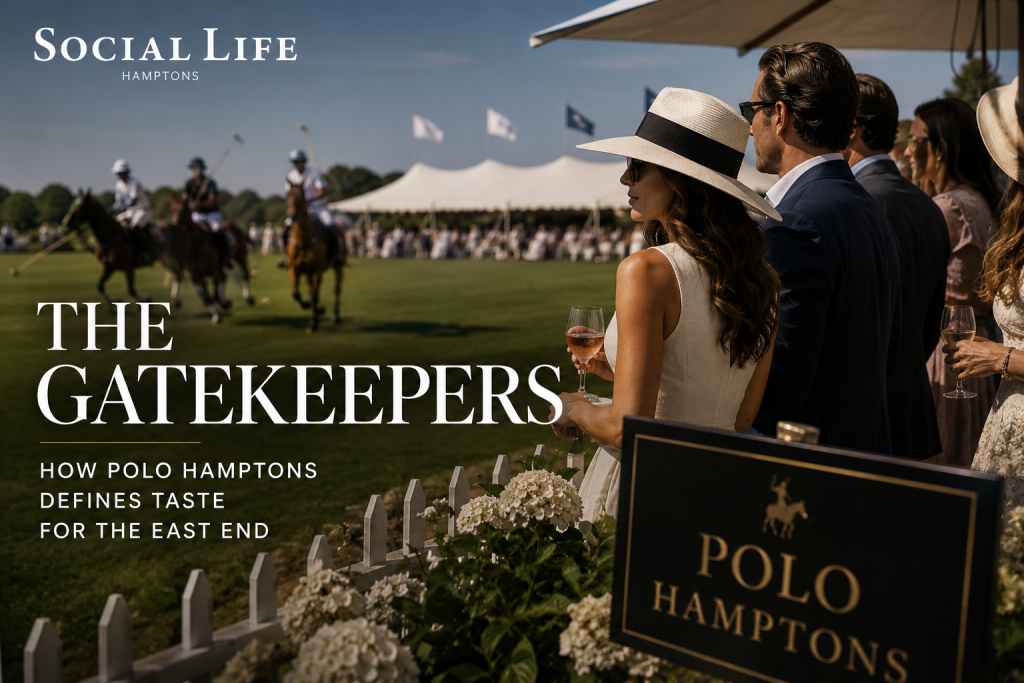
Every July, a Bridgehampton hayfield becomes the strictest classroom on the East End, and the syllabus is invisible. The Polo Hamptons taste codes are never printed, never emailed, and never explained, yet everyone in attendance is graded against them from the moment their car turns onto Lumber Lane. Now in its eleventh year, Polo Hamptons returns on July 18 and July 25 at the Fishel Estate, 900 Lumber Lane, with Christie Brinkley hosting and roughly a thousand guests sorting themselves, mostly unknowingly, into ranks.
Camille Paglia argued that taste is how hierarchy makes itself visible without violence, an idea unpacked in our series hub on how taste becomes power in the Hamptons. Nowhere on the East End does her theory perform better than at polo, because polo is a status machine wearing a sun hat. Here is the machinery, part by part.
Why Polo, of All Sports
Polo signals rank for structural reasons, not sentimental ones. A single playing string requires multiple horses per player, plus grooms, trailers, vets, and land. The sport cannot be miniaturized, franchised, or played casually after work. Its costs are irreducible, so its presence certifies capital the way a hallmark certifies silver.
Paglia would add an aesthetic reason. A polo match is order imposed on animal power, eight riders holding formation over creatures that outweigh them five to one. Watching it, guests witness the oldest luxury there is, which is control. Every other signal on the field descends from that one. Golf certifies leisure and tennis certifies fitness. Only polo certifies command, and command is the currency this crowd actually trades in.
The Geography of the Sideline
Guests believe they choose where to stand. In truth, the field chooses for them, because sideline geography at Polo Hamptons is a seating chart without chairs. Proximity to the VIP tent marks one rank. Ease inside it marks a higher one. The highest rank belongs to the people who drift away from the tent entirely, because they already know everyone inside and have nothing left to prove there.
Watch the champagne line at the second chukker. Newcomers queue early and hold their glasses like credentials. Veterans wait, since a full glass too early signals nerves. Nobody teaches this. Everybody enforces it.
What to Wear to Polo Hamptons
The dress question generates more searches than any other, and the answer is a Paglia case study. The field rewards form and punishes announcement. Linen over logos. Structure over shine. A woman in an unlabeled cream dress with a good straw hat outranks head-to-toe designer branding every single time, because the dress says taste while the logos say tuition.
Heels are the classic error, and not merely because of the grass. Wedges or flats signal that you have done this before, which is the entire point. For men, the failure mode is trying too hard in the other direction, the costume-party polo look with the popped collar. Dress as if you were invited last minute and happened to be perfect. Effort must be total and invisible at once.
The Divot Stomp as Social Audit
At halftime, guests walk the field to replace torn turf, a tradition that doubles as the afternoon’s most efficient audit. On the field, the crowd mixes without the protection of tables or tents. Who walks with whom becomes public record, documented in real time by photographers.
Old hands treat the stomp as a working session. Introductions happen mid-field that could never happen in the tent, because the ritual gives strangers a script. Newcomers who skip the stomp to guard their table miss the only ten minutes of the day when the hierarchy goes porous.
The Lens Decides Who Existed
Getty and Patrick McMullan photographers work the event, and their frames function as the official record. A Paglia reader understands what that means. Canonization is an editorial act. Of the thousand guests present, a few dozen will appear in the coverage, and those few dozen will have attended in a way the rest did not.
Positioning for the lens is its own failed strategy, though, since photographers of that caliber can smell pursuit. Their instinct is trained toward people at ease, people mid-laugh, people who would look the same if no camera existed. The record favors the unbothered. It always has.
What the Tiers Actually Buy
Polo Hamptons publishes sponsor tiers that read, to a Paglia eye, like a rank ladder rendered in invoice form. A Corporate Cabana begins at $6,500. Gold placement runs from $14,000. Platinum reaches $50,000 for the pair of dates. The escalation buys proximity, density, and documentation, which is to say it buys position inside the frame described above.
Yet the tier is a starting line, not a finish. A brand that buys Platinum and behaves like a billboard converts nothing. A brand that buys Cabana and hosts the best conversation on the sideline leaves with relationships the invoice never promised. The field prices access. Behavior sets the return.
The Rosé Question
What gets poured matters as much as what gets worn. This season, Château Léoube rosé arrives at the field by donation from the estate, a detail with a lesson folded inside it. A wine that arrives as a gift from Provence occupies different territory than a wine that arrives on a truck with an invoice, because gifts imply relationship and relationship implies rank.
Guests clock the label without seeming to. A correct pour tells the sideline that the hosts hold real relationships in the places that matter, which reflects on everyone drinking. Status flows through objects here the way current flows through wire. Provence to Bridgehampton is a long way for thirty cases to travel. Yet the distance is the message. An afternoon that can summon a French estate’s goodwill can summon most things, and the sideline knows it before the first cork moves.
The Two-Saturday Structure
Running the event across two dates, July 18 and July 25, builds a mechanism no single afternoon could. The first Saturday establishes the season’s field position. Who attended, who hosted well, who wore the field correctly. The second Saturday then prices that information, because everyone returns having heard the reviews.
Between the two dates sits the most active week of the Hamptons social summer. Lunches get booked off sideline introductions. Invitations shift. A guest who read the first Saturday correctly arrives at the second with adjusted strategy and better company. The interval is the exam period, and the second field is where grades post. Veterans will tell you the July 25 date is the truer event for exactly this reason, since by then the crowd has self-corrected.
The Newcomer’s One-Season Plan
For the guest attending a first Polo Hamptons with real ambitions, the field offers a workable syllabus. Underdress by ten percent relative to instinct. Skip the champagne line for the first hour and walk instead. Attend the divot stomp without a phone in hand. Ask questions at least twice as often as you answer them, because curiosity reads as confidence here while credentials read as need.
Above all, resist the urge to convert the afternoon on the spot. Nothing marks a first season like a pitch delivered field-side. The correct output of a first Polo Hamptons is three names who would take your call in October, nothing more. Rank on the East End is a compounding asset, and compounding requires a deposit left untouched.
The Host as Institution
Christie Brinkley hosting is not celebrity garnish, because the East End does not run on celebrity. It runs on tenure. Brinkley has held Hamptons standing across four decades, through every cycle of new money the Long Island Expressway has delivered, and her endurance is itself the credential. Plenty of famous faces have summered here once. Very few have become part of the furniture, in the sense the phrase intends as a compliment.
So her presence at the field performs a specific function. A host of that tenure vouches for the room, and the room in turn behaves like a vouched-for room. Guests rise to the occasion because the occasion has a witness whose memory reaches back further than theirs. Institutions need faces, and the durable ones choose faces that predate the current crowd.
The Arrival Problem
Before anyone reaches the sideline, the driveway has already filed a report. Arrival order matters, since coming too early reads as eager while arriving too late reads as careless. The practiced window opens about forty minutes after gates, when the field has filled enough to receive you but not enough to swallow you.
What you arrive in matters less than people fear, though it matters. A dusty Defender outranks a rented exotic, because the dust implies a house nearby and the rental implies a point being made. Once again the rule holds. Announcement costs rank. Evidence of a life already lived here earns it.
The Table as Territory
Inside the cabanas, behavior splits the initiated from the rest with unusual speed. A table is territory, but the skilled treat territory as a base rather than a fortress. They seat guests, launch introductions, and then circulate, returning often enough to keep the table warm. The unskilled sit all afternoon, guarding chairs against a siege that never comes.
Hosting well at someone else’s event is among the most advanced moves the field allows. Fill your table with people who improve each other’s afternoons and word travels by Tuesday. In fact, more durable Hamptons alliances have been minted at borrowed tables than at owned ones, because generosity witnessed in public compounds faster than any tier fee.
What Monday Decides
The event ends at sundown, yet the scoring continues into the week. Monday is when the field’s real ledger gets written, in follow-up notes, in introductions promised and actually made, in the photographs that surface and the ones that do not. A guest who converts three sideline conversations into two lunches has beaten a guest who collected forty handshakes and mailed none of them.
Because of this, veterans treat the match as the middle of a process rather than the point of one. Before, they study the likely room. During, they choose few targets and go deep. After, they move fast, while the afternoon is still warm in everyone’s memory. The field rewards the patient, but it pays the prompt.
Reading the Field Like a Text
Assemble the parts and the event reveals itself as a single instrument. Land certifies scale. Horses certify control. Dress sorts the initiated from the aspiring. The stomp audits alliances, the lens canonizes a chosen few, the tiers price the frame, and the rosé signs the whole afternoon like a painter’s mark in the corner.
None of it is accidental, and none of it is cruel. A legible hierarchy is a functioning one, and Polo Hamptons endures because it keeps the code readable for anyone patient enough to study it. Two Saturdays remain this season. The field will take attendance, quietly, as it has for eleven years.
Where The Conversation Continues
This piece is a spoke in our series on East End status machinery, anchored by the Paglia hub on taste and rank. For the houses where brands learn these codes off-field, read the activation house piece. For why performing all this for a phone camera fails, see the influencer illusion. Tickets and sponsor inquiries for July 18 and 25 run through polohamptons.com. The sideline holds a finite number of correct people. Consider being one of them.
Author

Written by
Recent Posts

AI for personal finance: where PennyGuard fits
How to Pick a Homecoming Dress for Your Body Type (and Feel Amazing in It)

World Cup Injury Attorney for Vancouver Events
What a 3-Carat Engagement Ring Actually Costs in 2026: The Real Numbers
The Skincare Habits That Make a Real Difference Over Time
Categories
- Art
- Articles
- Business of Luxury
- Celebrities
- Culture
- Entertainment
- Events
- Faces of Summer 2026
- Fashion
- Fashion & Style
- Featured
- Finance
- Food, Spirits, Wine
- Hamptons
- Hamptons Celebrities
- Health
- Health & Beauty
- Lifestyle
- Luxury Lifestyle
- Press
- Profiles
- Real Estate
- Technology
- The Chronicles
- Travel
- Uncategorized
- Weddings