
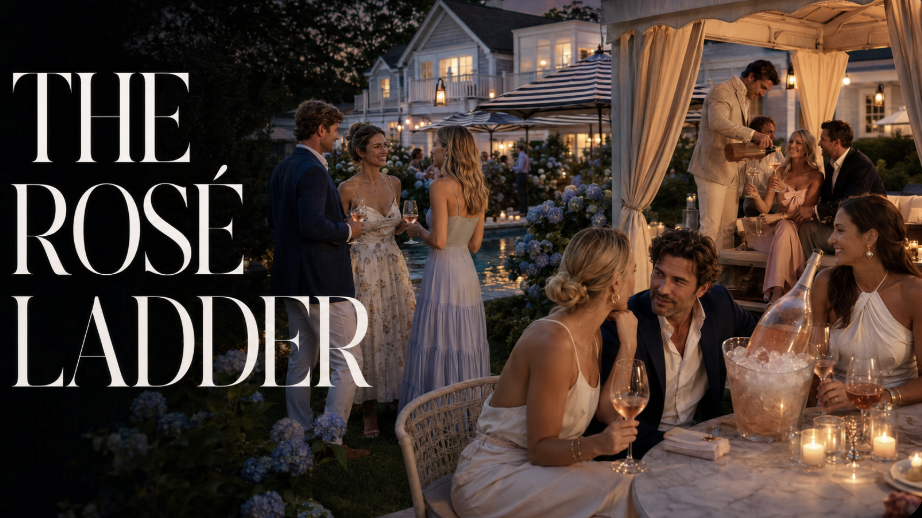
Two bottles arrived at the same dinner in July, and only one of them got asked about. The first was famous, a label everyone at the table could price on sight. It was received warmly and discussed never. The second was pale, unfamiliar, and poured by the hostess with four words of provenance. By the cheese course, three guests had photographed the back label. They did it discreetly, the way people photograph things they intend to acquire. Hamptons rosé is the most legible status system on the East End, and that dinner displayed its entire grammar in two pours.
This series reached the wine glass by a long route, and the route matters. Eight installments established that nothing important out here is bought from an advertisement. They also named the Pour the fastest referral chain in luxury, since the product performs at the table and the table is the venue. This installment climbs inside that chain. What gets poured is a disclosure, the bottle on the table is a membership card, and the cards, notably, come in ranks.
Call the ranking the rosé ladder. Everyone out here is standing on a rung of it, whether they know the ladder exists or not, and the people fluent in this economy’s signals can read a household’s rung from a single pour. What follows is the ladder in full: the rungs, the climb, the inversion at the top, and how one bottle becomes a village’s. Pour something and settle in. The irony is noted.
The Pour Is a Disclosure
Establish the mechanism first. Wine works as a signal because it sits at the exact intersection this economy prices: taste, money, and access. One object displays all three, and everyone at the table will hold it. The disclosure is involuntary, which is what makes it reliable. Clothes are chosen for the evening. The cellar was assembled across years of decisions, so the bottle testifies about the decade, not the outfit.
The testimony covers three questions, and the table scores them silently. First, judgment: does the household know the difference, or does it buy the advertisement. Second, access: certain bottles cannot be purchased with money alone. Allocation runs on relationships, and the pour proves the relationship. Third, orientation: the bottle reveals whom the host is trying to impress, which is the most intimate disclosure of the three. A pour aimed at the label readers says one thing. A pour aimed at the palate says another. The difference, of course, is audible in what gets asked.
None of this requires anyone to be a snob, and the best tables are not. The scoring runs beneath a perfectly warm evening, automatically, the way every verdict in this series runs. The wine is simply the most frequently repeated test, because it happens at every table, every weekend, all season.
The Ladder, Rung by Rung
Four rungs organize the climb, and honesty requires describing all of them, including the ones this magazine’s readers have already left.
The Crowd Pleaser
The bottom rung is the case of reliable pink from the store everyone uses, bought by volume for the deck and the beach. Nothing is wrong with it, and nothing is said about it. The crowd pleaser signals participation in the season, which is a real signal, and the last one on the ladder that costs nothing socially. It says: we are here.
The Label Buyer
The second rung purchases the famous name, the celebrity bottle, the label with the marketing budget. This rung believes it has climbed, which is its defining feature. In fact, the famous label discloses that the household buys wine the way it once bought watches: by recognition. The table receives it exactly as warmly as it receives any advertisement. It says: we know what you know.
The House Bottle
The third rung is where the ladder becomes interesting. The household has chosen one estate, deliberately, and serves it until the bottle becomes part of the household’s identity. Guests begin associating the wine with the address. The choice displays commitment rather than reach, and commitment, this series keeps finding, is what the room actually respects. It says: we have decided who we are.
The Provenance Rung
The top rung pours the unfamiliar bottle with the four words of history: the small estate, the friend’s vineyard, the allocation that travels by relationship. Price stops mattering entirely here. What gets displayed is access plus judgment, the two currencies money cannot mint directly. It says: we know people who know things, which out here is the whole game.
How a Bottle Becomes a Village’s
The ladder’s most powerful move happens between the third and fourth rungs, and it belongs to hosts rather than drinkers. Certain bottles stop belonging to households and start belonging to villages, and the conversion follows the mechanism the trust economy installment mapped at a single table. A respected hostess adopts an estate. Her guests ask, she attributes, and the attribution travels with the recommendation. Then two more good addresses adopt it. By August, the bottle appears at tables that never heard the original attribution. Its status arrives pre-installed.
Count the actual transactions involved, and the arithmetic stays shocking. Perhaps forty dinners, hosted by perhaps a dozen households, can seed a village for a decade. No campaign touches this efficiency, because no campaign can supply the ingredient doing the work. A specific person the drinker trusts staked standing on the pour. The wine trade has a word for regions and vintages. It lacks one for this, the moment a bottle acquires a social address.
The window, however, is guarded. The households capable of starting the cascade are precisely the ones this series calls social leaders, and they adopt estates the way they admit guests: slowly, on merit, and never on request. So the chain cannot be entered from the bottom of this article. It can only be entered from the next section but one.
The Ladder’s Etiquette
The system carries manners, and climbers should learn them before the first pour. Never announce a bottle’s price, up or down, since both directions are the same disclosure. Never ask a host what a wine costs, for the identical reason. When the unfamiliar bottle arrives with its four words, ask about the story rather than the score, because the story is what was actually being offered.
Guests hold obligations too. Bring wine at the rung you drink, not the rung you reach for, and hand it over without a speech. Also, expect the bottle you bring to stay unopened, since the evening’s pours were cast in advance like everything else at a serious table. The gift was the gesture. The cellar decision was never yours.
Above all, receive attribution honestly. When a host names her source, the name is a small gift of access, so treat it as one. Order a case, mention her when you pour it, and the chain does what chains do. Repeat the wine without the attribution, though, and you have pocketed something that was lent. The ledger, as ever, notices.
The Inversion at the Top
Regular readers will have predicted the ladder’s final property. At the top of every status system this series has mapped, the signal inverts, and the wine glass obeys. The loudest possible pour, the trophy magnum announced at volume, reads one rung lower than it costs. Meanwhile, the quiet bottle with the story reads one rung higher than its price, since restraint plus knowledge is the tell of someone with nothing left to prove.
The inversion produces the behavior newcomers find most confusing. Specifically, the most secure cellars pour modestly on ordinary nights and save nothing for impressing anyone. Impressing is itself the disqualifying move. The famous label appears, when it appears, with a shrug and a story about why this one is actually the good year, which converts even the second rung into the fourth. Knowledge, ultimately, is the top of the ladder. The bottles are just how it gets displayed.
For climbers, the instruction is the same one this series gives every arrival. Stop reaching. Choose a house bottle with actual conviction, learn its story until the four words are yours, and let repetition do what repetition does everywhere in this economy.
The Champagne Exception
One category operates on separate grammar, and the ladder should note it. Sparkling wine out here is not a disclosure but a punctuation mark. It announces that something has concluded well: the deal, the engagement, the season, the match. Because the message is occasion rather than identity, the rules shift. Recognition helps rather than hurts, since the cork’s job is to be understood instantly by the whole lawn.
Even here, though, the economy’s deeper rules hold. The household that produces the good bottle for the small, private conclusion, the Tuesday promotion, the quiet anniversary, discloses more than the one that saves it for an audience. Celebration calibrated to the moment rather than the crowd is its own provenance. The top of every ladder, it turns out, is paying attention. The category also carries the season’s calendar. June corks open the summer, and the Labor Day pour closes the books on it, so sparkling is the one wine out here that tells time. Houses that understand the punctuation earn the conclusions people remember, and conclusions, notably, are when everyone at the table is paying attention. There are worse moments to be the bottle in the photograph nobody took.
The Field Test
Every July, the ladder assembles in public, and readers of the cabana installment already know the venue. The tents at the polo pour all afternoon, and the row functions as the season’s open tasting of the status system this article describes. What each tent pours, how it attributes, and what guests carry home as a question: the field runs the whole chain live, between chukkers, at density no dinner matches.
For households, the afternoon is where house bottles get discovered. For estates, it is the audition in front of every chain at once. And for readers who have followed this series from the start, the field test is one more proof of its founding claim. The season is a market with excellent manners, and in July the market convenes in Bridgehampton with glasses out.
A Word for the Houses
Wine and spirits brands should now see their assignment complete, because it repeats every rule this series has taught. The Pour chain cannot be purchased, entered by campaign, or shortcut through the label buyer’s rung. It is entered the way guests enter. Presence in the right rooms, contribution without visible ask, and the patience to let a hostess adopt rather than accept. Supply the well-run house generously. Pour at the field beautifully. Then wait, since adoption on merit is the only version that cascades.
The prize justifies the discipline. A bottle with a social address holds it for a decade. Hosts defend it as a matter of their own taste, immune to the rival’s media budget. The famous labels rent recognition annually. The village bottles own it, and this series has now explained the difference twice, at two altitudes, on purpose.
Where This Series Goes Next
The pour is the fastest chain in this economy. The next installment maps the slowest and most valuable one: the Money. How the wealthy actually choose the people who manage everything, why the advisor is met at the dinner and confirmed at a lunch never called an interview, and what the formal process is actually for. The piece arrives in a few days, and the Family Office Principal returns for it.
New readers should begin with the founding map and climb from there. The manual assembles in order, and the good bottle is already open.
Where The Conversation Continues
Social Life Magazine has watched twenty-three summers of pours, adoptions, and cascades, and our tables, pages, and July field are where several of them started. If your estate is ready to earn a social address rather than advertise at one, the conversation starts before the season does. Hostesses adopt early. The guest list, as always, is limited by design.
Author

Written by
Recent Posts

4th Annual Catwalk Furbaby

Thomas J. Henry and Dr. Elena Alvarez-Henry Join Forces for Cancer Care
How an Emergency 24/7 Plumber Resolves Sudden Drain Backups Fast
Best Free Location Tracking Apps for Everyday Family Safety: iSharing and HeyPolo Compared
How Disney Channel Stars Become Pop Powerhouses: The Sabrina Carpenter Blueprint
Categories
- Art
- Articles
- Business of Luxury
- Celebrities
- Culture
- Entertainment
- Events
- Faces of Summer 2026
- Fashion
- Fashion & Style
- Featured
- Finance
- Food, Spirits, Wine
- Hamptons
- Hamptons Celebrities
- Health
- Health & Beauty
- Lifestyle
- Luxury Lifestyle
- Press
- Profiles
- Real Estate
- Technology
- The Chronicles
- Travel
- Uncategorized
- Weddings