
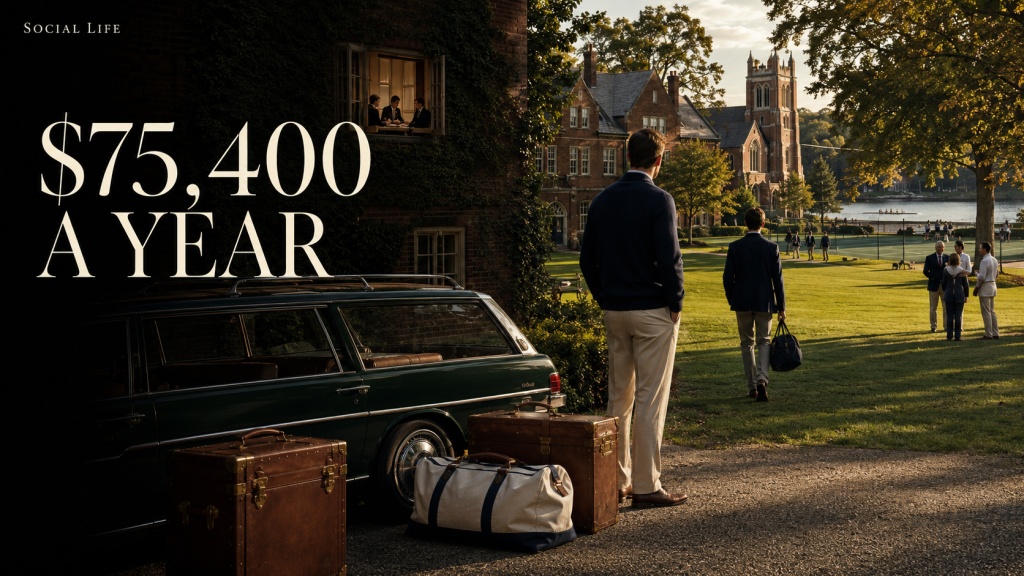
Here is a pricing puzzle worth a moment of anyone’s time. St. Paul’s School in Concord, New Hampshire lists tuition at $75,400 for the 2026 academic year, room and board included. Meanwhile the entire academic content of a secondary education, every theorem and every play, is available free to anyone with a phone. The customers of elite boarding schools are, by definition, sophisticated buyers. Certainly they do not pay premiums for commodities. So the question that should interest every parent, marketer, and social climber on this coastline is simple. So what is the actual product?
A sociologist named Shamus Khan answered it from the inside. He attended St. Paul’s, returned to teach there, and wrote the year up in Privilege, the Princeton study that anchors this entire series. When Khan did the research, the tuition was $45,000, and he framed the whole book around what that figure purchased. His answer holds at any price point. The product is ease. Four years of supervised practice at being comfortable in rooms that make other people stiff.
Note the growth rate while we are here, because the market is telling you something. From $45,000 to $75,400 in fifteen years is an increase of roughly two-thirds, about double what inflation did over the same stretch. Assets appreciate like that when buyers figure out what they are really purchasing. The families were never confused. The price simply caught up to the product.
The Cover Story and the Curriculum
Every institution in this economy runs two syllabi. The printed one lists Beowulf, calculus, and a language requirement. The real one meets at meals. Khan’s most quoted observations came from the dining hall and the formal dinner, where teenagers rehearsed the mechanics of a certain kind of adulthood. Which fork, yes, but more importantly which posture, which volume, which way to address the person serving and the person presiding, which silence to leave alone. Seated dinners at such schools are not nostalgia. They are labs, and the seating chart is the lab manual.
The genius of the format is that nobody experiences it as instruction. A class in comportment would produce self-conscious performers, and self-consciousness is the one failure the product cannot tolerate, as the body language research makes plain. So the teaching hides inside routine. Practice comfort daily for four years, in blazers, among the children of people whose rooms you will someday enter, and comfort stops being a skill. It becomes a temperament. Bourdieu called the result embodied cultural capital, and our primer on how such capital actually works maps the conversion tables.
The Summer Campus
The East End is where the same machinery runs in July, and it has run here for generations. Junior sailing out of the yacht clubs, where an eight-year-old learns to capsize without panic in front of witnesses. Junior tennis on grass, in required whites, at a club that has taught composure since 1887. The caddie yard, historically, where certain families sent sons who would never need the money, because carrying a bag for a stranger teaches a register no classroom offers. Cotillion in the shoulder season. The benefit committee apprenticeship for the teenagers, licking envelopes next to their mothers, absorbing the org chart of the summer colony by osmosis.
None of it announces itself as class formation. All of it is class formation. By the time these children are twenty-five, rooms simply feel like rooms to them, and the feeling reads as breeding to everyone who acquired it later or not at all. The membership institutions that host the coursework deserve their own study, and they get one.
What the New Buyers Substitute
Now watch the arrivals, because the substitution pattern is where the market gets interesting. Notably, families who missed the pipeline do not ignore the product. On the contrary, they chase it through adjacent vendors. The etiquette consultant, billing by the session. Likewise the image advisor. The membership strategist who maps the club landscape like a private banker maps jurisdictions. And lately the reels, where creators explain social posture to audiences of millions, a development that finally put this entire hidden economy on a phone screen.
The substitutes deliver information, and information has value. What they cannot deliver is the one input the schools actually sell, which is supervised repetition among the peer group across years. Granted, a weekend intensive can teach you the fork map. It cannot make a formal dinner boring to you, and boring is the goal. Ease is just familiarity that has stopped counting itself. The honest version of what transfers in adulthood, and at what cost, runs in learning the codes at forty-five.
The Glass Floor
One more finding from the research, and it is the one the brochures omit. These institutions do not only lift their students. They also catch them. Khan and the scholars around him describe a glass floor under the children of the elite. Specifically, a lattice of second chances, warm references, and forgiving interpretations keeps a mediocre performer from ever landing where a talented outsider starts. The tuition buys altitude, but it also buys the net.
That fact complicates the ladder story these schools now prefer to tell about themselves, in which admission is open and outcomes follow merit. Both halves are partly true, which is exactly the problem, and the full accounting of open gates and closed rooms is the subject of this series’ hardest chapter. For present purposes, note only what the floor implies about the product. The families are not buying an education. They are buying a probability distribution, trimmed at the left tail.
Reading the Invoice Correctly
So return to the pricing puzzle with the product identified. Is $75,400 a year expensive? Against calculus, absurdly. Against what it purchases, the buyers evidently think not, and the waiting lists agree with them. Four years of installed ease compounds across every room, deal, marriage, and membership decision of a long life. Priced as an asset rather than a service, elite boarding schools may be the last bargain in the luxury economy. That is presumably why the one thing their customers never do is complain about the bill.
For everyone who did not get the installation at fourteen, the news is mixed but not bleak. The curriculum exists outside the schools, this coastline teaches it every summer, and the adult semester, while slower and more public, does confer degrees. The old families are not guarding a secret. They are simply ahead on hours. The syllabus has been posted since 1887. The only real question is when you enroll.
Beowulf and Jaws, Priced In
Khan gave one chapter a title that doubles as the modern spec sheet, Learning Beowulf and Jaws. The old curriculum taught the canon and only the canon, because exclusivity was the signal. The current one teaches range. Graduates must move from the epic to the blockbuster without friction, fluent at both altitudes and impressed by neither. After all, the contemporary elite signals through breadth worn lightly rather than through gatekept taste.
This omnivore requirement is quietly the most expensive line item in the tuition. Range cannot be crammed, because range is exposure, and exposure takes childhood. The school supplies the Beowulf. Then the ski trips, the internships, and the tables full of adults from six industries supply the Jaws. Blended, they produce a twenty-two-year-old who can hold a seminar room and a tailgate with the same relaxed grip. Employers call the result polish. The balance sheet calls it what it is, which is purchased surface area.
For the East End translation, watch any August porch. The conversation runs from Basel to the Mets to a zoning fight to a series everyone is streaming, and the fluent participant tracks all of it without portfolio. That performance was manufactured somewhere, on purpose, and the factories charge what factories charge.
The Cotillion Economy Never Died
A common error holds that the formal training died with the white gloves. In fact the cotillion economy simply rebranded. The dance classes persist in the shoulder season, under gentler names, and around them has grown a full perimeter of finishing infrastructure. Sailing programs with waiting lists longer than the boats. Junior memberships that function as apprenticeships. Tennis academies where the actual product, as at the schools, is composure under observation, with a forehand included at no extra charge.
Then comes the newest wing, built for the families who missed the pipeline. The private consultant who preps a household for membership the way others prep for admissions. The etiquette intensive, the image audit, the summer strategist. Demand runs high and rising, for the obvious reason. The buyers already own everything else, and the one purchase that keeps failing is the one this economy claims to sell.
What should a clear-eyed buyer conclude? That the perimeter vendors sell maps, and maps have value, but the schools sell mileage, and mileage is the moat. Four years of daily reps among the peer group cannot be compressed into a weekend at any price, which the schools understand perfectly. It is why their product needs no advertising and their price needs no defense.
The Parent’s Real Calculation
Strip the sentiment and the enrollment decision is an asset allocation. A family paying full freight across four years commits roughly the price of a starter house in most of America, against an asset with no ticker. What the sophisticated buyers have concluded, waiting lists suggest, is that the asset outperforms. Installed ease compounds across every room its holder will ever enter, every negotiation, every membership committee, every seating chart, and it never needs rebalancing.
The calculation explains the otherwise puzzling behavior at the margin. Families of enormous wealth, who could tutor their children privately in anything, still compete ferociously for these particular seats. They are not buying instruction, which they could replicate. They are buying the peer group and the observation, the two inputs that cannot be assembled at home, because ease is installed socially or not at all. A child practicing composure alone is practicing something else entirely.
And the calculation carries one more line, rarely said aloud. The tuition also buys the floor, the lattice of second chances and warm interpretations that catches the mediocre performer. Priced as insurance alongside the appreciation, the invoice starts to look, to its buyers, almost conservative. That is the real answer to the pricing puzzle this piece opened with, and it is why the number will be higher again next year.
Where The Conversation Continues
This piece is the machinery hub of the ease curriculum, covering the institutions that manufacture what the rooms then read. Social Life Magazine has covered the summer campus for 23 years. Reach the features desk or step onto the field at Polo Hamptons, and join the list for the invitations that matter.
Author

Written by
Recent Posts
Vanderbilt & Seewald
Alberto Luzzi Opening of Fine Jewelry Room
The Victor dE Souza 2027 Spring Summer Collection

Malan Breton Presents “Garden of a Thousand Tomorrows”
What to Wear to a Summer Wedding as a Guest: A Hamptons Dress Code Guide
Categories
- Art
- Articles
- Business of Luxury
- Celebrities
- Culture
- Entertainment
- Events
- Faces of Summer 2026
- Fashion
- Fashion & Style
- Featured
- Finance
- Food, Spirits, Wine
- Hamptons
- Hamptons Celebrities
- Health
- Health & Beauty
- Lifestyle
- Luxury Lifestyle
- Press
- Profiles
- Real Estate
- Technology
- The Chronicles
- Travel
- Uncategorized
- Weddings