
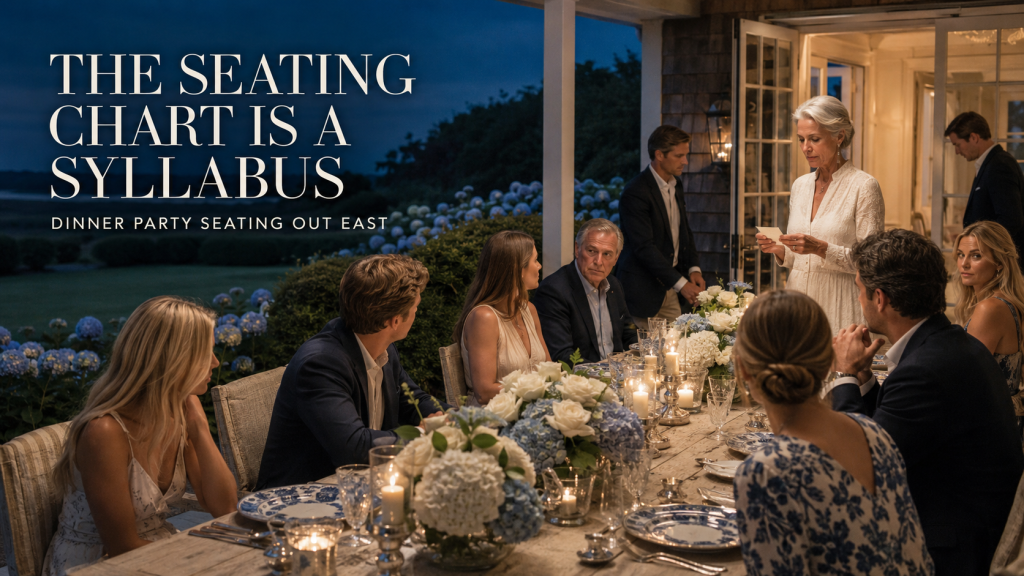
Every July, on kitchen islands from Southampton to Amagansett, a certain document gets drafted, revised, argued over, and finally committed to place cards. It is rarely discussed and never published. Yet dinner party seating is the most honest document produced on this coastline, more candid than any masthead, board list, or benefit program. It records what the host actually believes about every person in the room, in a language everyone at the table can read.
Menus flatter, and invitations flatter. The chart does not, because the chart has a job. Twelve people, one table, three hours, and a finite supply of good positions. Something must be decided, and the decision cannot hide. Whoever sits at the host’s right hand was ranked. So was whoever landed mid-table between two spouses, and so were you. The chart is where a season’s worth of polite ambiguity gets settled in ink, which is exactly why the old curriculum treated it as a teaching instrument.
Where the Lesson Comes From
The great schools understood this first. Shamus Khan’s research at St. Paul’s, the study behind this whole series, pays close attention to the formal dinner, where students cycled through assigned seats beside faculty, strangers, and each other. The rotation was the point. A teenager who has sat beside the intimidating adult forty times stops finding adults intimidating, and graduates into rooms pre-solved. The tuition history of that machinery is its own story. Its flagship product was the dinner.
The East End ran the same seminar at home. Likewise, the old summer tables seated children with adults deliberately, on the theory that composure is installed by exposure and nowhere else. A child who must make ten minutes of conversation with a federal judge before dessert is not being tortured. That child is being tutored, and the ease that later reads as breeding was assembled at exactly such tables, one required conversation at a time.
Reading Your Own Place Card
Now the practical translation, because everyone at the table wants it and nobody asks. The seats beside the hosts are the verdict seats. They go to honor, to novelty worth examining, or to accounts being courted. Each recipient should note which of the three applies. Mid-table is the engine room, where the host installs proven conversationalists to keep the machine turning. That placement is a compliment of a different kind. The corners tell their own story. And distance from the host, measured in chairs, is measured in something else too, which each guest may calculate privately.
Couples get separated at a serious table, always. The practice is not mischief. A couple seated together produces one conversational unit and consumes two chairs. Poor arithmetic, at any ambitious dinner. Separation forces every guest to perform solo, which is precisely the exam. Certain guests protest the custom. Yet the protest is itself an answer to a question the host had been quietly holding, since ease travels alone and unease requests an escort.
The Chart as Instrument of Power
Do not mistake the drafting for a chore. Placement is the host’s levers, all of them. A chart can mint a friendship by putting the right curator beside the right founder. Equally, it can end a courtship of the commercial kind by installing an ocean of table between two people who arrived hoping to talk. Introductions that would take a season of accidents get manufactured in one seating. Debts get paid in position. Messages get sent in it, and received.
The deeper mechanics of that authority, why the person who assembles the room outranks everyone inside it, belong to another chapter of this coastline’s operating manual. For the purposes of the syllabus, note simply that the chart is where such power becomes visible on paper, and that taste, as ever, is doing the scoring. A brilliant chart is a composition. The guests feel a great evening happened to them. The host knows it was written.
The Modern Complication
The estate dinner has lately become the coastline’s premier commercial format, quietly replacing the ballroom benefit as the room where consequential introductions happen. This raises the stakes on the old document considerably. When the twelve chairs include a brand’s principals, the chart stops being social record and becomes deal architecture. Accordingly, the houses staging such evenings have learned that placement is most of the production value. The candle matters less than who can see whom over it.
Yet the grammar has not changed since 1887, which is the reassuring part. Whether the table is family, philanthropy, or commerce, the chart still answers the same three questions. Who is honored. Who is working. And who is being watched. Learn to read your own answer without flinching, and to draft charts that answer generously, and you have completed one of the shorter, sharper courses in the whole curriculum. The document is honest. The trick is being ready for what it says.
A Short History of the Document
The chart is older than the colony and arrived with it. Specifically, the Gilded Age tables that established the East End’s protocols ran on strict precedence, rank seated by rule, ambassador before banker, age before beauty. That system arrived intact from the city ballrooms, administered by hostesses whose authority over placement was absolute and understood. The rules have since relaxed. Placement authority never did. What changed is only that placement went from code to composition. That made it more revealing, not less, since a composed chart records judgment where a coded one recorded merely protocol.
The old summer tables also established the apprenticeship model this piece described, children seated among adults as deliberate training. Contemporary tables largely abandoned the practice, exiling the young to their own sushi-fed satellite. And the abandonment shows a generation later, in adults paying consultants for the composure a hundred childhood dinners once installed free. The chart was always the cheapest classroom on the coastline. The families who remember this still run it.
Anatomy of a Twelve-Person Table
Read a serious table like a document, position by position. The host anchors one end, or in the modern style the middle, which converts the table from a hierarchy into a stage in the round. The right hand remains the verdict seat, honor’s ancient address. Across from it, novelty, the guest being examined, placed where the host can conduct the examination personally while appearing merely to pass the salt. The far corners hold the reliable, the guests who need no management and receive, as their reward, each other.
Mid-table, the engine room, takes the conversationalists, and their placement is load-bearing. A twelve-person table cannot run as one conversation past the first course. It must break into threes and fours, and the breaks happen at the seams the host built, which is why two brilliant talkers never sit adjacent. Adjacent, they entertain each other. Separated by two seats, they each power a section, and the table hums like a properly loaded ferry.
Note finally what the practiced eye checks first, which is its own position relative to the door, the host, and the guest of the evening. Every chair at the table answers the same quiet question, what does this house currently believe about me, and the answer arrives before the first pour. Learning to receive it without visible arithmetic is a body discipline of its own.
Drafting Your Own
Eventually the syllabus flips, and the guest becomes the author. A few compositional rules from the coastline’s better tables, offered as craft rather than law. Separate couples, always, and separate business partners too, since both arrive pre-conversed. Seat ambition next to accomplishment rather than next to other ambition, because ambition adjacent to ambition produces either alliance or arm wrestling, and neither improves the fish course. Give every shy guest one warm neighbor, deliberately chosen, and every relentless talker one listener who genuinely enjoys the job.
Then the master rule, the one that separates hospitality from strategy while containing both. Build each guest one conversation they could not have manufactured themselves. That is the actual gift of a great table, worth more than the menu, and it is why invitations to certain houses out here carry the weight they carry. The chart is honest about rank because it must be. The generous chart is honest about something better, which is what the host believes each guest might become, given the right neighbor and three unhurried hours.
Where The Conversation Continues
This spoke sits in the machinery wing of the ease curriculum, beside the schools that formalized the seminar and the clubs that host it. Social Life Magazine has read these tables for 23 years. Brands with a seat to earn can start at the features desk, and the invitations themselves travel through the list.
Author

Written by
Recent Posts

The New York Women’s Foundation’s 2026 Neighborhood Dinner

Marco Maranghello

The Baker House 1650
MvVO ART Show
Casita Maria Center for Arts and Education
Categories
- Art
- Articles
- Business of Luxury
- Celebrities
- Culture
- Entertainment
- Events
- Faces of Summer 2026
- Fashion
- Fashion & Style
- Featured
- Finance
- Food, Spirits, Wine
- Hamptons
- Hamptons Celebrities
- Health
- Health & Beauty
- Lifestyle
- Luxury Lifestyle
- Press
- Profiles
- Real Estate
- Technology
- The Chronicles
- Travel
- Uncategorized
- Weddings