
Every summer, the bumper stickers appear on Range Rovers and vintage Jeeps all along Montauk Highway. Two words, white on black: The End.
It is a clever bit of branding. Montauk sits at the eastern tip of Long Island, where the highway runs out of land and the Atlantic takes over. For a certain kind of New Yorker, it is the farthest the map is willing to go.
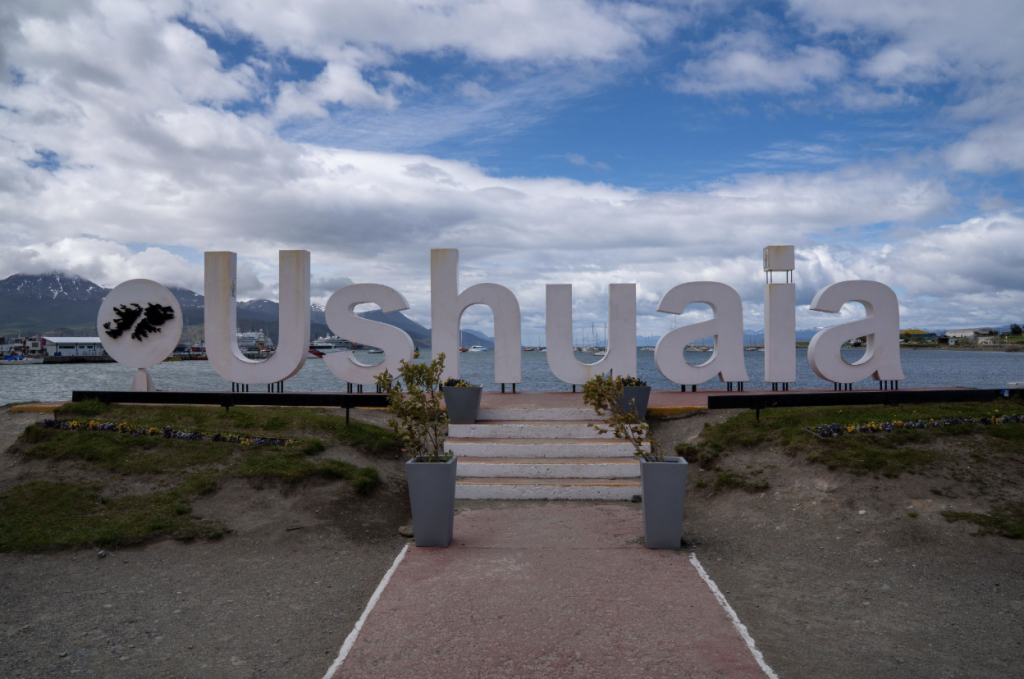
But there is another town that makes the same claim with far more authority. It sits at the bottom of the Americas, on the Beagle Channel, with the mountains of Tierra del Fuego at its back. Its sign says Fin del Mundo. The end of the world.
That town is Ushuaia. And unlike Montauk, it is not the end of anything. It is the beginning of the last great journey left on Earth.
Two Ends, One Ocean Apart
Montauk earned its mystique honestly. The hamlet has been the last stop on Long Island for centuries, a working fishing village long before the surfers and the restaurateurs arrived.
Its most famous landmark proves the point. The Montauk Point Lighthouse was commissioned by Washington in 1792, and it remains the oldest lighthouse in New York State. Standing beneath it at dawn, with the ocean on three sides, it is easy to feel you have reached the edge.
Ushuaia offers a more literal version. Argentina’s great southern highway, Ruta Nacional 3, ends at Bahía Lapataia, inside Tierra del Fuego National Park. A weathered sign marks the spot. Beyond it, there is no more road. Only forest, water and the long run south.
Montauk is where the road ends. Ushuaia is where the map runs out.
Where the Road Ends and the Antarctica Cruise Begins
Here is the real difference. Nobody leaves Montauk for somewhere more remote. The next stop is Block Island, or Portugal if you keep going.
Ushuaia, on the other hand, is a departure gate. Most trips to Antarctica begin in this corner of South America, and the harbor fills each southern summer with expedition ships bound for the ice.
For travelers who think of Montauk as the height of escape, Antarctica is the next level entirely. Silversea’s trips to Antarctica frame the continent as “the closest thing on Earth to another planet,” and it is hard to argue.
There are two ways to make the journey. The classic route crosses the Drake Passage over open sea, following the routes of the great polar explorers. The faster option, a fly cruise, skips the Drake entirely on a private charter to King George Island.
Either way, the voyage to the Antarctic Peninsula typically runs 10 to 12 days. Zodiac boats carry guests ashore almost daily, and on some landings they are the only way on or off the ship.
From 2026, Silversea’s fly cruise guests begin at The Cormorant at 55 South, a hotel in Puerto Williams, the small Chilean town just across the Beagle Channel from Ushuaia. It has been billed as the southernmost hotel on Earth. Montauk’s boutique hotels, for all their charm, cannot compete with that address.
The Lighthouse Test
Every end of the road needs a lighthouse. Montauk’s stands tall and white on its bluff, a symbol stitched onto sweatshirts and tote bags across the East End.
Ushuaia’s equivalent sits out on the water. Les Éclaireurs, a small red-and-white tower on a rocky islet in the Beagle Channel, is often called the lighthouse at the end of the world. Boats circle it daily, passing sea lions and cormorants crowded onto the surrounding rocks.
One lighthouse guards beach traffic and fishing fleets. The other watches over the waters that lead to Antarctica.
The Surf and the Ice
Montauk’s water is part of its identity. Ditch Plains has drawn surfers for generations, and the summer ritual of wetsuits, longboards and post-session coffee is practically a religion.
Ushuaia’s water tells a colder story. The Beagle Channel is calm and steel-gray, framed by snowcapped peaks even in midsummer. There is no surf culture here. There is something better: the knowledge that this water leads, eventually, to ice.
From an expedition ship, the view south shifts slowly from forest to rock to white. Icebergs replace sandbars. Penguins replace paddleboarders.
A Different Kind of Table
Montauk’s dining scene has evolved from clam shacks into a destination of its own. Lobster rolls, fresh-caught striped bass and long sunset dinners by the water define the season.
Ushuaia’s table is just as rooted in its waters. The local king crab, known as centolla, is the town’s signature dish, often simply steamed and served with lemon. Patagonian lamb, slow-roasted over an open fire, is the other essential.
Both towns understand the same luxury: food that tastes of the place where it was caught.
Who Really Owns the Edge?
None of this is a knock on Montauk. The End is a brilliant name for a place that feels, on a foggy morning, genuinely remote. It has every right to its mythology.
But geography is generous to Ushuaia. It is a gateway to a continent set aside for peace and science. The Antarctic Treaty, signed in 1959, keeps the entire continent reserved for peaceful purposes and scientific cooperation. No other destination on the planet comes with that kind of guarantee.
For the traveler who has done Montauk in July, St. Barth in January and the Amalfi Coast in between, that is the real draw. Ushuaia is not the end of a road trip. It is the starting line for the one journey most people only dream about.
The Last Word
Montauk will always be The End for New Yorkers. It is where the summer runs out, where the highway gives way to sand and the lighthouse marks the final stretch of Long Island.
But for anyone chasing the true edge of the world, the bumper sticker belongs to Ushuaia. Its road truly ends. Its harbor truly opens onto the unknown.
And somewhere beyond the Beagle Channel, past the last lighthouse and the last sea lion colony, the white continent is waiting.
Author

Written by
Recent Posts
Discovering the Elegance and Durability of Slate Roof Tiles
Montauk Calls Itself The End Of The Road But Ushuaia Actually Is
How to Plan a Luxury City Break Around Boutique Hotels and Fine Dining
Can Mocktails Change the Way We Socialise? The Rise of Alcohol-Free Entertainment
Rebuilding Confidence After Addiction: The Role of Self-Care
Categories
- Art
- Articles
- Business of Luxury
- Celebrities
- Culture
- Entertainment
- Events
- Faces of Summer 2026
- Fashion
- Fashion & Style
- Featured
- Finance
- Food, Spirits, Wine
- Hamptons
- Hamptons Celebrities
- Health
- Health & Beauty
- Lifestyle
- Luxury Lifestyle
- Press
- Profiles
- Real Estate
- Technology
- The Chronicles
- Travel
- Uncategorized
- Weddings