
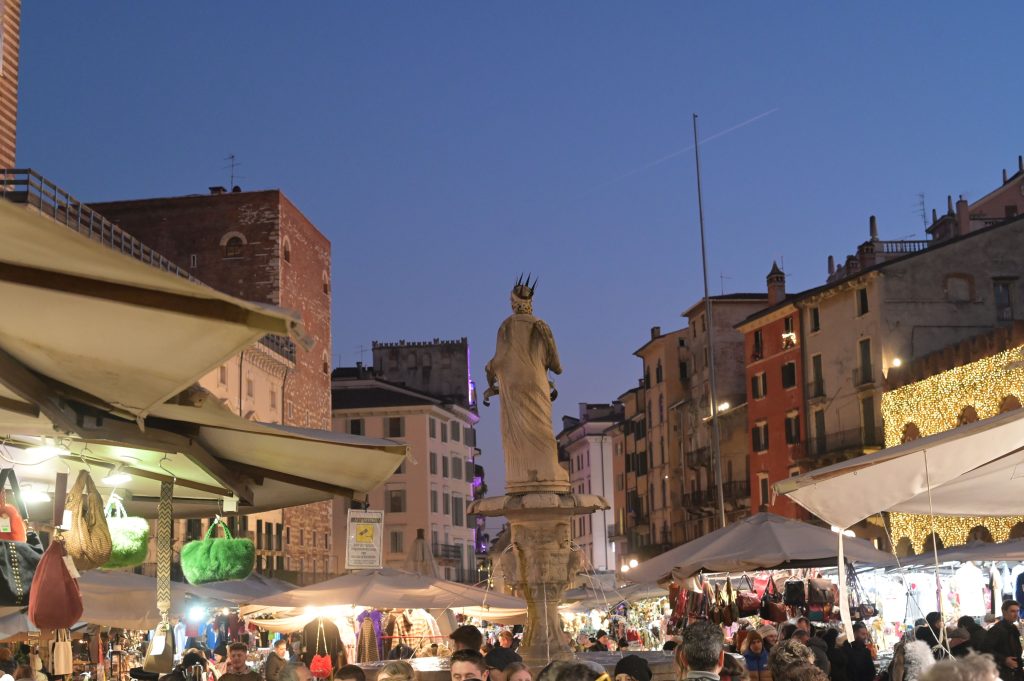
Verona is best known as the home of Romeo and Juliet, but December suits it just as well. A giant steel comet rises out of the Roman Arena, wooden chalets fill the square below it, and the smell of mulled wine drifts down the side streets. This is also the city where pandoro was born, so the bakery windows are stacked with tall, star-shaped cakes dusted in sugar.
The centre is compact and flat, and almost everything you’ll want to see at Christmas sits within a ten-minute walk of the Arena. It’s also close enough to Venice and Milan to visit for a day.
The Christmas market in Piazza Bra
This year’s market runs from 20 November to 27 December 2026. The main cluster of wooden chalets stands in Piazza Bra, the wide square in front of the Arena, selling glass and wooden decorations, knitwear, local food and small gifts.
The stalls open every day from mid-morning and stay open into the evening, later on Fridays and Saturdays. Christmas Eve and Christmas Day have shorter hours.
Weekday afternoons are the calmest time to browse. On Friday and Saturday evenings the square is packed, and the queue for vin brulè, Italian mulled wine, can wind back between the chalets.
The market spreads into two other squares this year. Piazza dei Signori, the quiet medieval square next to Piazza delle Erbe, has a smaller village of decorations and gift stalls. Down by the river, Piazza Sacco e Vanzetti has an ice rink in front of the old Austrian Arsenal, with the Castelvecchio bridge across the water.
The star over the Arena
The picture most people take home from Christmas in Verona is the comet. A huge steel star rises from inside the Arena, and its tail arcs out over Piazza Bra, lit up after dark. The architect Rinaldo Olivieri designed it for the city’s first international nativity exhibition in 1984. It was meant to stand for that one season, but it has returned every December since. The structure is around 40 metres high and weighs about 80 tonnes.
The star is at its best after dark. In December the sun sets at around half past four, so the lights are on by late afternoon.
The nativity exhibition that started it all still runs. Presepi dal Mondo gathers nativity scenes from museums, collectors and artists around the world, from elaborate Neapolitan scenes to small figures carved in wood. It runs from mid-November to mid-January and opens every day, holidays included. Allow an hour or so, and keep it in mind as an indoor stop if the weather turns.
Santa Lucia comes first
In Verona, many children open their presents on 13 December, well before Christmas Day. Local tradition says Santa Lucia rides through the city on her donkey on the night of the 12th, leaving sweets and gifts for good children and coal for the ones who misbehaved. Before bed, families put out a little food and some straw for the donkey.
In the days leading up to the 13th, Piazza Bra and Via Roma fill with the stalls of the Santa Lucia fair. Traders come from all over Italy to sell sweets, toys, handmade goods and regional food. It feels different from the Christmas market: busier, louder and very much aimed at children.
If you can, plan your visit for the second week of December. The fair’s exact dates are confirmed nearer the time, so check with the Verona tourist office before you book. Come that week and you get the Christmas market, the star and Santa Lucia in a single trip.
What to eat and drink
Pandoro is Verona’s cake. It’s tall and star-shaped, light and buttery inside, and served under a thick dusting of icing sugar. Its ancestor is the nadalin, an older Veronese Christmas bread that is also star-shaped but flatter, and topped with icing and almonds. In 1894 the Veronese baker Domenico Melegatti patented pandoro, baking it in moulds designed by the painter Angelo Dall’Oca Bianca. The city’s pastry shops sell both in December, and the nadalin is the one you’ll struggle to find anywhere else.
For something savoury, look for pearà, a peppery sauce of breadcrumbs, beef marrow and broth. Veronese families serve it with boiled meats and cotechino sausage over the holidays, and traditional trattorie keep it on the menu through the winter.
At the market, vin brulè is the standard warm drink, often poured into a Verona Christmas mug you can take home. Bombardino, a hot mix of egg liqueur and brandy topped with whipped cream, is the stronger choice. Verona also sits at the edge of the Valpolicella wine region, so a glass of Valpolicella or Amarone with dinner is an easy way to end a cold evening.
Making a day of it
Verona is an easy day trip from Venice or Milan. Fast trains reach Verona Porta Nuova in a little over an hour from either city, and slower regional trains cost less if you have the time. From the station, Piazza Bra is a 20-minute walk straight up Corso Porta Nuova.
Arrive in the early afternoon, find somewhere to leave your suitcase near Porta Nuova, and walk up to the Arena with time to browse before the lights come on. Spend the late afternoon at the nativity exhibition, or wander over to Piazza delle Erbe and Piazza dei Signori. Then head back to Piazza Bra once it’s dark to see the star lit up.
Weekdays are quieter than weekends, especially in the last fortnight before Christmas. Restaurants around the Arena fill up on December evenings, so book a table if you’re staying for dinner. Pack warm layers too: Verona sits in the Po Valley, and its winter evenings are cold and often damp.
By the time you board the train home, you’ll have stood under a star rising out of a Roman amphitheatre, eaten pandoro in the city that invented it, and probably bought a decoration or two you hadn’t planned on.
Author

Written by
Recent Posts
Layered Lighting and Fire Features Are Extending Outdoor Entertaining Well Past Sunset
Christmas in Verona
Best family cars and SUVs for Chicago winters
Beyond Rental Income: How to Protect the Long-Term Value of an Apartment Building
The art of everyday carry: choosing a phone case that balances personal style and practicality
Categories
- Art
- Articles
- Business of Luxury
- Celebrities
- Culture
- Entertainment
- Events
- Faces of Summer 2026
- Fashion
- Fashion & Style
- Featured
- Finance
- Food, Spirits, Wine
- Hamptons
- Hamptons Celebrities
- Health
- Health & Beauty
- Lifestyle
- Luxury Lifestyle
- Press
- Profiles
- Real Estate
- Technology
- The Chronicles
- Travel
- Uncategorized
- Weddings