
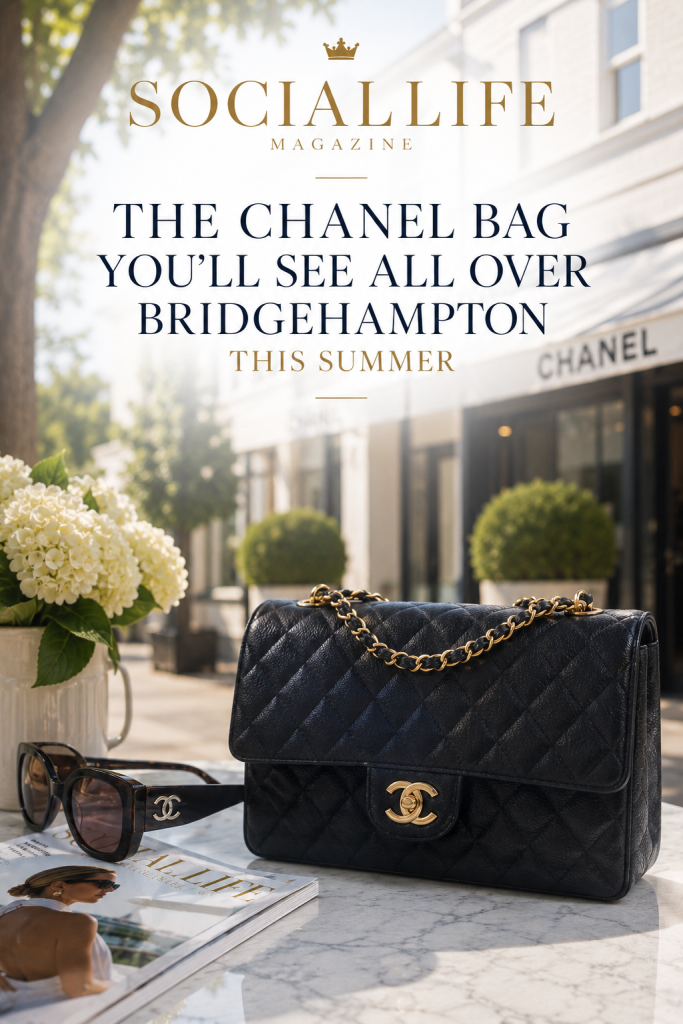
Every summer one bag wins. Not in a magazine, and not on a runway, but in the only arena that counts out here, the forearms of the women crossing the lot at the Bridgehampton farmers market on a Saturday in July. The Hamptons summer bag is never an accident. It is a decision the whole season reads in a glance, and this year the decision has already been made. The loud status bag is out. The quiet one, the one that barely announces itself, is the only thing carrying real weight.
This is a shift worth understanding if you sell bags, or if you simply want to read the room correctly when you arrive. The logic that picks the winning bag is the same logic that runs everything else on the East End. It rewards restraint, punishes effort, and hands its loyalty to whoever understands the difference.
The Tote That Replaced the Status Bag
For a decade the move was the hard-sided status bag, the one with the recognizable hardware and the resale value. It signaled arrival, and arrival was the point. But the room has moved on, because arrival is no longer interesting once everyone has arrived.
The bag that replaced it is softer, plainer, and somehow more expensive to read. A structureless leather tote in a quiet tan. A canvas carryall with leather handles worn pale at the grip. These bags do not shout a brand. Instead they reward the person who already knows, which is exactly the audience that summers here.
Specifically, the winning bag this year is the one that looks like it has been owned for years. Patina beats polish. A little slouch beats a stiff structure. Think of the Chanel flap that reads correctly out here, not the box-fresh seasonal color but the classic caviar in quiet black or beige, softened by a few summers and clearly earned rather than just bought. The woman carrying it is not trying to tell you she just bought it, and that restraint is the entire flex.
Why the Logo Lost
The logo lost because the logo got crowded. When every newcomer can buy the same monogram, the monogram stops sorting anyone. It becomes a floor, not a ceiling, and the Hamptons have never been interested in floors.
So the fluent buyer retreated to the pieces a logo cannot help. A bag with no visible name forces the observer to actually know, which restores the sorting the logo used to do. Knowing is the new luxury, and knowing cannot be counterfeited at a highway outlet.
There is a deeper read here too. A visible logo tells the world what you spent. A quiet bag tells a narrower world who you are, and the narrower world is the only one that matters at a Sagaponack dinner. The brands that grasp this stopped enlarging their logos years ago. The brands still chasing recognition are quietly losing the customer they most want.
How the Trend Reaches the Forearm
The winning bag does not appear out of nowhere. It travels a predictable route, and watching that route is how a brand sees the wave before it breaks. The trend starts on screens, in the bag everyone clocked on a celebrity at the airport, in the slow churn of what people carry in the videos they cannot stop watching.
From there it migrates to the front row, then to the editors, then to the women who summer here and quietly set the local tone. By the time a bag reaches the Bridgehampton lot, it has been filtered three times, sanded down from a statement into something wearable. The Hamptons rarely invent the trend. Instead they ratify it.
This is useful intelligence if you sell bags. The forearm is a lagging indicator of a conversation that began months earlier and somewhere far louder. Watch that conversation, place the product into it early, and you arrive at the lot already approved. Arrive late and you are merely the bag everyone already decided against.
The Canvas Rule
Canvas is the season’s quiet code, and it confuses people who assume luxury must mean leather. Out here a beautiful canvas tote from a serious house can outrank a five-figure leather bag, because canvas reads as ease and ease is the whole aesthetic.
The canvas bag says you are headed to the beach, the market, the boat, somewhere a precious bag would be absurd. Yet the canvas in question is rarely cheap. It carries the same quiet pedigree as everything else, just dressed down on purpose. That deliberate down-dressing is a flex only the secure attempt.
By contrast, the anxious buyer protects the expensive leather bag like a relic, and the protection gives the game away. Real fluency treats a fine bag like a tool, not a trophy. A scuff is proof of life. A pristine bag, two summers in, quietly admits it never went anywhere worth going.
The Price Nobody Says Out Loud
Money is the loudest thing nobody discusses out here, and the bag is where the silence gets expensive. A quiet canvas tote can run twelve hundred dollars and look like nothing. A soft leather carryall climbs past five thousand and still refuses to announce itself. The point of the spend is to make the spend invisible.
This inverts the usual logic of price. In most markets a higher price wants to be seen, because the seeing is the reward. Here the higher price wants to vanish, because vanishing is the more advanced move. The bag that costs the most is often the one a stranger would price the lowest, and that gap is the entire game.
A brand should sit with that gap before it sets a Hamptons strategy. The customer out here is not paying for recognition. Rather she is paying for the confidence of not needing it, which is a far more durable thing to sell. Price the quality in, design the noise out, and you have built exactly the object this market rewards.
The Straw Bag Has a Season
Straw belongs to a narrow window, and the window is policed. A good straw bag, the handwoven kind that looks collected on a trip rather than bought at a shop, peaks from late June through August. After that it reads as a costume.
The straw bag works because it carries a story without a word. It implies a market in the south of France, a house someone keeps in Mallorca, a life that travels lightly and well. That implied story is the product, far more than the bag itself.
Still, straw has a strict ceiling. It does not cross into evening, and it does not survive the city. Carry it to a gallery dinner and you have misread the moment. Reading these small seasonal clocks is the difference between fluent and merely funded, and the room notices both.
The Beach-to-Dinner Test
Every great Hamptons summer bag passes one test. It has to move from the beach to dinner without changing character. The day is loose and salt-stained out here, so a bag that only works in one register is a bag that fails by sundown.
The winners share a few traits. They are large enough to swallow a towel and a bottle of rosé, yet refined enough to set on a restaurant banquette without apology. They are unprecious enough for sand, but never cheap. That balance is rare, and rarity is what the fluent buyer pays for.
This is also the trait a brand should chase if it wants the forearm. Build the bag that survives the whole day, because the whole day is the actual life out here. A bag for one occasion gets bought once. A bag for the entire summer gets carried until it becomes part of the person, and that is the bag the room remembers.
What the Bag Says About the Woman
A bag is shorthand, and out here everyone is reading shorthand all day. The right Hamptons summer bag announces a specific kind of woman before she says a word. She has tenure. Her taste predates the trend. And she does not need you to know what she spent.
The wrong bag announces the opposite just as loudly. Too new, too logoed, too carefully protected, and the read flips to someone performing a life rather than living it. The performance is not a crime, but it is legible, and legibility is the thing the fluent most want to avoid.
This is why the bag decision carries weight far past the bag. It is a small, portable thesis about who someone is, carried into every room she enters. Get it right and the room relaxes around her. Get it wrong and the room, politely, files her elsewhere.
The Inside Tells the Truth
Open a bag and the truth spills out, which is why the inside is its own quiet status test. The fluent bag is never crammed. It holds a few good things, chosen rather than accumulated, the way a confident closet holds fewer pieces than an anxious one.
A single fine lipstick, a worn leather card case, sunglasses that cost more than the outfit, a set of house keys on a plain ring. Notably, there is no clutter, no fistful of receipts, no overstuffed chaos. The restraint inside mirrors the restraint outside, because the two are the same instinct expressed twice.
This matters to a brand more than it first appears. The interior is where craft actually lives, in the lining, the stitching, the way a bag wears its years on the inside first. Build an interior that ages with grace and you have built loyalty, since the owner meets that quality every single time she reaches in.
The Men Carry Too
The bag conversation is not only a women’s conversation, though the men like to pretend otherwise. A man out here carries something, and what he carries gets read just as closely. The backpack is the one true mistake, a commuter’s object that drags the city straight onto the beach.
Instead the fluent man reaches for a worn leather holdall, a canvas weekender, or a simple carryall he would never call a tote. The bag should look like it has made the trip many times before. New luggage betrays a new arrival exactly the way a new shoe does. Patina, once again, is the password.
There is real room here for any house that makes men’s leather goods. The men’s market out here stays underserved and quietly hungry, full of buyers who want the right object but refuse to be sold one obviously. Make the bag that ages well, keep the branding nearly silent, and the same word of mouth that moves the women’s bags will move yours.
The Brands Quietly Winning the Forearm
Here is the part that should interest any leather-goods house plotting a Hamptons season. The forearm is not won with a billboard. It is won with placement, with the right bag on the right shoulder at the right Friday dinner, and with the patience to let the room do the talking. A heritage house like Chanel wins exactly this way. The flap earns its place by tenure, never by shouting a name.
A brand that lands one bag on one tastemaker in June can watch it spread by recommendation through July. That spread costs nothing and converts better than any campaign, because it arrives as a friend’s endorsement rather than an advertisement. The Hamptons run on exactly this kind of organic proof.
So the smartest play is not the loudest. Place the bag where the residents already gather, let it earn its scuffs in public, and become the name the room passes along. That is how a bag becomes the bag, and that is the seat worth buying out here. We make introductions like this for a living.
Where The Conversation Continues
The bag is one fluent sentence in a much longer language. To read the rest, start with the full status map in our pillar on the Hamptons summer style codes money can’t fake, then go deeper on decoding quiet luxury in the Hamptons and the companion read on the watch that says Hamptons without saying a word. The room is already carrying its decision. The only question left is whether your brand is the one on the forearm or the one watching from the lot.
Author

Written by
Recent Posts

AI for personal finance: where PennyGuard fits
How to Pick a Homecoming Dress for Your Body Type (and Feel Amazing in It)

World Cup Injury Attorney for Vancouver Events
What a 3-Carat Engagement Ring Actually Costs in 2026: The Real Numbers
The Skincare Habits That Make a Real Difference Over Time
Categories
- Art
- Articles
- Business of Luxury
- Celebrities
- Culture
- Entertainment
- Events
- Faces of Summer 2026
- Fashion
- Fashion & Style
- Featured
- Finance
- Food, Spirits, Wine
- Hamptons
- Hamptons Celebrities
- Health
- Health & Beauty
- Lifestyle
- Luxury Lifestyle
- Press
- Profiles
- Real Estate
- Technology
- The Chronicles
- Travel
- Uncategorized
- Weddings