
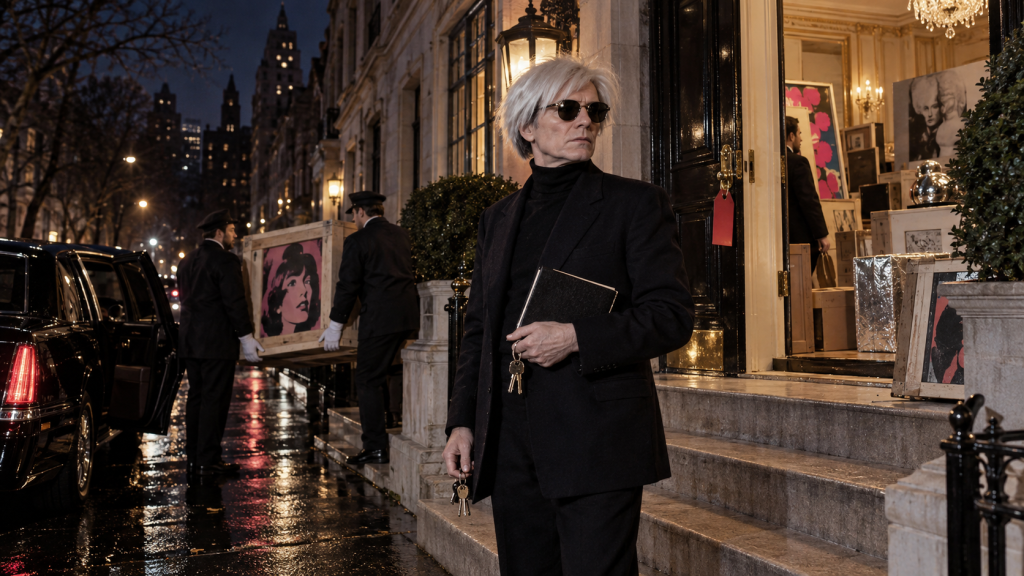
Most rooms that cite Warhol are citing permission. He did something colder. He let money lead and kept a sentence that still traded after the Factory closed.
That is why he is the stress test for Hyde’s gift and for the two contracts. Hyde says the gift must arrive first. Warhol made the invoice part of the surface. The gift did not vanish. It changed address.
The Compound Was a Sentence
Eothen in Montauk cost $225,000 in 1971. Mickey Drexler paid $27 million in 2007. The listing later asked $85 million. Adam Lindemann closed the 5.7-acre compound in 2015 for $50 million, then the most expensive residential sale in Montauk, and said he had known Andy in the early 1980s and collected the work. He bought a house and a line. The line was the premium.
Comparable oceanfront without that sentence does not clear the same number. Provenance here is not a barn floor. It is a guest list that became a market.
| Year | Price | What actually traded |
|---|---|---|
| 1971 | $225,000 | Compound + access to a working myth |
| 2007 | $27 million | J. Crew CEO buys the myth intact |
| 2015 list | $85 million | Ask for the sentence at peak volume |
| 2015 close | $50 million | Collector-dealer buys the line about knowing Andy |
The live Eothen feature carries the property path. This page carries the contract.
Money as Medium
Warhol’s intelligence was not “selling out.” It was refusing the official story that the market and the work could not share a surface. Editions, portraits on commission, the Factory as production — those are artisan structures. The sentence that survived is artist residue: you cannot look at the object without looking at the price weather around it.
Isabelle Graw later called that weather celebrity culture. Warhol got there early. Collectors who use him as cover for a chimney-breast PDF are doing the artisan half without the sentence. That is not Warhol. That is a brief with better merch.
Further Lane still lives next to this logic. Gagosian’s house is not Eothen. It is the dealer version of bilingualism: chapel face, arithmetic fluency. How collectors buy art needs both addresses.
Decoder
- If you cite Warhol to justify a brief-first object with no remaining sentence, you borrowed the permission and left the method.
- If the premium is a story about having known him, you bought row three of the pillar table.
- If the work still makes the price visible as content, money led and the gift found a new door.
What He Actually Did
Warhol’s portraits on commission are artisan structures. The sitter paid. The size was known. The Factory produced. That is Collingwood’s craft with better lighting. The intelligence was putting the invoice on the surface so nobody could pretend the chapel and the calculator were strangers.
Hyde says the gift arrives first. Warhol made the market visible as content. The gift did not vanish. It moved into the social fact of being seen wanting to be seen. Collectors who use that history as cover for a chimney PDF are taking the artisan half and leaving the sentence.
Eothen’s price path is the residential version of the same move. Two hundred twenty-five thousand in 1971. Twenty-seven million in 2007. Fifty million in 2015 for the compound Lindemann closed after an eighty-five million ask. He said he had known Andy in the early eighties. The sentence was the premium. Comparable oceanfront without that sentence does not clear the same number.
Factory Logic, East End Time
Further Lane still lives next to this logic. The dealer who lives among collectors is bilingual. Chapel face. Arithmetic fluency. Citing Warhol at a Saturday lunch to justify a matched interior is not bilingualism. It is a borrowed alibi.
Editions, repeating images, the conversion of a face into inventory: those are production decisions. They can still carry a gift if something in the repetition remains unearned. Most repetition now is just inventory. The difference is whether the work makes you look at the price weather as part of the object. If it does not, you do not have Warhol. You have supply.
Decoder additions
If the premium is a story about having known him, you bought row three, the work still makes the price visible as content, money led and the gift found a new door. If you needed Warhol’s name to bless a brief, you borrowed permission and left the method.
Mickey Drexler’s chapter matters because a retailer recognized a brand. Lindemann’s chapter matters because a collector-dealer recognized a sentence. Two different purchases of the same acreage. The live Eothen feature on this site carries the property path. This page carries the contract.
FAQ
Is Warhol a rebuttal to Hyde? He is the stress test. The gift changed address.
Can a living artist copy the move? Only if the market-on-the-surface is actually the content, not an excuse.
What did Lindemann buy? A house and a line. Price the line separately in your own head.
Aura After the Factory
Walter Benjamin’s aura is the usual academic guest at this table. Warhol spent a career showing how aura could be manufactured, sold, and still sting. The Montauk house later sold aura as real estate. That is not a contradiction. It is the method leaving the studio and entering the listing.
Collectors who own Warhol now own weather as much as they own silk screens. The weather is public. Dining-room speeches about intimacy with Andy are row-three purchases. Dining-room silence in front of a good screen is rarer and more useful.
The Factory also trained a generation to treat production help as invisible. Hands other than Andy’s were in the work. Same hands, different master, again. The master was a system that could print a face until the face became a market.
Do not use that history to mistreat living studios. Use it to see systems. If your painter has an assistant and a PDF, you may be closer to Factory craft than to Springs solitude. That can be fine. Name it.
Extra FAQ
Did the house make the work more expensive? The sentence did. The house carried the sentence.
Should estates trade on visits? They already do. Price the visit as pilgrimage, not as a certificate.
Collecting After Permission Became Cheap
Once Warhol made money visible as content, every later room wanted the permission. Permission is now the cheapest part of the inheritance. The expensive part is still making a sentence that survives a quiet year.
Look at a late portrait. Ask whether you are seeing a person or a product line. Both can be true. If you can only see the product line, you are in inventory. If you can only see the person, you are performing chapel. Warhol asked you to hold both. That double hold is the method.
Montauk added geography to the product line. The end of the island became a caption. Captions trade. Houses trade. The hour in the Factory does not trade, which is why people keep buying captions.
Living painters who run studios like small factories should be paid like factories when that is the contract, and like artists when a veto is real. Mixing the two without saying so is how assistants disappear from stories and PDFs put on Factory glamour they did not earn.
A collector can own the work and still fail the method by hanging it as lifestyle. Lifestyle is artisan display. The screen can survive that hanging. Your sentence cannot.
A Quiet-Year Test for a Warhol
Take the work off Instagram. Take Andy out of the first sentence. What remains on the surface. If the answer is a product line you already know by heart, you are buying weather. If the answer is a specific screen, a specific damage of color, a specific deadpan, you may be buying a work.
Then put the sentence back. Does the Montauk caption change what you see, or only what you can say. Captions that only change speech are row three. Captions that change seeing are rarer.
Compare insurance value, last public print, and the number you would tell a guest. If those three cannot sit in one paragraph without embarrassment, you do not yet have a price. You have a cluster of dialects. That is normal. Name the dialects before you hang the work over a hedge-facing sofa.
The method survives only if you keep the cold part. Money can lead. A sentence can remain. Most rooms keep the leading and drop the sentence. Do not be most rooms.
The CassWorld Take
Warhol is useful only if you keep the cold part: money can lead and still leave a sentence, but most rooms keep the leading and drop the sentence. Dealers and founders who understand that difference can reach Social Life at the contact page or submit a paid feature; the list, Polo Hamptons 2026, and the print subscription are the summer version of that weather. Written by CassWorld. Cass Almendral is Head of Business Development at Social Life Magazine and Co-Founder of Polo Hamptons. Reach editorial at [email protected].
Author

Written by
Recent Posts

Sculpting Chic

Inside the Year-Round Hot Yoga Spot Quietly Becoming the Hamptons’ Real Club

How to Choose Useful Tech Gifts for Employees and Clients in 2026
The Garage Question: Which Car Goes South for the Season?

VandS Clinic Review Treatment: How Seoul Injectable and Laser Options Compare for US Patients
Categories
- Art
- Articles
- Business of Luxury
- Celebrities
- Culture
- Entertainment
- Events
- Faces of Summer 2026
- Fashion
- Fashion & Style
- Featured
- Finance
- Food, Spirits, Wine
- Hamptons
- Hamptons Celebrities
- Health
- Health & Beauty
- Lifestyle
- Luxury Lifestyle
- Press
- Profiles
- Real Estate
- Technology
- The Chronicles
- Travel
- Uncategorized
- Weddings