
Your skincare routine was built for one address. If you split the year between South Florida and New York, Boston, Chicago or Canada, it now has to work at two.
The sun is the first reason it often doesn’t.
The EPA’s long-term UV averages put South Florida at a UV index of about 5 in January. In New York, Boston and Chicago, the January average is closer to 1 or 2. Toronto and Montreal sit farther north still.
Add a dry flight, humid air outside and air conditioning inside, and the cream that worked in October can feel wrong by December.

Why the Northern Routine Stops Working
Back home, the heat is on, whether the winter outside is a Boston nor’easter, a Chicago wind or a Montreal freeze.
Heated indoor air is dry. Skin loses water faster in dry air, which is why so many faces feel tight by evening in November. On the plane, cabin air is drier still.
Then comes South Florida. The air outside is milder and more humid than a northern winter, and almost every room is air-conditioned. Your skin now moves between warm air outdoors and cool, drier air indoors, several times a day.
The rich cream that rescued your skin from radiator heat can feel heavy in Palm Beach humidity. In some faces, it starts to show up as congestion around the nose and chin.
Air conditioning also lowers indoor humidity. So for some people, the surface looks shiny while the skin underneath feels tight.
That mix doesn’t match a single “skin type.” You don’t have one skin anymore. You have a skin that changes with the address.
Is the Winter Sun in Florida Really a Problem?
Yes. On the EPA’s scale, a reading of 3 or more means sun protection is needed, and South Florida’s January average sits above that.
A lunch on a terrace in Boca Raton counts as sun exposure. So does an afternoon of tennis, a walk along Worth Avenue or a morning on the Hollywood Beach Broadwalk.
The risk grows if your routine includes exfoliating acids or a retinoid. Both can make skin more sensitive to the sun. The FDA recommends a sunburn alert on alpha hydroxy acid products for exactly that reason.
What to Change in the South Florida Bathroom
None of this calls for a new shelf of products. A few small changes usually cover it:
- Lighten the day cream. A lotion or gel often sits better in humidity than a rich northern cream.
- Make sunscreen a daily habit. The American Academy of Dermatology recommends a broad-spectrum, water-resistant sunscreen with SPF 30 or higher.
- Keep the retinoid at night. Pair it with sunscreen every morning, and ask your dermatologist before layering it with acids.
- Watch the chin and nose. New congestion can be a sign the routine is too heavy for the climate.
- Pack the hat. A wide brim does work that no serum can.
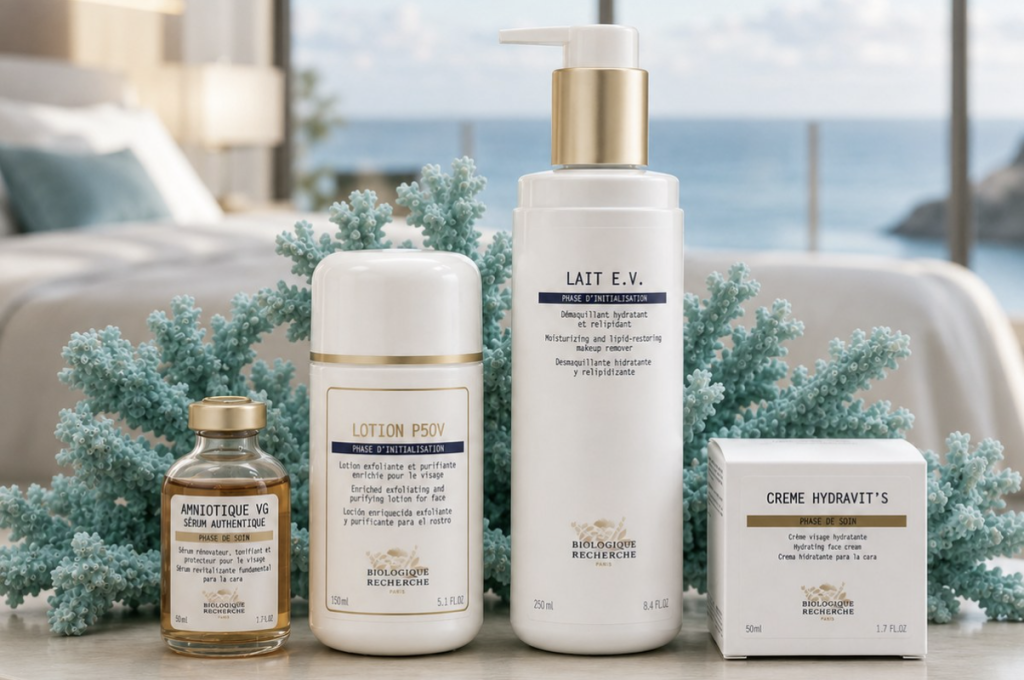
Why a Facial That Starts Fresh Fits a Two-House Life
This is where Biologique Recherche, the French skincare house, makes sense for people who split the year. Its method starts from one idea: treat skin as it is on the day. The brand calls the state of your skin at a given moment its Skin Instant©.
A trained aesthetician assesses it at the start of each visit, with questions and a hands-on reading of the skin. The facial is then built from concentrated treatment steps the brand calls boosters, chosen for what the skin needs that day. The facial you get in November may look nothing like the one you get in February.
For skin that travels between a heated city apartment and a Florida winter, that is the appeal. Even the brand’s iconic exfoliating lotion, Lotion P50, comes in several versions for different skin conditions.
What the First Facial of the Season Looks Like
It starts with questions and a close look. Expect to be asked about the flight, the products you brought, any recent procedures, prescription skin medications or pregnancy, and how your skin has felt since you arrived.
Then comes the reading of the skin, done by touch as much as by sight. From there, the steps vary. Lotion P50 is often part of the treatment, and because it exfoliates, sunscreen matters even more for the week after.
The boosters are layered in and worked into the skin with a precise manual technique, which is a large part of the method. Some people leave a little flushed. It is temporary.
Men are welcome too. Biologique Recherche facials can be adapted for men’s skin, which helps in households where both partners make the trip south.
How to Find a Real Biologique Recherche Provider
Biologique Recherche treatments are available only through Biologique Recherche-certified providers. The brand keeps an official provider locator on its website, and it is a quick way to check a spa’s claim before you book.
Once you find one, three questions help.
Is every aesthetician trained in the method, or only one specialist? Do they assess your skin before choosing a protocol? And how do they adjust treatments for the local climate?
In Hallandale Beach, for example, Bogat Aesthetics & Wellness is listed on the brand’s locator, and every aesthetician on the team is Biologique Recherche-trained. The team adjusts its Biologique Recherche facials in South Florida for sun, humidity and salt air, which matters for skin that arrived from the north.
Timing It Around the Season
Book the first facial within your first couple of weeks south, once the travel dryness has settled. It gives the aesthetician a clear read on how your skin is handling the move.
To build results, a facial every three to four weeks is a common rhythm. Before a gala or a big dinner, book five to ten days ahead, so your skin has time to settle.
One rule doesn’t change with the season. A facial is not a skin check. Any spot that is new, changing or bleeding should be seen by a dermatologist first.
Before you fly north in spring, book one last visit. Ask the aesthetician to adjust your at-home routine for the return trip, because the radiator season will be waiting.
Nobody wears a Chicago winter coat to a Palm Beach lunch. Your skin shouldn’t wear one either.
Author

Written by
Recent Posts
The Two-House Face: What Your Skin Needs When You Winter in South Florida
The Hamptons Summer Beauty Guide: Staying Smooth From Beach Days to Nights Out

Dressing the Event: Custom Embroidered Apparel for Galas, Club Weekends and Charity Drives
What Spring Harvesting Means For Artisanal Green Tea
How to Grill Thick Greek-Style Flatbread Properly
Categories
- Art
- Articles
- Business of Luxury
- Celebrities
- Culture
- Entertainment
- Events
- Faces of Summer 2026
- Fashion
- Fashion & Style
- Featured
- Finance
- Food, Spirits, Wine
- Hamptons
- Hamptons Celebrities
- Health
- Health & Beauty
- Lifestyle
- Luxury Lifestyle
- Press
- Profiles
- Real Estate
- Technology
- The Chronicles
- Travel
- Uncategorized
- Weddings