
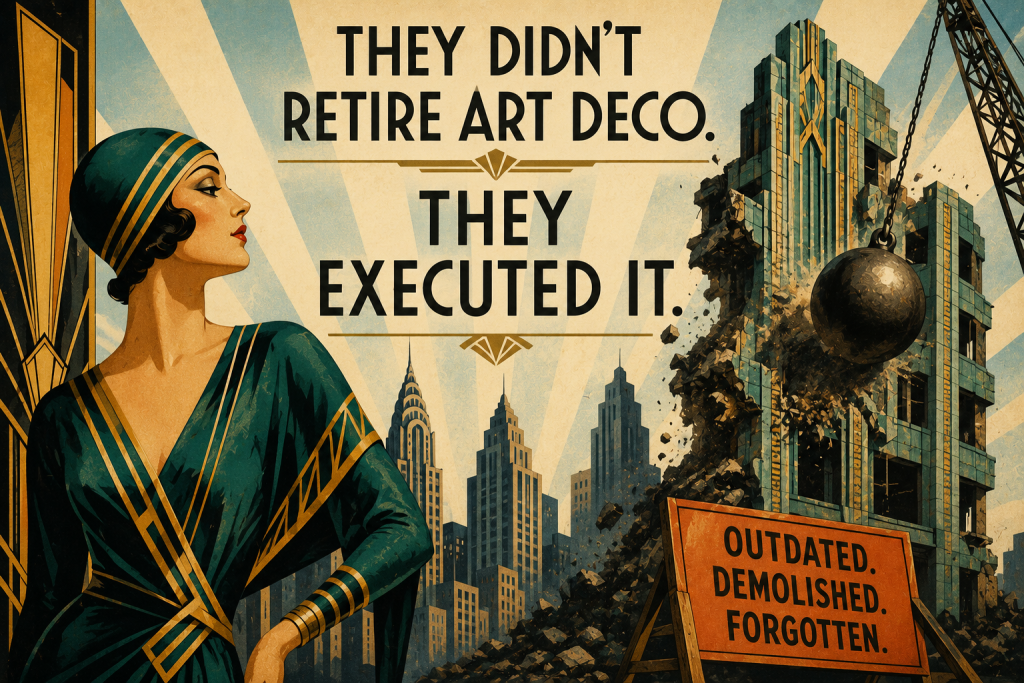
The most confident style of the twentieth century did not die of old age. It was killed, deliberately, by people who decided that beauty was a kind of lying. The Art Deco revival we are living through now is really an argument with that verdict. It is a long-delayed objection from a culture that misses agreeing on what the future should look like. To understand the comeback, you first have to understand the murder.
The standard story says Deco simply faded, the way trends do. That story is too gentle. What actually happened was an execution carried out in the name of progress, and we have lived in the aftermath for almost ninety years. The good news, for anyone who loves a sunburst, is that the verdict is finally being appealed.
When Ornament Became Obscene
The Depression changed the moral math of decoration. In 1929 a gilded skyscraper read as triumph. By 1932, with men selling apples on the sidewalk, that same gold read as insult. Ornament had not changed, but the audience had, and suddenly the joy of the 1920s looked like a tasteless joke.
Budgets collapsed alongside the mood. Developers could no longer afford bronze gargoyles and hand-laid mosaics, even if they had wanted them. So the conditions were set for a cheaper, sterner idea of what a building should be, and that idea was waiting in the wings.
The Style That Replaced It
The rival was Modernism, specifically the International Style. Its champions preached a hard gospel, since they believed ornament was dishonest and that a building should express only its structure and function. Glass, steel, and concrete in clean right angles became the new virtue.
The famous slogan was that less is more. The buildings got bare, and the bareness got rebranded as truth. A movement that started with moral seriousness hardened into a rule, and the rule had no room for a chevron or a sunburst anywhere.
The Takedown of the Chrysler
The shift was already underway in the criticism. As early as 1931, the influential critic Lewis Mumford dismissed the Chrysler Building as a series of restless mistakes. The most romantic tower in America was being written off as vulgar almost before its paint dried. That was the future talking, and the future had decided gold was over.
Living in the Absence
We have inhabited the result ever since. Look at most buildings raised since 1950 and notice what they refuse to do, which is decide what the future should look like. They are efficient, rentable, and mute. They make no promise and tell no story.
That silence has a cost we rarely name. Art Deco gave ordinary people a shared visual language of optimism, a sense that the machine age was building toward something glorious. Modernism took the optimism and kept the machine. The glory left the room, and most of us never noticed the door closing.
The Long Road Back
Deco never fully disappeared, of course. It waited. In the 1960s the style enjoyed a revival, and that is when it finally got its name, pulled from the 1925 Paris fair that started everything. Preservationists fought to save the towers that the wrecking ball had marked, and slowly the public fell back in love.
The Chrysler Building won landmark protection in the 1970s. Radio City was saved from demolition around the same time. What had been dismissed as vulgar excess was reclassified as national treasure, since a generation finally admitted it missed the beauty.
Why It Is Surging Now
The current revival runs deeper than nostalgia. After decades of disposable minimalism and identical glass boxes, the culture is hungry again for permanence, craft, and a point of view. Designers are reaching back for the geometry, the rich materials, and the sheer nerve of the original. In fashion, interiors, and hospitality, the sunburst is everywhere once more.
What the Comeback Means for a Brand
Here is the strategic reading for anyone building a name on the East End. The Deco revival is a market signal. It tells you people will pay a premium for things built to last and meant to be loved. Minimalism whispered that you should want less. Deco insists you deserve more.
A brand that wants relevance in the Hamptons should study that insistence. The audience that summers here is exhausted by sameness and starved for glamour with a backbone. The full story of how that glamour conquered a culture lives in our pillar on the last future we agreed on. Its cathedral appears in the race to the sky. Its ballrooms fill Radio City and café society, and its local gamble plays out in Carl Fisher’s Montauk.
Where The Conversation Continues
Art Deco was killed for believing the future should be beautiful. Now that belief is winning again, and the brands that move first will own the moment. Social Life Magazine has spent twenty-three summers tracking which aesthetics rise and which ones quietly date the people who chose them.
If you want to be early to the comeback instead of late to it, this is the room to be in. Join the list at sociallifemagazine.com. Become a patron of the archive here. A yes is a place at the front of the revival. A no is another glass box nobody remembers.
Author
Written by
Recent Posts

Sculpting Chic

Inside the Year-Round Hot Yoga Spot Quietly Becoming the Hamptons’ Real Club
How to Choose Useful Tech Gifts for Employees and Clients in 2026
The Garage Question: Which Car Goes South for the Season?
VandS Clinic Review Treatment: How Seoul Injectable and Laser Options Compare for US Patients
Categories
- Art
- Articles
- Business of Luxury
- Celebrities
- Culture
- Entertainment
- Events
- Faces of Summer 2026
- Fashion
- Fashion & Style
- Featured
- Finance
- Food, Spirits, Wine
- Hamptons
- Hamptons Celebrities
- Health
- Health & Beauty
- Lifestyle
- Luxury Lifestyle
- Press
- Profiles
- Real Estate
- Technology
- The Chronicles
- Travel
- Uncategorized
- Weddings