
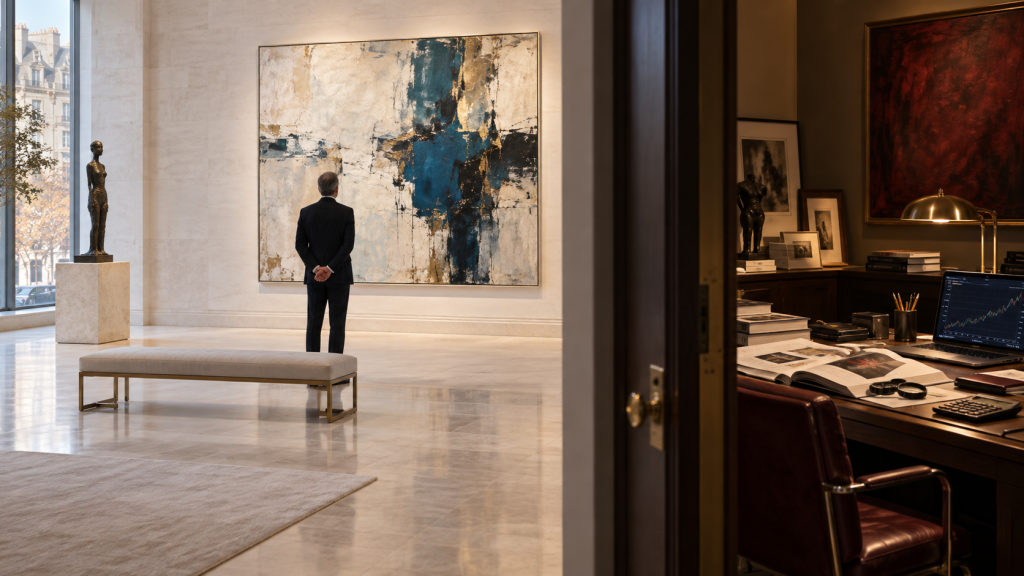
Phillips Southampton occupies the old town hall. Bridgehampton stacks six galleries in four blocks. In the good rooms the front is still performing non-commerce: white wall, quiet voice, no calculator. Six steps back, or downstairs, or on a later call, the arithmetic happens. Olav Velthuis sat with dealers in New York and Amsterdam and wrote the ritual down. The split protects the artist from looking like inventory and protects the collector from looking like a shopper. Both parties need the theater.
What a price says in a dining room is the dinner version. This is the gallery version.
Why the Ritual Exists
A price is not only a quantity. It says who bought first, whether a discount would stain the artist, and who is allowed into the next allocation. Speak it too early and you collapse the chapel into a store. Speak it never and you are hiding a stall.
| Move | Where it belongs | What it announces |
|---|---|---|
| Silence beside the work | Front | The object is not a toaster |
| Number on a later call | Back | You have been admitted |
| Fast discount in front | Mistake | The work is not moving or the ritual is dead |
| “It’s going to the Parrish” | Either, carefully | Row four, not row five |
Gagosian living on Further Lane is the residential rhyme. The person who knows the back-room number also knows how to keep the front-room face. Bilingualism is the status.
Decoder
- If they quote you in front of the work without flinching, the chapel is already a store. Price accordingly.
- If they will not quote you at all, you have not been admitted or the work is not for you.
- If the discount arrives before the sentence, someone is unprotected.
Why the Building Is Split
A price is not only a quantity. It says who bought first, whether a discount would stain the artist, and who is allowed into the next allocation. Speak it too early and you collapse the chapel into a store. Speak it never and you are hiding a stall.
The front room performs non-commerce so both parties can keep their faces. The collector does not want to look like a shopper. The dealer does not want the artist to look like inventory. Six steps back, the arithmetic happens. Everyone in the good rooms knows this. Pretending not to know it is part of the ritual.
Phillips in the old town hall and the upstairs rooms on Bridgehampton’s four blocks still run the split. Ask for the number next to the painting and watch the face change. That change is information. If there is no change, the chapel is already a store. Price accordingly.
Allocation Is the Real Currency
Primary at a serious gallery is not a shelf. It is a waiting list with manners. First-buyer consideration, never called a discount, enrolls you. Obligation later. Refuse the later obligation and the next canvas goes elsewhere. That is not a scandal. That is how administered prices protect a path.
Owned inventory at a fair is different. The dealer is principal. The whole check stays. Ask which you are in before you admire the lighting. Price on request is a door, not a mystery.
Discount as Speech
A public cut on a living artist writes a new comp. Every other owner takes a mark. That is why primary looks unreasonable to people who think like auctions. It is not failed discovery. It is a protected path. Fast discounts in the front room mean the work is stuck or the ritual is dead.
Private adjustments after admission are another dialect. They happen in the back room because they have to. Drag them forward and you turn a sentence into a sale sign.
FAQ
Why the silence beside the work? The object is not a toaster.
What does a later call mean? You have been admitted to the arithmetic.
What does a fast front-room discount mean? Movement problem or dead ritual.
Is Gagosian on Further Lane part of this? It is the residential rhyme. Chapel face and arithmetic fluency in one address.
How to Walk In Without Breaking It
Do not open with a number. Open with the work. If you are serious, the dealer will walk you back. If you are shopping, the front room will stay polite and empty of arithmetic. That politeness is a filter.
Bring an advisor who understands the split. An advisor who performs toughness by demanding a quote beside the canvas is costing you allocation later. Toughness belongs on condition reports and quiet-year tests, not on chapel manners.
Online viewing rooms collapse the split. Everything is a store. Price that collapse into your expectations. A number on a website is not a front-room silence. It is a shelf tag with better photography.
Fair booths are half chapel, half store. Time is short. The ritual speeds up and gets sloppy. Ask inventory versus consignment anyway. Sloppy rituals still have consequences for living artists.
After You Are Admitted
The back-room number should come with condition, provenance, and whether comparable works are about to appear at auction. If those three are missing, you were admitted to a pitch, not to arithmetic.
Take notes in the car, not in the chapel. Write down which model you think you are in. Primary administered. Secondary discovered. Inventory. Signal. Then sleep on it. Speed is a fair tactic. It is a poor collection tactic.
If the dealer asks you to flip later as a favor, that request is part of the price. Price the favor. Some favors are how markets stay liquid. Some are how you become inventory.
A clean goodbye is also ritual. Thank the front room. Do not perform a bargain at the door. The door is still chapel.
Errors That Look Like Sophistication
Performing secrecy about a number everyone in the room already knows. Performing toughness in the chapel. Performing loyalty you will not keep at the next fair. Performing ignorance of premium when you compare a hammer to a primary invoice.
Each performance costs allocation or money or both. Stop performing. Learn the split. Use it.
Dealers who still keep the two rooms honest are doing labor the public will never applaud. They are why living artists have paths instead of weather. Treat them as partners in a path, not as obstacles to a quote.
When the ritual dies, everything becomes a store. Stores are fine. They are not what you drove to Bridgehampton to find.
Why This Spoke Exists
Velthuis mapped a building. Collectors still walk into it like a store or a temple and miss that it is both. Learn the split and the number starts talking sense. Miss the split and you will either insult a path or buy a shelf tag at chapel prices.
Short answers
Should I bring the husband who wants the number first? Bring him after you have looked. Should I record the meeting? No. The chapel is still a chapel. Write in the car.
One more door
Leave without a quote if the work did not survive your silence. You can email later. Later is back room. Later is allowed. What is not allowed is turning the first room into a register because you are in a hurry. Hurry is how paths get stained and how collectors go home with shelf tags.
Thank the person at the desk. They are part of the split even when they never touch the number. Manners keep the chapel standing. The calculator needs the chapel more than the chapel needs your urgency.
This page is part of the Same Hands cluster. Read the pillar first if you landed here from search. Then come back and apply the test in a real room this week, not in theory.
The CassWorld Take
A collector who can hear a price as a sentence stops breaking the ritual or being taken by it, and that fluency is what the back room is testing. Dealers and advisors who still keep the two rooms honest can reach Social Life through the contact page or submit a paid feature; the email list, Polo Hamptons 2026, and the print subscription are the other chapel. Written by CassWorld. Cass Almendral is Head of Business Development at Social Life Magazine and Co-Founder of Polo Hamptons. Reach editorial at [email protected].
Author

Written by
Recent Posts

Sculpting Chic

Inside the Year-Round Hot Yoga Spot Quietly Becoming the Hamptons’ Real Club
How to Choose Useful Tech Gifts for Employees and Clients in 2026
The Garage Question: Which Car Goes South for the Season?
VandS Clinic Review Treatment: How Seoul Injectable and Laser Options Compare for US Patients
Categories
- Art
- Articles
- Business of Luxury
- Celebrities
- Culture
- Entertainment
- Events
- Faces of Summer 2026
- Fashion
- Fashion & Style
- Featured
- Finance
- Food, Spirits, Wine
- Hamptons
- Hamptons Celebrities
- Health
- Health & Beauty
- Lifestyle
- Luxury Lifestyle
- Press
- Profiles
- Real Estate
- Technology
- The Chronicles
- Travel
- Uncategorized
- Weddings