
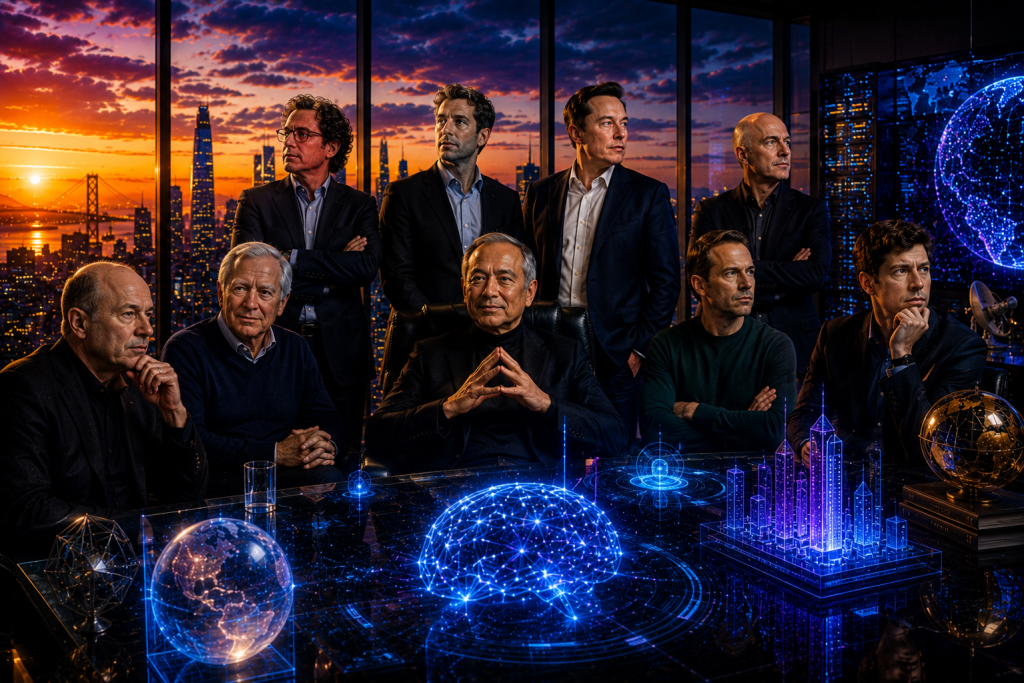
The AI Investor Class: Billionaires Who Bankrolled the Intelligence Revolution
Somebody had to write the checks. Before Jensen Huang’s chips shipped, before Sam Altman’s models launched, before a single AI product reached a consumer, the AI investor class provided the capital that made everything else possible. This hub of the AI billionaires 2026 story covers the people who did not build the technology but bankrolled it, and whose returns have been staggering. Andreessen deployed $20 billion in a single fund. Son deployed $180 billion in a corporate pivot. Khosla turned $50 million into billions with a single bet on OpenAI. Together with Dario Amodei, whose Anthropic represents the philosophical pivot from the intelligence layer to the safety layer, these four figures define the capital architecture of artificial intelligence.
Dario Amodei: The Researcher Who Became the Richest AI CEO
Dario Amodei’s net worth of $7 billion makes him wealthier than Sam Altman, despite running a company whose valuation ($380 billion) is roughly half of OpenAI’s ($730 billion). The difference is equity. Altman owns zero shares in OpenAI. Amodei holds a meaningful stake in Anthropic. He left OpenAI’s research division in 2021, co-founded Anthropic with his sister Daniela, and built it into a company with $14 billion in annual revenue and 500+ corporate clients. His “constitutional AI” approach positioned Anthropic as the safety-first alternative in a market increasingly nervous about unconstrained AI development. Revenue reaching $30 billion in run rate by April 2026 validated the thesis that safety and commercial success are not opposites.
Marc Andreessen: The Kingmaker With 20,000 GPUs
Marc Andreessen’s AI strategy at a16z has redefined what venture capital means in the AI era. The firm manages $42 billion, launched a $20 billion AI fund, and deploys 20,000 Nvidia GPUs to portfolio companies through its Oxygen initiative. Andreessen’s personal net worth of approximately $2 billion understates his influence: through carried interest, board seats (including Meta), and capital allocation decisions, he shapes which AI companies survive. His portfolio spans the entire foundation model landscape: stakes in OpenAI, xAI, Mistral, and Databricks. He co-founded Netscape, wrote “Software is eating the world,” and is now funding Mira Murati’s Thinking Machines Lab at a $10 billion pre-product valuation.
Masayoshi Son: The $69 Billion Gambler Who Came Back
Masayoshi Son’s net worth of $69.4 billion represents the most dramatic comeback in technology history. He lost $70 billion when the dot-com bubble burst, nearly destroyed his credibility with WeWork, and then pivoted everything into AI. SoftBank invested $41 billion in OpenAI (11% stake), acquired Ampere Computing for $6.5 billion, bought ABB’s robotics division for $5.375 billion, and secured a $40 billion bridge loan for further AI investment. The Stargate project, a joint venture with OpenAI and Oracle, envisions $500 billion in AI infrastructure. Son’s 90% stake in Arm Holdings, the chip architecture company, is worth over $155 billion alone. He bets at a scale no other investor matches, and his outcomes are always more extreme than anyone predicts.
Vinod Khosla: The $50 Million Check That Changed Everything
Vinod Khosla’s net worth of $13.4 billion was built on patience. He co-founded Sun Microsystems, spent a decade as Silicon Valley’s most prominent climate-tech investor, and then became the first institutional investor in OpenAI with a $50 million bet at a $1 billion valuation. That check, if his stake has held, is now worth tens of billions. Khosla Ventures manages $15 billion across 1,500+ investments. Fund XIII, at $3.5 billion, targets nuclear fusion, humanoid robots, and AI infrastructure. Khosla predicts AI will eliminate 80% of jobs by 2030 and argues that the resulting deflation will make life dramatically more affordable. He is investing accordingly.
The Capital Hierarchy: Who Funds What and Why It Matters
There is a hierarchy within the investor class that mirrors the technology stack itself, and understanding that hierarchy is essential to understanding how AI wealth flows from thesis to fortune. At the top sits conviction capital: money deployed before the market consensus forms, when the risk is highest and the potential return is most asymmetric. Khosla’s $50 million OpenAI check in 2019 is conviction capital. Below it sits scaling capital: money deployed after early traction is demonstrated but before the outcome is certain. Andreessen’s growth-stage AI fund deploys scaling capital. Below that sits momentum capital: money deployed after the thesis is proven, when the risk is lowest and the returns are most compressed. SoftBank’s $41 billion OpenAI investment deploys momentum capital at conviction-capital scale, which is the specific financial innovation that makes Son’s approach so difficult to categorize and so impossible to replicate.
The Allocation Decision as Worldview
Each investor in this hub made a capital allocation decision that functioned as a declaration of belief about what intelligence is, what it will become, and how much that transformation is worth. Amodei bet that safety would be the differentiator. Andreessen bet that infrastructure would be the bottleneck. Son bet that scale would be the winner. Khosla bet that timing would be everything. Four bets, four fortunes, four completely different theories of how the AI economy would develop. The fact that all four are currently right tells you something about the size of the market: it is large enough to reward contradictory strategies simultaneously, which is the hallmark of a technology cycle in its expansion phase rather than its consolidation phase.
What Happens When Capital Picks Sides
Capital is never neutral. When Andreessen commits $20 billion to AI infrastructure, he is not merely predicting that AI infrastructure will be valuable. He is making AI infrastructure more valuable by directing $20 billion of purchasing power toward GPU clusters, talent acquisition, and enterprise distribution. When Son deploys $180 billion through Project Stargate, he does not predict that AI will require massive compute. He ensures it. The investor class does not observe the AI economy from a distance. It constructs the AI economy through its allocation decisions, and the returns it generates are returns on a reality it helped build. This is not a criticism. It is a structural observation about how venture capital works in a technology cycle where the capital requirements are so large that the investors become infrastructure themselves.
The Deeper Read
Each layer of the capital hierarchy produces a different return profile and attracts a different type of investor psychology. Conviction capital produces the largest multiples but requires the highest tolerance for being wrong. Khosla could have lost his entire $50 million. The fact that he did not, and that the return is now measured in hundreds of multiples, validates the approach but does not reduce the risk for the next conviction bet. Scaling capital produces moderate multiples with moderate risk, which is why most institutional venture capital operates at this layer. Momentum capital produces the smallest multiples but at the largest absolute scale, which means the dollar returns can be enormous even if the percentage returns are modest by venture standards. Son’s 11% stake in OpenAI at a $730 billion valuation does not need to produce a 10x return to generate an extraordinary dollar profit. A 2x return on $41 billion is $41 billion in profit. At SoftBank’s scale, even modest multiples produce life-altering numbers.
What the Capital Layer Means for the AI Economy
The four investors in this hub represent $91.4 billion in combined personal wealth and control capital allocation decisions affecting hundreds of billions more. Their investment patterns reveal a structural truth: AI wealth concentrates at the top of the capital stack. Amodei built the company. Andreessen chose to fund it. Son chose to bet $41 billion on its competitor. Khosla chose to be first. Each decision required conviction at a scale most investors cannot sustain and produced returns that most investors will never replicate.
For the East End real estate market, the investor class represents the second wave of AI wealth. Founders arrive first, liquid from stock vesting events and exits. Investors arrive second, liquid from carried interest distributions and fund returns. Limited partners, the institutional investors behind the funds, arrive third. Each wave brings purchasing power, each wave changes the buyer profile, and each wave moves prices higher. The capital that bankrolled the AI revolution is now compounding into personal fortunes that reshape the luxury markets those fortunes enter.
The Structural Imperative
The capital layer is not merely funding the AI economy. It is designing the economy’s architecture. Allocation decisions shape which companies survive, which model architectures dominate, and which business models become viable. Andreessen’s infrastructure thesis funds GPU clusters and enterprise distribution. Son’s scale thesis funds data centers spanning continents. Khosla’s timing thesis funds early-stage research that institutional capital ignores. Amodei’s safety thesis funds alignment work that competitors treat as optional. Together, these four investment strategies constitute the financial skeleton of artificial intelligence, and understanding that skeleton is prerequisite to understanding where the returns will ultimately concentrate in the next decade of the boom.
Where the Conversation Continues
You are reading this because the capital behind AI is not abstract. It is the wire transfers, the fund commitments, and the investment decisions that determine which technologies succeed and which markets transform.
If your brand, property, event, or company belongs in this conversation, reach us through our contact page. For premium editorial visibility, explore our paid feature submission process. Subscribe at sociallifemagazine.com/enflyer. Polo Hamptons returns July 18 and 25 at 900 Lumber Lane, Bridgehampton. BMW is the title sponsor. Details at polohamptons.com. Subscribe at sociallifemagazine.com/subscription.
Author

Written by
Recent Posts

How to Choose Useful Tech Gifts for Employees and Clients in 2026
The Garage Question: Which Car Goes South for the Season?

VandS Clinic Review Treatment: How Seoul Injectable and Laser Options Compare for US Patients
Before Buying a View Home: What a Sloped Lot Means for the Purchase

Powerful Strategies to Stay Ahead in a Fast-Moving Real Estate Market
Categories
- Art
- Articles
- Business of Luxury
- Celebrities
- Culture
- Entertainment
- Events
- Faces of Summer 2026
- Fashion
- Fashion & Style
- Featured
- Finance
- Food, Spirits, Wine
- Hamptons
- Hamptons Celebrities
- Health
- Health & Beauty
- Lifestyle
- Luxury Lifestyle
- Press
- Profiles
- Real Estate
- Technology
- The Chronicles
- Travel
- Uncategorized
- Weddings