
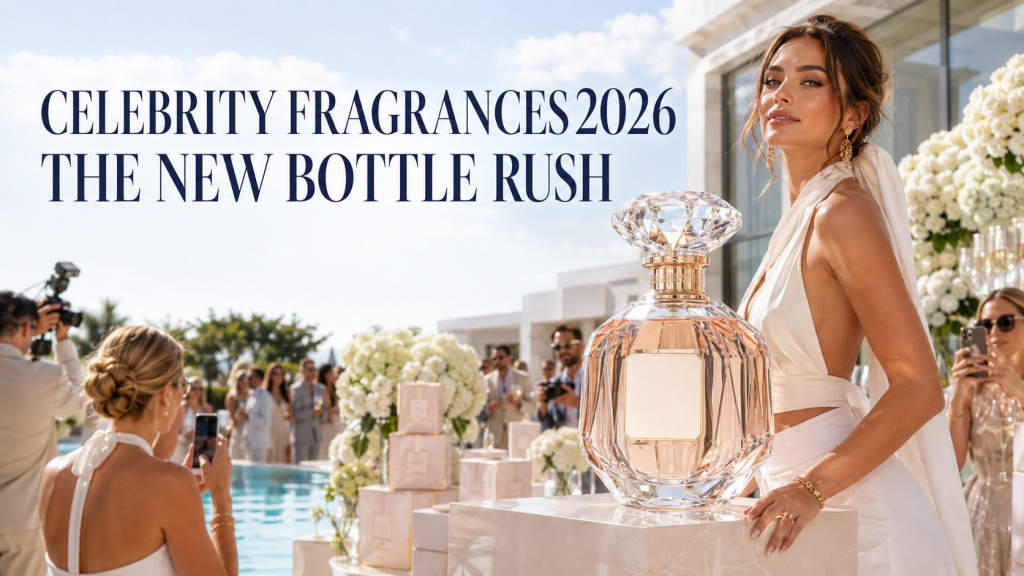
The perfume counter is having its biggest year since Glow by JLo made 2002 smell like ambition. Ariana Grande’s fragrance line has passed $1 billion in retail sales. Sabrina Carpenter cleared $100 million in 2025 alone, while July 2026 delivered three major launches in two weeks. Celebrity fragrances 2026 is the story of an old machine running at new speed.
This piece covers the modern rush. For the first gold rush, read our 90s fragrance empires deep dive, because the two eras rhyme on purpose.
The Rush, Quantified
Start with the retail math. Ulta calls fragrance its fastest-growing category, inside a quarter that did $3.2 billion in net sales. Meanwhile the launch calendar has compressed, with Megan Thee Stallion, Khloé Kardashian, and Ariana all shipping new bottles inside a single summer.
The projections got bold too. Luxe Brands expects both Cloud Aurora and XO Blue to clear $50 million in first-year retail, numbers that would have sounded like typos in 2019. Although the category never died, it has not moved like this since the Hilton era.
Geography tells the same story. Ulta owns the accessible end, Sephora holds prestige, and the Korean beauty chains drawing a thousand visitors a day keep adding fragrance walls. Shelf space follows demand, never the reverse.
Ariana’s Billion-Dollar Cloud
One artist anchors the whole revival. Ariana Grande’s fragrance business crossed $1 billion in cumulative retail sales, built since 2015 on Cloud and its sequels. The trade coverage treats her line as the category benchmark, because it is.
Cloud Aurora arrives in July 2026 as the newest sequel. The strategy reads like franchise filmmaking, with a flagship scent, spin-offs, and even Wicked tie-in bottles. Her broader empire economics sit in our pop powerhouse breakdown.
Remember that she also bought back her makeup line from a bankrupt parent. Fragrance royalties funded that patience. The bottle, not the palette, is her real beauty business.
The Class of 2026
The celebrity fragrances 2026 roster reads like a casting call. Megan Thee Stallion’s Hot Girl Summer landed at Ulta in July at $84, through Coty. Khloé Kardashian’s XO Blue arrived a month earlier through Luxe Brands, chasing that $50 million first year.
Even the Rolling Stones joined, with a five-scent collection capped at 999 bottles. Scarcity theater at its purest, and it moved on schedule. When boomer rock and Gen Z rap share a category, the category is having a moment.
The machinery behind these launches stays concentrated. Coty and Luxe Brands run most of the boards, so the same two operators quietly take a piece of nearly everyone’s bottle.
The Sabrina Surge
Sabrina Carpenter is the newest proof of speed. Her line passed $100 million in global retail during 2025, riding the espresso-fueled year her tour created. Fragrance converted that attention faster than any other product could have.
The lesson is about timing. A bottle ships in months, while a skincare line takes years of formulation. For an artist mid-surge, fragrance is the only merchandise that reads as luxury and margins like it too.
Her playbook also shows the sequence working mid-career. Tour first, scent second, skincare maybe never. Not every star needs an empire, because sometimes the bottle is the whole business.
The Billie Baseline
Before the current rush, Billie Eilish proved the Gen Z case. Her debut scent arrived in 2021 as an amber gourmand, then sequels followed in steady rhythm. For a fanbase raised on merch drops, perfume was simply the premium tier.
Her line matters because it reset the buyer’s age. Fragrance counters spent decades chasing women thirty and up, yet the new customer now discovers scent at seventeen through a phone. Whoever owns her first bottle owns a decade of repurchases.
That math explains the bold projections. A $50 million first year stops sounding aggressive once the buyer is starting a lifelong habit rather than switching brands. So the operators now sign artists younger, sometimes before the first arena tour.
Royalty vs. Equity: Who Keeps the Money
Now the cluster question: who actually gets rich? Most of these deals are licenses, so the star collects royalties in the single digits while Coty or Luxe Brands owns the machine. The bottles gross billions, and the celebrities bank millions. Equally, the license structure explains the relentless launch cadence, because volume is how a royalty fortune compounds.
History already priced this structure. Glow by JLo built a fragrance dynasty, yet JLo’s $400 million portfolio shows how modest a slice of those billions stuck. Sarah Jessica Parker’s fortune tells a similar story at boutique scale.
The blueprint still traces to one person. The $300 million Hilton blueprint proved a single name could carry 30 launches, a run the It Girl era files put in context. Licensing built those fortunes, although it also capped them.
Why Fragrance Came Back
The revival has a discovery engine. PerfumeTok taught a generation to argue about notes and dupes, so scent became a personality trait you can buy for $84. Entry-price luxury always wins a recession of attention.
There is also a status logic underneath. A fragrance is invisible until someone stands close enough to matter, which makes it the most intimate flex in the beauty aisle. Quiet luxury found its category.
The price ladder helps too. The shelf runs from body mist money up to Beyoncé pricing a bottle at $160, so every fan finds a rung. Few luxury categories let a teenager and her mother shop the same wall.
The Dupe Economy
The rush has a shadow market, and it flatters the originals. Dupe culture treats every hit scent as a reference point, so the knockoffs function as free advertising for the benchmark. Nobody dupes a flop.
The brands have noticed and stopped fighting it. A duped fragrance holds its price because the original buyer wants the label, not just the notes. Status products survive imitation, since imitation is the proof of status.
For the money story, dupes signal something better. A scent worth copying is a scent with pricing power, and pricing power is what turns royalty checks into franchise renewals.
The Crossover Play
Watch the equity founders enter next. Gaga ran fragrance as a licensed experiment back in 2012, tuition that shaped the Haus Labs comeback story. Meanwhile Rihanna’s beauty fortune already includes a Fenty scent that sells out on drops.
The supermodels are moving too. Bella Hadid’s Orebella launched as an owned brand rather than a license, a structural upgrade our supermodel wealth rankings would applaud. The next fragrance fortunes will be equity fortunes.
The ones who wait may win biggest. An established skincare base plus a first fragrance is the sequence the smartest founders are saving, and the beauty brand graveyard explains why they refuse to rush it.
The East End Nose
Out here, scent is seasonal identity. The summer signature fragrance is a Hamptons ritual as fixed as the Friday train, and this year the bottles doing the spraying are increasingly celebrity-built. The old snobbery against them is quietly dying.
For fragrance and beauty sponsors, that shift is the opening. The reader wearing Cloud to a vineyard dinner is the same reader planning a July of benefit committees. Reach her where the rituals get decided.
The activation writes itself. A scent bar at a July event, a signature fragrance for the season, a profile in these pages beside it. Ritual plus press is how a bottle becomes a habit out here.
The Fall Calendar
The back half of 2026 is already stacked. Trade chatter points to more drops timed for the holiday quarter, the category’s traditional kill zone. Expect sequels over debuts, since franchises are what the operators fund now.
Watch the equity experiments closest. Any established beauty founder adding a first scent this fall will arrive with ownership papers, and that structural shift is the real story to track. The bottles are the surface. The cap tables are the plot.
Where The Conversation Continues
The money boards live in the 2026 celebrity net worth rankings and our celebrity beauty empire rankings. The celebrity fragrances 2026 story keeps compounding, with the fall launch calendar already loaded.
Sponsors, take the hint. Scent decides summer, and summer gets decided in these pages. The brands that understand ritual buy early.
Author

Written by
Recent Posts

AI for personal finance: where PennyGuard fits
How to Pick a Homecoming Dress for Your Body Type (and Feel Amazing in It)

World Cup Injury Attorney for Vancouver Events
What a 3-Carat Engagement Ring Actually Costs in 2026: The Real Numbers
The Skincare Habits That Make a Real Difference Over Time
Categories
- Art
- Articles
- Business of Luxury
- Celebrities
- Culture
- Entertainment
- Events
- Faces of Summer 2026
- Fashion
- Fashion & Style
- Featured
- Finance
- Food, Spirits, Wine
- Hamptons
- Hamptons Celebrities
- Health
- Health & Beauty
- Lifestyle
- Luxury Lifestyle
- Press
- Profiles
- Real Estate
- Technology
- The Chronicles
- Travel
- Uncategorized
- Weddings