
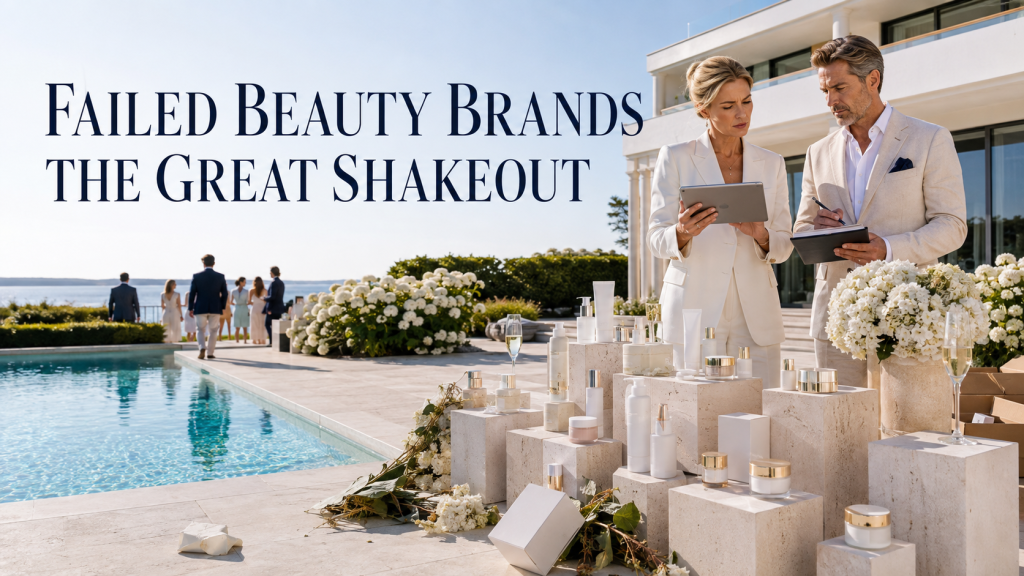
Between 2023 and 2026, the beauty industry quietly buried more famous names than anyone predicted. Addison Rae’s line closed. Jaclyn Hill’s brand followed, and an entire incubator of celebrity labels went to auction. The list of failed celebrity beauty brands now runs longer than the list of winners, although nobody says that out loud at Sephora events.
The winners, though, won historically big. This is the other half of the story we tell in our celebrity beauty brand net worth rankings, and the half that explains the prices. Autopsies are how the living learn.
The Numbers at a Glance
Confirmed closures since 2023: Item Beauty, Jaclyn Cosmetics, and most of the Amyris stable. Bankruptcies: two, with Forma Brands and Amyris filing within months of each other. Buybacks: one, by Ariana Grande.
Billion-dollar exits in the same window: exactly one. Brands that crossed a billion in founder value while staying private: two. The ratio of funerals to fortunes now runs about ten to one, although the fortunes were so large that the category still nets out ahead.
The Casualty List
Start with the cleanest case. Item Beauty launched in 2020 with one of TikTok’s biggest followings attached, then shut down in 2023 anyway. Followers, it turns out, are not customers.
Jaclyn Hill ran the same arc at higher altitude. Her namesake line closed in 2023 after years of controversy, as the trade press documented. The brand had audience access most marketers would trade a kidney for, yet it could not survive its own launches.
The deeper collapse was structural. Forma Brands, the company behind Morphe and a stable of influencer labels, went through bankruptcy that same year. One backer’s stumble erased a decade of creator-economy beauty bets in a single filing.
The timing tells its own story. Most of these labels launched between 2019 and 2021, when capital was free and every talent agency had a beauty deck. Then the closures came due like a balloon payment, three years later, almost to the month. By contrast, the Rhode class of 2022 launched into skepticism and had to earn every customer.
The Amyris Domino
The strangest graveyard belongs to Amyris. The biotech company built a portfolio of famous-name lines, including Rosie Huntington-Whiteley’s Rose Inc, Naomi Watts’ Stripes, and Jonathan Van Ness’ JVN. Then it filed for Chapter 11 in August 2023 and sold the brands at auction.
Read that sentence again, because it is the whole lesson. Famous faces with real products ended up on the block like office furniture, priced to move. The incubator model assumed celebrity guaranteed a floor. That floor was a trapdoor.
Some of those brands found new owners and kept operating. Others simply stopped. Either way, the founders learned that a label inside someone else’s structure is not the same as ownership. Notably, JVN found a buyer and kept its shelf space, because hair care had real differentiation underneath the famous face. The lesson survived even where the incubator did not.
The Buyback Clause
Ariana Grande wrote the escape scene. When Forma collapsed, she bought r.e.m. beauty back for a fraction of its build cost, then relaunched it under her own control. The bankruptcy that killed her neighbors handed her the company.
That move separates operators from endorsers. An endorser watches the parent company fail and issues a statement. An owner shows up at the auction with a bid. Of course, the buyback only works if you still want the asset. She did, and the relaunch made the repurchase price look like theft.
It is the same instinct that made Hailey Bieber’s Rhode exit so clean. Control the cap table and the disaster becomes an entry point, because you are the buyer of last resort for your own name.
The Four Fatal Patterns
Line up the failed celebrity beauty brands and four patterns repeat. First, licensing deals instead of equity, so the celebrity collected rent rather than ownership. Second, no founder hours, because the famous name showed up for launch day and vanished.
Third, product without a point of view. A famous face selling the same vegan mascara as everyone else is a markup, not a brand. Fourth, too many products too fast, the exact opposite of the scarcity math that made Rhode sellable.
Notice what is missing from that list. Fame quantity appears nowhere, since the biggest casualties had more reach than half the survivors combined. Reach is the entry fee, not the moat.
The Licensing Trap
The most common autopsy finding among failed celebrity beauty brands is the licensing structure. In a typical deal, the celebrity granted a company her name for a royalty in the high single digits. She had income, but she owned nothing that could ever be sold. Worse, the licensor controlled the exit timing, so the face could not even sell when the market peaked.
Compare that to the grand exception. Kathy Ireland turned licensing inside out by owning the licensor, a story told in her model-to-mogul breakdown. The structure, not the fame, decided who kept the fortune.
Every post-2023 founder negotiation now starts with that lesson. Equity first, royalties never, and creative control written into the purchase agreement. The Rhode paperwork reads like a direct response to a decade of licensing funerals.
The Founder-Hours Test
The second finding is attendance. Real founders show up between launches, in the unglamorous meetings where formulas get rejected and margins get argued. The failed brands mostly rented a face for the campaign shoot. Attendance shows up in the product, because details are the one thing delegation cannot fake.
History already ran this experiment once. Paris Hilton’s fragrance fortune was built across dozens of launches she personally worked, decades before anyone said founder-led. The perfume counter rewarded the same obsession the beauty aisle rewards now.
Buyers can smell the difference in due diligence. A founder who knows her unit economics gets a multiple, while a spokesperson gets a settlement. Nobody pays 3.8 times sales for an absentee.
What the Survivors Share
Now flip the ledger. Rihanna’s Fenty machine has LVMH operators underneath it. Selena Gomez’s Rare Beauty has a mission that outlives any single product cycle. Jessica Alba’s Honest empire was built on trust categories before beauty was even the point.
Even the outliers prove it. Jeffree Star’s beauty fortune survived every scandal the internet could generate, because the products shipped and the margins held. Operators, ownership, and an actual reason to exist. The survivors have all three.
For the full mechanics, read our breakdown of how a face becomes a fortune. The short version fits on an index card. Equity, obsession, difference.
The Kylie Half-Life
Then there is decline without death, the strangest category. Kylie Jenner’s cosmetics empire lost its billionaire crown and most of its valuation, yet the brand keeps selling. A markdown is not a funeral.
Her case matters because it set the shakeout’s opening price. Coty paid top of market in 2020, and every acquirer since has used that writedown as a negotiating chip. The Rhode deal was priced by people who remembered the lip kits.
Half-life brands teach the market patience. So the next generation of founders sold earlier, kept operating roles, and stopped confusing peak fame with peak value.
What Retail Learned
Sephora and Ulta rewrote their math too. Shelf space for famous faces contracted after 2023, and buyers started asking for the numbers behind the followers. A celebrity meeting now opens with a P&L, not a media kit. Several retailers also cap famous-founder launches per season, a quota nobody needed in 2021.
Earned media value became the tell. Rhode ranked first in its category before e.l.f. paid a billion, which is why the multiple made sense. The failed brands bought their attention, while the winners generated it.
For the wider mechanics behind these swings, our guide to how fame becomes fortune maps the full conversion chain, and the celebrity wealth field guide holds the rest of the archive.
How to Read the Next Launch
The shakeout leaves a usable checklist, so here it is. First question: does the celebrity own equity, or is the name rented? Rented names walk away clean, which means they also walk away poor.
Second question: who operates the company between campaigns? Third: would the product survive with an unknown founder’s name on the label? If the answer is no, the fame is doing margin work that fades with the algorithm.
Last question: is the launch calendar patient? Rhode shipped a handful of products in three years, while the graveyard brands shipped fifty in two. Restraint, in this category, is the loudest signal of confidence a founder can send.
The Status Read
Underneath the spreadsheets sits a status story. A beauty brand is a claim that a famous person’s taste is worth buying, and the market spent three years testing every claim at once. Most failed the audit.
The audit was really about a kind of capital that never shows up on Instagram. Cultural authority converts. Visibility alone does not, no matter how the follower counts look in a pitch deck.
That is why the same faces that could not sell mascara still sell magazine covers. Different products test different claims. The beauty aisle is simply the most honest courtroom fame ever built. Taste, after all, is the one luxury that cannot be licensed.
The East End Postscript
There is a Hamptons coda to all of this. The failed brands bought reach, but the surviving founders bought presence, the kind measured in benefit committees and July tents rather than impressions. Presence is the older technology, and it still converts.
The proof sits in the local beauty economy. The Hamptons longevity clinic boom and the 111Skin outposts serve the exact customers the failed brands never reached with performance ads. Out here, taste travels by word of mouth at dinner parties.
For beauty and medspa brands drawing conclusions, draw this one. The winners of the shakeout put their names where their buyers actually live. So does the smart money that sponsors these pages.
Where The Conversation Continues
The living and the dead share one leaderboard, tracked in our celebrity net worth rankings for 2026. Expect the failed celebrity beauty brands list to grow before it shrinks, because the shakeout has at least a year left to run.
For the brands still standing, the lesson is placement. The founders who survived read this magazine, summer in these zip codes, and sit in the July tents. Being seen next to the winners is its own strategy. After all, the next Rhode is already in someone’s group chat, deciding which magazine gets the first call.
Author

Written by
Recent Posts

AI for personal finance: where PennyGuard fits
How to Pick a Homecoming Dress for Your Body Type (and Feel Amazing in It)

World Cup Injury Attorney for Vancouver Events
What a 3-Carat Engagement Ring Actually Costs in 2026: The Real Numbers
The Skincare Habits That Make a Real Difference Over Time
Categories
- Art
- Articles
- Business of Luxury
- Celebrities
- Culture
- Entertainment
- Events
- Faces of Summer 2026
- Fashion
- Fashion & Style
- Featured
- Finance
- Food, Spirits, Wine
- Hamptons
- Hamptons Celebrities
- Health
- Health & Beauty
- Lifestyle
- Luxury Lifestyle
- Press
- Profiles
- Real Estate
- Technology
- The Chronicles
- Travel
- Uncategorized
- Weddings