
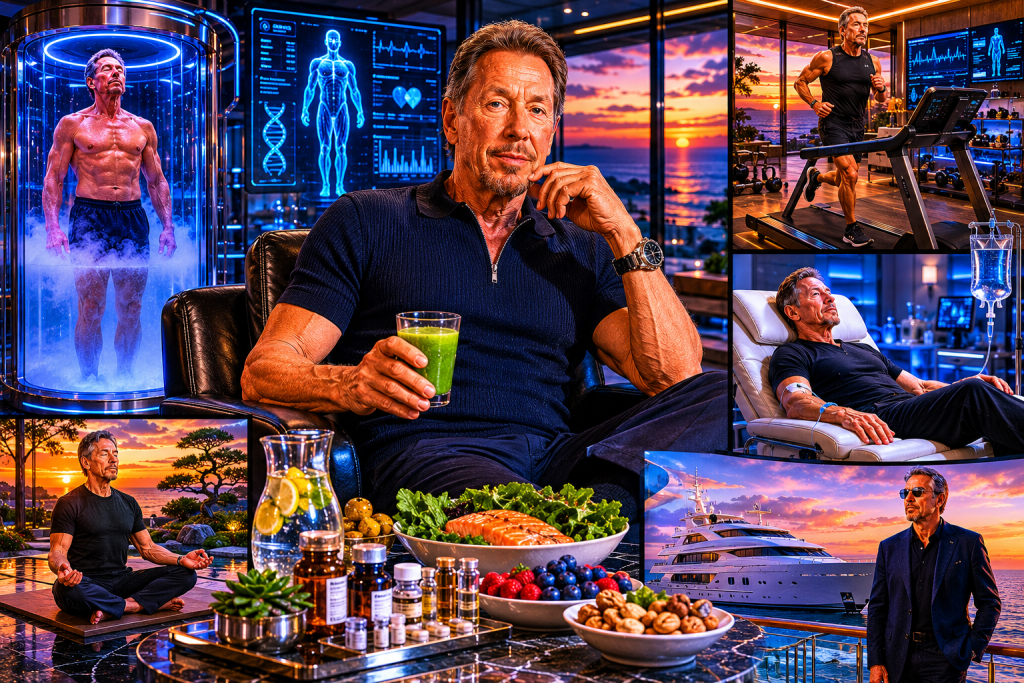
When Larry Ellison stepped on stage in January 2025 to announce Oracle’s Project Stargate, the audience noticed two things. The first was the scope of the AI initiative. The second was the man presenting it. Ellison was 80 years old. He looked 60. Bryan Johnson, the most vocal anti-aging advocate on the planet, posted afterward that Ellison “is doing a good job managing biological aging.” From a man spending $2 million a year on the project, that qualifies as high praise. The Larry Ellison anti-aging longevity crusade is the longest-running, most heavily funded personal war against mortality in modern history. And unlike most wars against nature, this one appears to be winning.
Ellison has poured more than $430 million into aging research through the Ellison Medical Foundation. He donated $200 million to USC to create an institute dedicated to transformative medicine. He signed the Giving Pledge in 2010, promising 95% of his fortune to charitable causes, with longevity research as the primary beneficiary. Fortune ran a cover story in February 2026 on his next chapter, titled “Oracle billionaire Larry Ellison’s next big bet: Redefining how long and how well we live.” Among the longevity billionaires, Ellison is not the loudest. He is the most capitalized.
The $430 Million Foundation That Changed Aging Science
Ellison established the Ellison Medical Foundation in 1997 with a mission to fund basic biomedical research on aging and age-related diseases. Over the next 16 years, the foundation channeled approximately $430 million to laboratories across the United States. Funding went to researchers at Harvard, the Buck Institute for Research on Aging, Rockefeller University, and dozens of other institutions. The grants were not targeted at cosmetic anti-aging or consumer wellness. They funded foundational science: the molecular biology of cellular decay, the genetics of longevity, and the mechanisms by which organisms age.
Among the research areas the foundation supported, caloric restriction stood out. Studies showed that reducing calorie intake without malnutrition extended lifespan and improved healthspan in multiple species, from yeast to primates. This work led to the development of therapeutic compounds designed to mimic the effects of fasting in humans without requiring extreme dietary changes. The Larry Ellison anti-aging longevity investment did not create these discoveries. It funded the laboratories where the discoveries happened, which is arguably more important.
The foundation ceased making new aging grants around 2013, but its impact continues to compound. Researchers trained on Ellison grants now lead laboratories across the country. Techniques refined with Ellison funding form the backbone of commercial longevity companies. When Altos Labs raised $3 billion for cellular reprogramming or when Retro Biosciences secured $180 million for lifespan extension, they were building on scientific infrastructure that Ellison helped pay for. He did not invent the longevity economy. He irrigated the soil from which it grew.
The Ellison Institute: $200 Million for Transformative Medicine
After the foundation shifted focus, Ellison redirected his philanthropic energy toward the Lawrence J. Ellison Institute for Transformative Medicine at USC. The $200 million gift created a research center designed to attack disease, aging, and health disparities using technology and data science. The institute’s mandate is broader than the foundation’s, encompassing cancer research, immunology, and population health alongside aging biology.
Strategic logic drives the structure. Previously, the foundation funded individual grants across dozens of institutions. Now the institute concentrates resources in one location with a unified research agenda. Ellison’s transition from distributed funding to centralized infrastructure mirrors a pattern familiar from his business career. Oracle succeeded by consolidating data under one system. His institute attempts something similar with biomedical research: one roof, one dataset, one mission.
For the Larry Ellison anti-aging longevity story, the institute represents a second act. His foundation built the scientific base. Now the institute aims to translate that science into therapies that reach patients. Bridging the gap between laboratory discovery and clinical application is where most longevity research stalls. Ellison’s $200 million bet is that concentrated capital and a technology-first approach can close that gap faster than the traditional academic model.
A Personal War Against Mortality
The financial commitment is extraordinary. The personal motivation is simpler. Ellison’s biological mother left the family when he was a child. His adoptive mother died of cancer during his college years. Those two losses sit at the center of everything that followed. “Death has never made any sense to me,” he told biographer Mike Wilson. “How can a person be there and then just vanish, just not be there?”
That question, asked by a man now worth over $200 billion, carries a weight that philosophy alone cannot produce. Ellison is not debating mortality in the abstract. He is funding its defeat with the same intensity he brought to building Oracle from a two-person startup into a company with $57 billion in annual revenue. His self-described “addiction to winning” applies to databases, to yacht racing, to tennis (he owns the Indian Wells tournament), and now to the biological clock that governs every organism on earth.
The emotional core of the Larry Ellison anti-aging longevity narrative distinguishes him from every other figure in this series. Daymond John was motivated by cancer. Tom Brady was motivated by performance. Bryan Johnson is motivated by data. Ellison is motivated by grief. A mother who vanished. An unanswerable question. And a fortune that grew large enough to fund the only answer that matters. Every dollar of the $430 million is an attempt to make the question make sense.
Larry Ellison Net Worth: $201 Billion and a Concentrated Bet
As of early 2026, Ellison’s net worth sits at approximately $201 billion, according to Bloomberg. He finished 2025 as the fifth-richest person in the world at $247 billion. A 22% decline in Oracle shares through the first quarter of 2026 erased $46.7 billion, the largest single-person wealth decline of the year. In September 2025, Ellison briefly passed Elon Musk to become the richest person on earth for part of one day before falling back.
His fortune is concentrated in Oracle, where he holds more than 40% of the company’s outstanding shares. Additional positions include a stake in Tesla and involvement in the Paramount Skydance acquisition led by his son, David Ellison. He owns nearly all of the Hawaiian island of Lanai, along with luxury estates in Florida and properties across the country. He signed the Giving Pledge in 2010, promising to donate at least 95% of his wealth. In a letter to the group, he wrote that he had “already given hundreds of millions of dollars to medical research and education, and I will give billions more over time.”
The longevity portfolio within that commitment is singular. No individual in history has directed more personal capital toward aging research. The $430 million through the foundation, $200 million to USC, and undisclosed amounts through private investments and ongoing commitments position Ellison as the largest single patron of the field. When historians write the story of how the longevity economy emerged, Ellison’s name will appear on the first page.
At 80, the Protocol That Keeps Ellison Going
Ellison does not publish his health data or post supplement stacks on social media. His approach to personal longevity is old-school and private, which is itself a status signal. What is known from associates and biographers: he follows a pescatarian diet focused on fish, vegetables, and fruit. Alcohol and drugs are excluded entirely. Green tea and water are the only beverages. Daily exercise, reportedly hours in the gym, rounds out the routine. Disciplined but not performative.
In the 1990s and 2000s, Gina Smith, a journalist who worked with Ellison, observed that he drank only green tea and water and ate a clean diet even when surrounded by the lavish entertaining for which he was famous. The yacht parties and Lanai retreats may have projected excess, but the man at the center of them was quietly running one of the most consistent personal health protocols of any tech executive of his generation.
At 80, the results speak without needing a spreadsheet. Ellison moves with energy, presents with sharpness, and maintains a schedule that includes running Oracle’s technology strategy, overseeing the Paramount acquisition through his son, backing the U.S. TikTok deal, and traveling between Hawaii, Florida, and Silicon Valley. Bryan Johnson praised his biological aging management. Fortune put him on the cover. The man who asked how someone can “just vanish” has spent nearly three decades making sure the question does not apply to him.
What Ellison’s Investment Means for the East End
Larry Ellison does not summer in the Hamptons. But his money does. The research he funded at the Buck Institute, Harvard, and Rockefeller laid the groundwork for the treatments now offered at Hamptons wellness clinics. NAD+ therapy traces back to research on nicotinamide pathways funded by labs like those the Ellison Medical Foundation supported. Senolytic compounds were developed in academic settings that relied on grant funding from sources including the foundation. The downstream commercial applications are everywhere.
Hamptons BioMed at 223 Hampton Road in Southampton offers exosomes, epigenetic counseling, and functional lab testing. These services exist because researchers at institutions Ellison helped fund spent decades converting basic science into clinical applications. The East End longevity corridor is, in a very direct sense, a retail outlet for the science that Ellison’s $430 million helped create.
For clinic operators and wellness brands reading this, Ellison’s story carries a different message than the other spokes in this series. Johnson sells protocols. John sells transformation. Brady sells proof of concept. Ellison sells legitimacy. When your marketing references “research-backed” treatments or “science-driven” wellness technology, the science behind those claims often traces back to laboratories that operated on Ellison Foundation grants. That lineage is real. And for Social Life Magazine readers evaluating where to invest their health dollars, the pedigree matters.
Where The Conversation Continues
Ellison’s story represents the longest view in this series. Not the flashiest protocol or the most viral social media presence, but the deepest roots. Social Life Magazine is covering every dimension of the longevity economy from the research funding to the clinical delivery to the cultural shift reshaping the South Fork.
If you operate in the longevity, biotech, or wellness space and want editorial visibility with the East End audience, reach out at [email protected].
For brands seeking premium placement, explore our Paid Feature options. A feature in Social Life Magazine positions your name alongside the people and institutions shaping how we age.
Stay current on longevity, luxury, and everything in between at sociallifemagazine.com.
Polo Hamptons returns July 18 and 25, 2026, at 900 Lumber Lane, Bridgehampton. BMW is the title sponsor. For sponsorship inquiries, visit polohamptons.com.
Already a reader? Share this piece or subscribe to Social Life Magazine for five summer issues and Fall/Winter editions delivered to your door.
If this journalism matters to you, support it directly via PayPal. Independent publishing on the East End runs on readers who believe the story is worth telling.
Frequently Asked Questions
How much has Larry Ellison spent on anti-aging research?
Larry Ellison has directed more than $630 million toward aging and health research. The Ellison Medical Foundation, established in 1997, channeled approximately $430 million into basic biomedical research on aging at institutions including Harvard, the Buck Institute, and Rockefeller University. A separate $200 million gift to USC created the Lawrence J. Ellison Institute for Transformative Medicine. He signed the Giving Pledge in 2010, promising 95% of his wealth to charitable causes with medical research as a primary focus.
What is Larry Ellison’s net worth in 2026?
Larry Ellison’s net worth is approximately $201 billion as of early 2026, according to Bloomberg. He finished 2025 at $247 billion as the fifth-richest person in the world. A decline in Oracle shares through the first quarter of 2026 reduced his net worth by $46.7 billion. In September 2025, Ellison briefly surpassed Elon Musk to become the richest person on earth for one day. His fortune is primarily concentrated in his 40%+ stake in Oracle Corporation.
What is Larry Ellison’s personal health routine?
Ellison follows a pescatarian diet centered on fish, vegetables, and fruit. He avoids alcohol and drugs, drinks green tea and water, and exercises daily. Associates have described hours-long gym sessions as part of his routine. Unlike public biohackers such as Bryan Johnson, Ellison does not share detailed protocols or biological data publicly. At 80, he maintains an active schedule including Oracle leadership, major acquisition oversight, and travel between residences in Hawaii, Florida, and Silicon Valley.
What is the Ellison Medical Foundation?
The Ellison Medical Foundation was established by Larry Ellison in 1997 to fund basic biomedical research on aging and age-related diseases. Over 16 years, it distributed approximately $430 million to researchers at major universities and research institutions across the United States. Key research areas included the molecular biology of cellular aging, caloric restriction studies, and therapeutic compounds designed to slow biological decline. The foundation ceased making new aging grants around 2013, but its impact continues through ongoing research programs and researchers trained on its grants.
Author

Written by
Recent Posts

AI for personal finance: where PennyGuard fits

How to Pick a Homecoming Dress for Your Body Type (and Feel Amazing in It)

World Cup Injury Attorney for Vancouver Events
What a 3-Carat Engagement Ring Actually Costs in 2026: The Real Numbers
The Skincare Habits That Make a Real Difference Over Time
Categories
- Art
- Articles
- Business of Luxury
- Celebrities
- Culture
- Entertainment
- Events
- Faces of Summer 2026
- Fashion
- Fashion & Style
- Featured
- Finance
- Food, Spirits, Wine
- Hamptons
- Hamptons Celebrities
- Health
- Health & Beauty
- Lifestyle
- Luxury Lifestyle
- Press
- Profiles
- Real Estate
- Technology
- The Chronicles
- Travel
- Uncategorized
- Weddings