
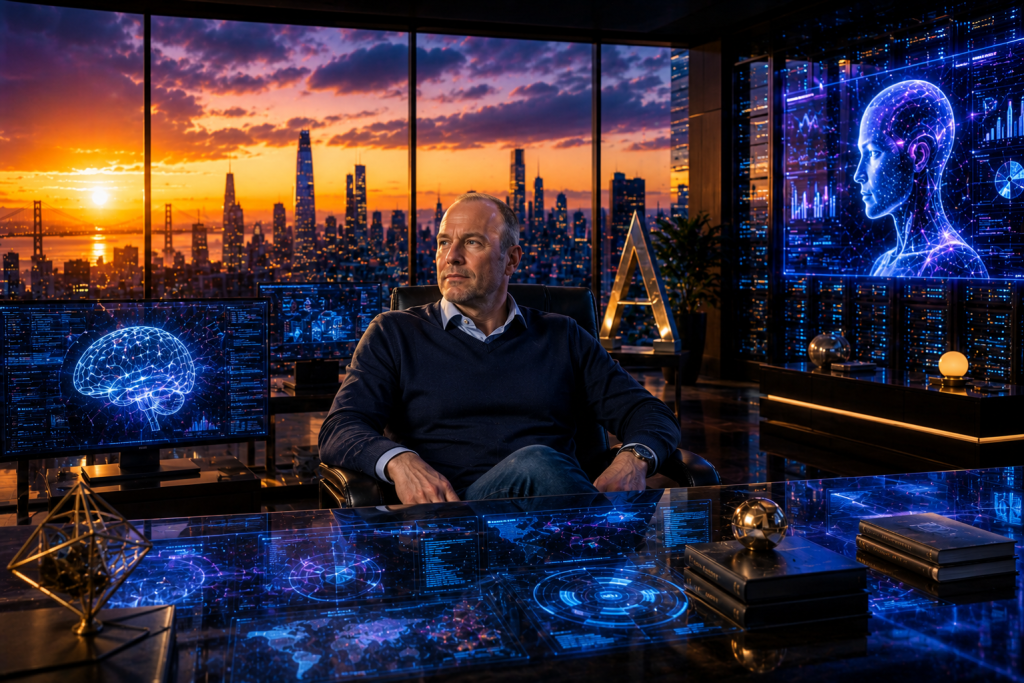
Marc Andreessen AI Bets: How a16z Went All-In on Artificial Intelligence
Marc Andreessen AI strategy has transformed Andreessen Horowitz from a prominent venture capital firm into the most aggressive institutional investor in the artificial intelligence economy. Known as a16z, the firm manages over $42 billion in assets and launched a $20 billion AI-focused fund in 2025, the largest AI fund in venture capital history. Andreessen’s personal net worth sits at approximately $2 billion, built from Netscape’s $4.2 billion sale to AOL, decades of carried interest from a16z funds, and board positions at Meta and other public companies. He is not the richest person in the AI billionaires story. He is the one who decides which AI companies get funded.
From Netscape to a16z: The Arc of Platform Conviction
Andreessen co-created Mosaic, one of the first web browsers, and co-founded Netscape in 1994. Netscape’s IPO in 1995 launched the commercial internet era. AOL acquired the company for $4.2 billion in 1999. Andreessen’s personal proceeds were estimated at $50 to $70 million. He co-founded Loudcloud, which sold to Hewlett-Packard for $1.6 billion. In 2009, he and Ben Horowitz founded Andreessen Horowitz with a $300 million first fund. The thesis: “Software is eating the world.”
The portfolio since then reads like a proof of concept: Airbnb (invested $60 million, IPO at $47 billion), Coinbase (invested $25 million, IPO at $86 billion), GitHub, Stripe, Instagram, Slack, Databricks. The firm holds stakes in Mistral AI, OpenAI, and xAI, positioning itself across the entire foundation model landscape. In February 2026, a16z committed $465 million to Navan via secondary market activity. The American Dynamism fund, at $1.176 billion, backs defense companies like Anduril and Shield AI.
The $20 Billion AI Fund and 20,000 GPUs
The $20 billion AI fund focuses entirely on growth-stage companies, with significant capital reserved for follow-on investments in existing portfolio companies including Databricks, xAI, and France-based Mistral. A16z is also expected to lead the funding round for Thinking Machines Lab, the new venture from former OpenAI CTO Mira Murati, which is courting a $10 billion valuation before releasing a product.
A16z’s Oxygen initiative, launched in late 2025, gives portfolio companies access to over 20,000 Nvidia GPUs. Startups can rent the private GPU cluster in exchange for equity, addressing the AI industry’s biggest bottleneck: compute power. The move transforms a16z from a capital provider into an infrastructure provider. Startups backed by the firm get not just money but the physical hardware required to train AI models, a combination no other venture firm can match at this scale.
The Man Who Named the Era
Andreessen’s influence on the AI economy cannot be measured in net worth alone, which is why his $2 billion fortune is both accurate and misleading. His 2011 Wall Street Journal essay, “Why Software Is Eating the World,” did not merely predict a trend. It named the paradigm. It gave venture capitalists, entrepreneurs, and corporate strategy teams a mental framework for understanding why software companies were overtaking traditional industries, and that framework drove trillions of dollars in capital allocation over the subsequent decade. Airbnb ate hotels. Uber ate taxis. Netflix ate Blockbuster. The framework worked because it was true, and it worked because Andreessen was not merely describing it. He was funding it.
The Architecture of Conviction
Andreessen’s “Why AI Will Save the World” essay, published in June 2023, ran 7,000 words and read less like a technology forecast than like a confession of faith. Every objection anticipated. Each counterargument pre-empted. Every historical parallel deployed with the precision of someone who has been arguing with the future since 1994 and has been right often enough to treat skepticism as a character flaw rather than a methodology. The essay did something unusual for a venture capitalist’s public writing: it took a position so absolute that retreat became impossible. When you publish 7,000 words declaring that AI regulation would constitute civilizational self-sabotage, you cannot quietly diversify into healthcare SaaS the following quarter. The essay was a strategic commitment device disguised as an opinion piece, and the $20 billion fund that followed was the financial expression of the commitment the essay had already made public.
The AI pivot is the sequel. Software ate the world. AI is eating software. The $20 billion fund is Andreessen’s bet that the next decade of technology will be defined not by human-written code but by machine-generated intelligence, and the companies that control that intelligence will control the economics the way software companies controlled the economics of the 2010s. Whether this thesis is correct, and the early evidence from Nvidia’s revenue growth and OpenAI’s valuation trajectory suggests it might be, will determine whether a16z’s $20 billion fund generates the kind of returns that justify its unprecedented size or whether it joins the list of oversized vehicles that mistook a cycle for a paradigm.
The Deeper Read
Andreessen sits on Meta’s board. He backed Thinking Machines Lab (Mira Murati’s post-OpenAI venture) at a $10 billion pre-product valuation. He funded Anduril, the autonomous defense systems company that is building AI-powered weapons platforms for the U.S. military. The breadth is deliberate. Andreessen is not betting on a single company or a single model or a single application. He is betting on the entire technology transition, from consumer AI to enterprise AI to defense AI to crypto AI to biotech AI, and the 20,000 GPUs are the physical expression of that bet: compute power allocated across the full spectrum of artificial intelligence applications, owned by the fund, controlled by the fund, and exchanged for equity in the companies that will define the next generation of wealth creation.
The Insider Angle: The Kingmaker’s Position
Andreessen’s personal fortune of $2 billion is modest relative to the $7 billion Amodei or the $69 billion Son commands. But net worth understates his influence. Through a16z’s fund structure, Andreessen controls capital allocation decisions that determine which AI companies survive, which scale, and which die. His board seat at Meta gives him direct influence over one of the largest AI spenders on earth. His Oxygen GPU network gives his portfolio companies a hardware advantage competitors cannot replicate.
On the East End, Andreessen represents the capital layer of AI wealth: the investor class whose returns depend on the companies that bankrolled the AI revolution. His net worth may not buy a compound on Further Lane, but his investment decisions determine who can.
The Venture Capitalist as Infrastructure Provider
There is a specific transformation happening in venture capital that Andreessen’s $20 billion AI fund and Oxygen GPU initiative represent, and the transformation is this: the traditional venture capital model, in which a fund provides money and advice and introductions and then waits for the portfolio company to succeed or fail, is being replaced by a model in which the fund provides money and advice and introductions and also the physical computing infrastructure required to build the product. When a16z gives a startup access to 20,000 Nvidia GPUs in exchange for equity, it is not merely investing. It is becoming a co-production facility. The startup builds the model. A16z provides the compute. The relationship is not investor and investee. It is landlord and tenant, with the rent paid in equity rather than cash, and the property being not office space but processing power.
For related coverage, explore Vinod Khosla’s AI kingmaker play.
This transformation matters because it changes the competitive dynamics of AI venture capital in ways that are probably irreversible. A startup choosing between a16z and a competing fund is not choosing between two checks. It is choosing between a check plus 20,000 GPUs and a check without 20,000 GPUs. In an industry where compute is the binding constraint, where the difference between shipping a model in six months and shipping a model in eighteen months is the difference between market leadership and irrelevance, the GPU access is not a perk. It is a structural advantage that no smaller fund can replicate without building its own data center, which no smaller fund has the capital to do.
The Deeper Read
Andreessen understood before most of his peers that the AI venture market would be won not by the fund with the best network or the deepest expertise or the most famous partners, but by the fund that could solve the compute bottleneck. “Software is eating the world” was a thesis about applications. The Oxygen initiative is a thesis about infrastructure. The shift from one to the other mirrors the broader shift in the AI economy from application-layer excitement to infrastructure-layer dominance. Andreessen wrote the essay that defined the application era. He is now building the GPU cluster that defines the infrastructure era. Both acts are expressions of the same conviction: whoever controls the platform controls the economics. The platform just changed from software to silicon.
Where the Conversation Continues
You are reading this because the person who funds the AI revolution shapes it as much as the person who builds it.
If your brand, property, event, or company belongs in this conversation, reach us through our contact page. For premium editorial visibility, explore our paid feature submission process. Subscribe at sociallifemagazine.com/enflyer. Polo Hamptons returns July 18 and 25 at 900 Lumber Lane, Bridgehampton. BMW is the title sponsor. Details at polohamptons.com. Subscribe at sociallifemagazine.com/subscription.
Author

Written by
Recent Posts

AI for personal finance: where PennyGuard fits

How to Pick a Homecoming Dress for Your Body Type (and Feel Amazing in It)

World Cup Injury Attorney for Vancouver Events
What a 3-Carat Engagement Ring Actually Costs in 2026: The Real Numbers
The Skincare Habits That Make a Real Difference Over Time
Categories
- Art
- Articles
- Business of Luxury
- Celebrities
- Culture
- Entertainment
- Events
- Faces of Summer 2026
- Fashion
- Fashion & Style
- Featured
- Finance
- Food, Spirits, Wine
- Hamptons
- Hamptons Celebrities
- Health
- Health & Beauty
- Lifestyle
- Luxury Lifestyle
- Press
- Profiles
- Real Estate
- Technology
- The Chronicles
- Travel
- Uncategorized
- Weddings