
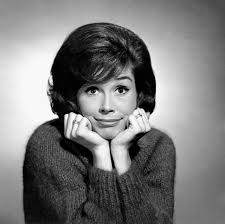
January 25, 2017. Greenwich, Connecticut. Mary Tyler Moore died of cardiopulmonary arrest at Greenwich Hospital at 80, after decades of complications from the type 1 diabetes she had been diagnosed with at 33. The Mary Tyler Moore net worth at the time of her death was approximately $60 million. Distributed across her Manhattan and Connecticut properties, her share of the MTM Enterprises television production catalog, and the JDRF (Juvenile Diabetes Research Foundation) endowment she had spent the last 30 years of her life funding. The fortune was real. The cultural footprint was larger.
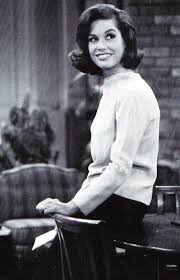
She was Laura Petrie on The Dick Van Dyke Show, the wife who pivoted American sitcom domesticity from June Cleaver to capri pants. Was Mary Richards on The Mary Tyler Moore Show, the single career woman in Minneapolis whose throwing-the-hat opening sequence became the visual shorthand for second-wave feminism in commercial entertainment. She was Beth Jarrett in Ordinary People, the brittle suburban mother in Robert Redford‘s 1980 directorial debut whose grief-frozen performance won her the only Oscar nomination of her career.
The fortune was the residue. Work was what compounded.
The $60 Million Question
The headline number is $60 million. The texture is structurally interesting.
Most of Moore’s wealth came from MTM Enterprises, the production company she co-founded in 1969 with her then-husband Grant Tinker. MTM produced The Mary Tyler Moore Show, Rhoda, Phyllis, The Bob Newhart Show, Lou Grant, Hill Street Blues, St. Elsewhere, and a dozen other prestige network dramas across the 1970s and 1980s. Tinker became NBC chairman in 1981. The MTM library was sold to Television Inc. in 1988 for approximately $320 million. Moore’s share of the proceeds, after years of dividend distributions, was estimated at $40 to $50 million pre-tax.
Her acting salary across the same decades was structured differently. The Dick Van Dyke Show paid her approximately $1,000 per episode in 1961 dollars. The Mary Tyler Moore Show paid her $40,000 per episode at peak in 1977. Ordinary People in 1980 paid her $250,000, a deliberate scale-down for prestige. Her stage work in Whose Life Is It Anyway? on Broadway in 1980 paid her around $25,000 weekly across the 96-show run.
The Manhattan apartment on Park Avenue she held from the early 1990s until her death is currently estimated at $7 million. The Connecticut farm in New Canaan she bought with her third husband, cardiologist Robert Levine, sold from her estate in 2018 for $11.6 million.
From Brooklyn To The Dick Van Dyke Show
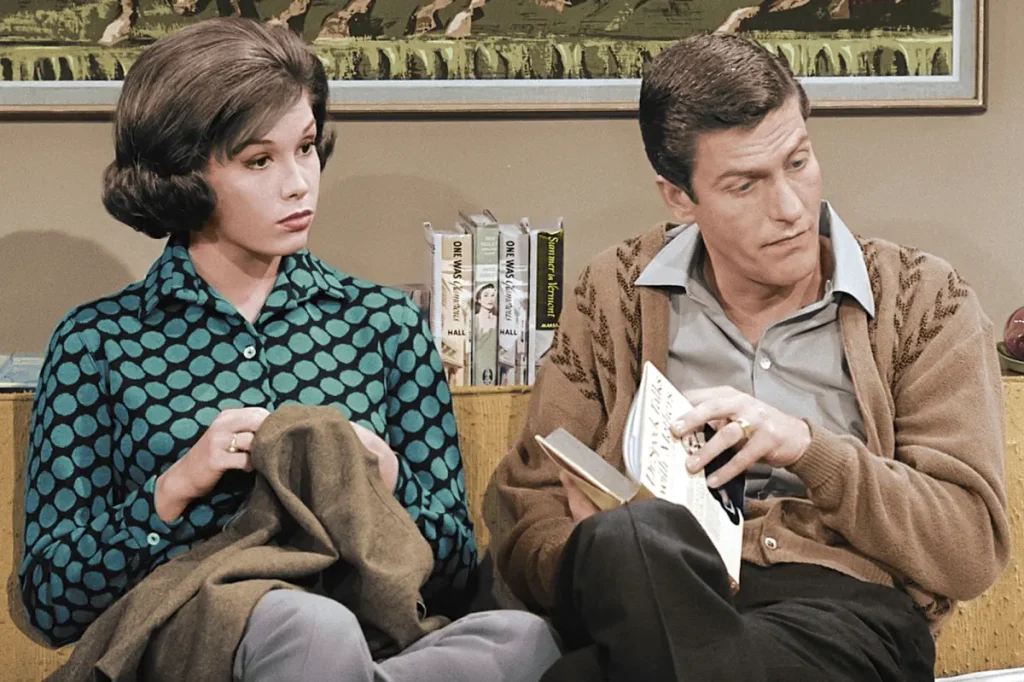
Mary Tyler Moore was born December 29, 1936, in Brooklyn. The childhood was lower-middle-class Catholic, an alcoholic mother who moved the family to Los Angeles when Mary was 8, a clerk father who provided structurally but not emotionally. A steady early dance training that became her first professional credit at 17 as Happy Hotpoint in a Hotpoint appliance commercial that ran during The Adventures of Ozzie and Harriet.
The dance training was the foundation. Carl Reiner cast her as Laura Petrie in The Dick Van Dyke Show in 1961 specifically because she could move on camera. The capri pants she wore on that show, against CBS network preference for housedresses, became the most consequential American sitcom wardrobe choice of the early 1960s. Show ran five seasons, won 15 Emmys, and made her a star at 25.
The pivot to The Mary Tyler Moore Show came in 1970. CBS gave her the development deal because of Dick Van Dyke. She used it to build the show that would change the genre. Mary Richards was 30, single, professional, and unapologetic about it. The show won 29 Emmys across seven seasons. The four-second sequence of her throwing the hat into the air at the corner of Nicollet and Seventh in downtown Minneapolis is the most replayed credits sequence in American television history.
Ordinary People With Redford
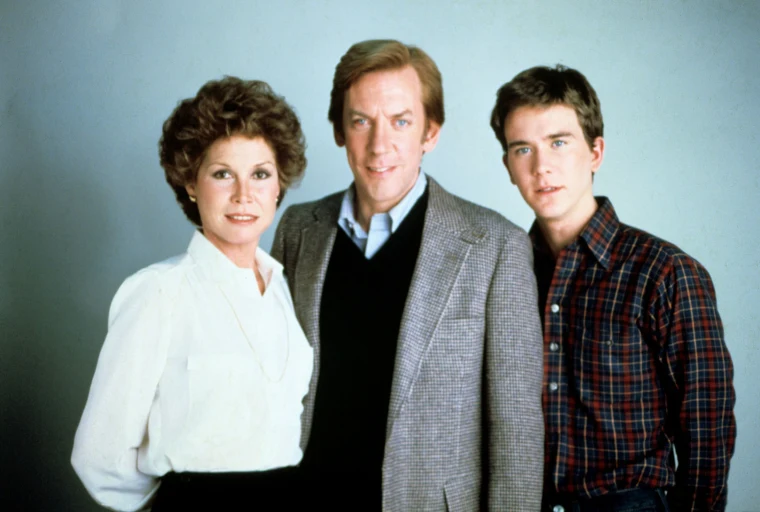
Robert Redford cast her as Beth Jarrett in his 1980 directorial debut. The casting was structurally radical. Moore was the most beloved figure in American television comedy. The role required her to play an emotionally frozen suburban mother whose unprocessed grief over her drowned eldest son becomes the destructive center of the family’s collapse. She was second choice. Ann-Margret had turned it down. Lee Remick was unavailable.
Moore agreed because Redford asked her to. They had no prior working relationship. He flew to Connecticut to ask her in person at her farm. The salary was $250,000, a significant scale-down from her television rate. She accepted because the role would let her do what no one in the industry believed she could.
The film won Best Picture, Best Director (Redford), Best Adapted Screenplay, and Best Supporting Actor for Timothy Hutton. Moore earned a Best Actress nomination. She did not win. Sissy Spacek won that year for Coal Miner’s Daughter. The nomination, however, was the structural pivot of Moore’s career. She was no longer a comedian who could occasionally do drama. She was a dramatic actress whose comedy had been one phase of a broader range. The full arc of Redford’s directorial career and how Ordinary People changed it lives in the Robert Redford net worth pillar.
The Three Marriages And The JDRF Endowment
Moore married three times. Her first marriage at 18 to Richard Meeker produced her only child, Richie, who died of an accidental shotgun discharge in 1980 at age 24. The grief structurally informed her Ordinary People performance, filmed less than two years later. Her second marriage to Grant Tinker produced MTM Enterprises and lasted 1962 to 1981. Her third marriage to cardiologist Robert Levine, 17 years her junior, lasted from 1983 until her death in 2017.
The JDRF endowment was the legacy structure. Moore was diagnosed with type 1 diabetes at 33. She became JDRF’s most prominent advocate over the next 47 years, raising more than $300 million for diabetes research through the JDRF Children’s Congress and various campaigns. Her estate continued the funding through structured trust distributions after her death. The MTM Enterprises catalog royalties, distributed to her estate after Tinker’s 2016 death, are partially earmarked for JDRF in perpetuity.
MTM Enterprises And The Production Empire
MTM Enterprises was incorporated in 1969 with Grant Tinker as president and Moore as the corporate face. The company’s mascot was a kitten meowing in parody of the MGM lion. The kitten was named Mimsie after a stray Tinker had rescued. That logo became the most recognizable production-company brand stamp on American network television across the 1970s and early 1980s.
The shows MTM produced read like the canon of American sitcom and prestige drama from 1970 through 1988. The Mary Tyler Moore Show ran 1970 to 1977. Rhoda ran 1974 to 1978. Phyllis ran 1975 to 1977. The Bob Newhart Show ran 1972 to 1978. Lou Grant ran 1977 to 1982. WKRP in Cincinnati ran 1978 to 1982. The White Shadow ran 1978 to 1981. Hill Street Blues ran 1981 to 1987. St. Elsewhere ran 1982 to 1988. Newhart ran 1982 to 1990. Remington Steele ran 1982 to 1987. The company won 77 Emmy Awards across 19 years.
The financial mechanics of the company were structured around what television industry insiders called the deficit-financing model. MTM produced shows for the network at a per-episode license fee that was consistently below production cost. The deficit was made up in syndication and international distribution after the network run ended. Hill Street Blues alone generated approximately $200 million in syndication revenue across its post-network life. St. Elsewhere generated roughly $80 million.
The 1988 Sale And The Studio City Lot
The 1988 sale to Television Inc., the British holding company subsequently rebranded as TVS Entertainment, paid approximately $320 million for the entire MTM library and ongoing production deals. Moore’s share after the dilution caused by various employee equity participations and the structural payout to Tinker was approximately $40 to $50 million pre-tax. The sale closed seven years after Moore and Tinker’s 1981 divorce. Structurally cooperative working relationship between them survived the marital dissolution intact.
The CBS Studio Center on Radford Avenue in Studio City was MTM’s primary production base across the company’s entire 19-year run. The lot still operates as a major Los Angeles television production facility under CBS ownership. Mary Tyler Moore Show Stage 2 was renamed the Mary Tyler Moore Stage following her 2017 death and remains a prestige production address among television showrunners.
Moore’s 2009 memoir Growing Up Again: Life, Loves, and Oh Yeah. Diabetes detailed the financial and personal mechanics of running MTM Enterprises while simultaneously starring in its flagship show, raising her son Richie, managing her Type 1 diabetes, and navigating the 1981 divorce from Tinker. The book was structurally not a celebrity memoir but a business case study. Television industry executives still cite it as the most accurate insider account of how a working-actor production company actually generated returns under the network era’s deficit-financing economics.
The Last Sitcom Star Who Pivoted
Category Moore occupied is closed. The American sitcom star who built a multi-million-dollar production company. Pivoted to dramatic film, earned an Oscar nomination, and channeled her fortune into a single charitable cause for the rest of her life is a Hollywood economic logic that no longer renews. Streaming algorithms reward franchise faces. The mid-budget adult drama like Ordinary People is functionally extinct.
Mary Tyler Moore net worth ledger at death was $60 million. The cultural ledger is the throwing-the-hat sequence and the silent-grief Beth Jarrett. She did both. Almost nobody in American television did both at her scale.
Where The Conversation Continues
Social Life Magazine has been writing about luxury legacy since 2003. Polo Hamptons sponsorships for July 18 and 25 in Bridgehampton are filling now. The Moore-coded universe is heritage, charitable infrastructure, second-act reinvention, and the kind of symbolic capital that survives the medium that made it.
If your brand belongs in that conversation, the entry point is [email protected]. The yacht has a finite manifest. Cabana sales are tracking ahead of last year. Categories already locked are auto (BMW), Hermès, and one real estate sponsor. The rest is open until it isn’t.
Author

Written by
Recent Posts

AI for personal finance: where PennyGuard fits

How to Pick a Homecoming Dress for Your Body Type (and Feel Amazing in It)

World Cup Injury Attorney for Vancouver Events
What a 3-Carat Engagement Ring Actually Costs in 2026: The Real Numbers
The Skincare Habits That Make a Real Difference Over Time
Categories
- Art
- Articles
- Business of Luxury
- Celebrities
- Culture
- Entertainment
- Events
- Faces of Summer 2026
- Fashion
- Fashion & Style
- Featured
- Finance
- Food, Spirits, Wine
- Hamptons
- Hamptons Celebrities
- Health
- Health & Beauty
- Lifestyle
- Luxury Lifestyle
- Press
- Profiles
- Real Estate
- Technology
- The Chronicles
- Travel
- Uncategorized
- Weddings