
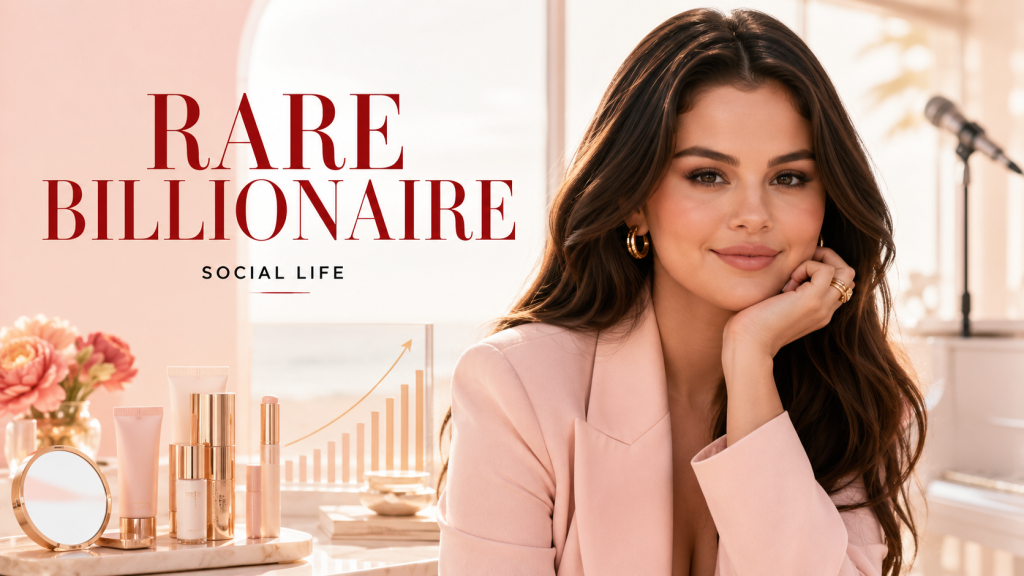
On June 3, 2025, Forbes released its annual list of America’s Richest Self-Made Women. At No. 48, between logistics operators and software founders, sat a former Disney Channel kid from Grand Prairie, Texas. The Selena Gomez net worth figure attached to that listing read $700 million. Her self-made score, meanwhile, came in at 9 out of 10. Bloomberg had gone further still, calling her a billionaire at $1.3 billion in September 2024. Both scorekeepers agree on the engine, and it is not music.
Rare Beauty, of course, is the asset. A makeup line launched into Sephora in September 2020 now anchors the strangest fortune in pop. Songs built the audience, yet blush built the balance sheet. For the medspa founder reading this from a buildout in Water Mill, that inversion is basically the entire lesson.
The Forbes Self-Made Women Moment
Forbes does not hand entertainers the self-made label as a courtesy. After all, the list runs from Diane Hendricks’s roofing-supply billions down through founders in freight and enterprise software. Gomez entered at No. 48 in 2025 because the magazine scored her equity, not her streams. Her Forbes profile values Rare Beauty at $1.3 billion. It also notes she owns at least 51 percent of the company.
Still, that placement did quiet work for her positioning. A pop star on a founders’ list stops being a pop star, at least in rooms where capital gets allocated. She now sits beside the pop girl billionaires who turned fame into holding companies. In that group, though, her ratio is the most extreme. Rihanna still carries touring memory. Gomez has not toured since 2016, yet the fortune grew anyway.
Consider who else measures against this list. The Hamptons reader knows the type: the founder who sold a logistics firm for $400 million and still feels unseen at Sant Ambroeus. By comparison, Gomez arrived with the audience already built. Yet the list rewards the same thing in both cases, since Forbes only counts what you own. Fame without equity scores a zero.
Selena Gomez Net Worth: Two Numbers, Both Real
Start with the Bloomberg math. In September 2024, Bloomberg’s index crowned her a billionaire at $1.3 billion. Roughly $1.1 billion of that sits in her reported 51 percent of Rare Beauty. The implied brand valuation runs north of $2 billion. That figure matches the sale interest bankers reportedly fielded the same year.
Forbes, by contrast, marks Rare Beauty at $1.3 billion total. So its Selena Gomez net worth estimate lands at $700 million. Neither outlet is wrong. Private beauty brands trade on revenue multiples, and the inputs are arguable. Rare Beauty generated nearly $370 million in revenue in 2023, per Forbes reporting. Apply Charlotte Tilbury’s exit multiple and you get one answer. Apply a post-2022 haircut and you get the other.
The gap persists because nothing forces a mark. Private companies under no outside pressure never get priced in public. Until a sale or a funding round prints, both estimates stay alive. Of course, only one of them fits on a magazine cover with the word billionaire.
What the Rest of the Portfolio Adds
Beyond the makeup equity, the rest is diversified but small. Television money leads it. Music catalog income trails far behind. Producing fees flow through her July Moon banner. Endorsements with Coach, Puma, and Louis Vuitton added eight figures over a decade. Real estate stays modest by peer standards, notably a $4.9 million Encino compound bought from Tom Petty’s estate in 2020. In fact, every other line item together would not crack the top 60 of the self-made list.
Rare Beauty: The Blush That Built the Billion
The launch came in September 2020, Sephora-exclusive, mid-pandemic. Prices sat in the accessible $20 to $30 band. By 2022, the Soft Pinch Liquid Blush had become a TikTok phenomenon. The product sold on a one-swipe demonstration loop that cost the company almost nothing in media. Her Instagram following, above 400 million at its peak, meant customer acquisition ran through her face. Paid channels barely mattered. That is the margin story investors kept circling.
The business model deserves a second look, too. Sephora gave the brand national doors on day one, while TikTok supplied the demonstration space for free. Each restock sold out, so scarcity did the advertising. In addition, the price point kept the customer young and repeatable. A $23 blush is an entry-level luxury, which is exactly the product a recession cannot kill.
The Sale That Never Happened
By 2024, reports had the brand exploring a sale. The floated valuation ran above $2 billion, with strategics circling. Then the process went quiet. She kept the company independent. That choice reads less like indecision and more like patience. She had watched Rihanna hold her Fenty Beauty stake and let it compound. The breakdown of Rihanna’s Fenty fortune shows the same pattern: equity held long out-earns any album cycle.
Independence also preserved optionality on timing. Strategic buyers pay peak multiples while a brand still grows double digits, so selling early forfeits the compounding years. Above all, holding kept her in control of the story, and the story is the product.
The Comparison Set That Matters
Every celebrity beauty brand claims authenticity. Most are license deals wearing a founder costume. Rare Beauty is different on the documents: majority founder-owned, category-focused, profitable on reported numbers. That puts it closer to Skims than to the graveyard of famous-face makeup lines. By comparison, Kylie Jenner sold Coty a 51 percent stake for $600 million in 2019. Forbes later slashed her numbers. Gomez sold nothing. Our celebrity net worth rankings for 2026 track a dozen such ventures. Most never clear $50 million in revenue. Hers cleared seven times that.
Mental Health as the Best Brand Story in Beauty
Here is the part the medspa founder should study. Rare Beauty’s positioning was never really about makeup. From day one, the brand pledged 1 percent of all sales to the Rare Impact Fund. The stated goal: raise $100 million for youth mental health services. The product promised light coverage; the marketing promised self-acceptance.
Gomez had spent years disclosing in public. The lupus diagnosis came first. Then the 2017 kidney transplant from her friend Francia Raisa. Then the bipolar disorder disclosure in 2020, plus the treatment stays. Her 2022 documentary My Mind and Me turned the medical file into a feature-length brand document. Cynics called it oversharing. The market called it the most defensible moat in beauty. A competitor can copy a blush formula in a quarter. Nobody can copy a decade of documented vulnerability.
What the Founder Reading This Should Steal
The mechanism deserves plain naming. Intimacy converted to trust. Trust converted to conversion rate. Conversion rate converted to enterprise value. Notably, the confession always preceded the product, never the reverse. That order is why it scanned as true. A founder who discloses only at launch is running an ad. One who disclosed years earlier is running a brand.
A cautionary footnote exists too. Wondermind, the mental health media startup she co-founded in 2022, reportedly hit financial trouble by 2024. It had carried a reported $100 million valuation at launch. Vulnerability sells product. It does not sell media companies. The lesson for the treatment-room entrepreneur is precise: attach the story to something with margin.
Only Murders in the Building Money
Television is the second-largest line item, and the gap to the first is a canyon. Forbes reports she earns $600,000 per episode of Only Murders in the Building. She works as both actress and executive producer opposite Steve Martin and Martin Short. Five seasons had aired by fall 2025, with a sixth ordered. The producer credit matters more than the acting fee, because she gets paid on the package.
The show also did subtler work for the enterprise. Playing Mabel opposite two comedy legends aged her out of the pop-act box. Hollywood rarely grants former child stars that upgrade. Compare the arc to Lady Gaga’s Mayhem-era balance sheet, where film prestige and arena touring carry the growth. Gomez runs the reverse model. Prestige television funds the lifestyle while beauty equity does the compounding.
Then there is the Hulu halo on the beauty business. Every Emmy season reintroduced her to an older, richer customer. Meanwhile, the show’s Upper West Side setting flattered the demographic that shops Sephora for a granddaughter. Cross-promotion this clean normally requires a media budget. She collects it as a salary.
Music: The Smallest Line Item
Now the uncomfortable arithmetic for the record business. Gomez has not mounted a tour since the Revival Tour stopped early in 2016. Her catalog streams reliably. Rare handed her a first No. 1 album in 2020. Still, recorded music likely contributes a single-digit share of her current net worth. Streaming checks arrive monthly, of course, but they read like rounding errors beside a Sephora restock. The music industry net worth rankings make the pattern explicit. The biggest fortunes in music now come from everything except music.
Even the 2025 album reads as a relationship asset. I Said I Love You First arrived in March 2025 as a duet project with Benny Blanco. It functioned as a public courtship document that happened to chart. By contrast, Taylor Swift’s $2 billion year was built on touring and owned masters. Gomez never took that path. Two billionaire-track outcomes, opposite engines, and only one required 149 stadium dates.
The Benny Blanco Merger
She married Benny Blanco on September 27, 2025, in Santa Barbara. The dress was a custom Ralph Lauren halter gown. Taylor Swift, Paris Hilton, Steve Martin, and Martin Short made the guest list. Tabloids covered the flowers. The wealth press noticed something else. This was a founder marrying a producer whose reported $50 million comes from writing other people’s hits.
Financially, the match changes little, and that is the point. Her fortune predates him and sits inside her company. Forbes methodology still scores it as self-made. Since the wedding, the two have presented as a creative partnership rather than a merger of estates. That framing keeps the brand story clean. For her rank against the whole field, our celebrity net worth guide runs the full methodology.
There is a wealth-psychology reading here as well. She keeps the operating circle small: her mother Mandy Teefey produced alongside her early, while CEO Scott Friedman runs Rare Beauty’s daily operations. Founders who marry after the equity is built keep the ownership story simple. Estate lawyers in East Hampton would applaud the sequencing.
Where the Selena Gomez Net Worth Goes Next
The forward question is a single variable: the Rare Beauty exit. A strategic sale at the reported $2 billion-plus marks would settle the argument. Even the conservative Forbes tally would clear the billion line for good. Holding is also a bet, specifically that the brand keeps its Sephora shelf against a thousand imitators. So far she has won that bet for five consecutive years.
Watch the 2026 calendar closely. Any Rare Beauty transaction, for example, would reset both scoreboards overnight. Also worth circling: the self-made women list lands each June. Until a deal prints, the honest answer to the Selena Gomez net worth question is a range. Call it a $700 million floor, a $1.3 billion ceiling, and one blush company between them.
Among the richest female musicians of 2026, she is the only one whose fortune needs no stage. No catalog sale. No tour rider. Ultimately, that is the provocation she poses to every founder measuring herself against this story. The audience was the easy part. Owning 51 percent of what the audience buys was the fortune.
Where The Conversation Continues
The people who allocate against these numbers do not read the trades. Instead, they read Social Life Magazine on a Bridgehampton veranda in July, somewhere between the Hampton Classic and a Rare Beauty restock. The print issue carries conversations that never reach the feed. Also, the Polo Hamptons field in Bridgehampton is where this story’s founders actually compare notes. Our full Pop Girl Billionaires report maps every fortune in this class, from blush empires to stadium economies. The summer social calendar fills early. People who matter already know which weekends count. The July issue is being assembled now. Someone’s brand will anchor it.
Author

Written by
Recent Posts

Planning an Arizona Road Trip? Practical Details to Handle Before You Leave

Short Homecoming Dresses That Feel Polished, Not Overdone
Men’s Health After 40: Important Changes to Pay Attention To
What You Need to Know About Spray Tanning

Simple Ways to Upgrade Your Summer Drink Routine
Categories
- Art
- Articles
- Business of Luxury
- Celebrities
- Culture
- Entertainment
- Events
- Faces of Summer 2026
- Fashion
- Fashion & Style
- Featured
- Finance
- Food, Spirits, Wine
- Hamptons
- Hamptons Celebrities
- Health
- Health & Beauty
- Lifestyle
- Luxury Lifestyle
- Press
- Profiles
- Real Estate
- Technology
- The Chronicles
- Travel
- Uncategorized
- Weddings