
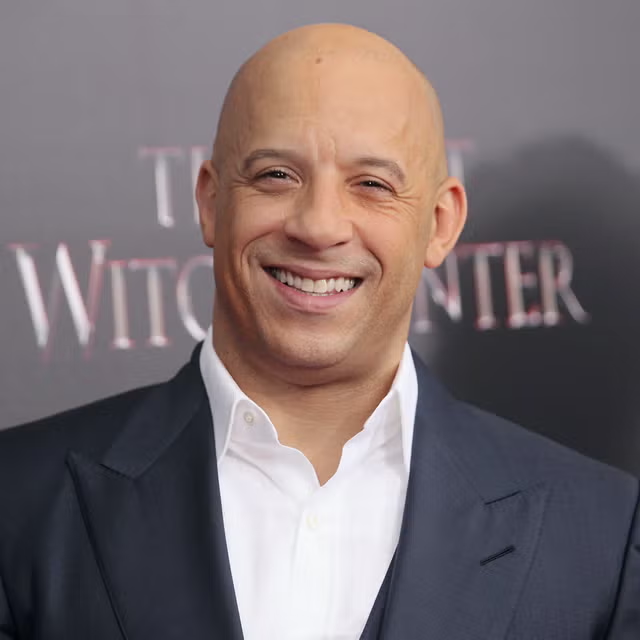
The Before: Mark Sinclair, a Theater Break-In, and the Name He Invented at the Door
Subsequently, mark Sinclair was born on July 18, 1967, in Alameda County, California, and raised in a Manhattan artist’s co-op by a mother who was an astrologer and a stepfather who was a theater manager and acting instructor. He never knew his biological father. Meanwhile, he has described his ethnicity as “ambiguous” — a word that in Hollywood translates to “difficult to cast.” He has a fraternal twin brother, Paul Vincent, who became a film editor. Indeed, the family was creative, multiracial, modestly resourced, and immersed in the performing arts in the way that New York families sometimes are: not as aspiration but as atmosphere.
Ultimately, at seven years old, he and a group of friends broke into a theater in Greenwich Village with the intention of vandalizing it. By contrast, a woman stopped them and offered each of them a script and $20, on the condition that they return every day after school. The bribe worked. The vandal became an actor. In particular, he performed in his stepfather’s repertory company and on the Off-Off-Broadway circuit through his teenage years.
Even so, at seventeen, already built like a man twice his age, he took a job as a bouncer at the Tunnel and the Palladium — two of New York’s most notorious nightclubs. Specifically, the job required a name that sounded harder than Mark Sinclair. As a result, he assembled one from spare parts: “Vin” from his mother’s married name, Vincent, “Diesel” from his friends’ description of his energy. The name was a costume. The costume became the career. However, the kid who broke into a theater to destroy it got a script and $20 instead, and the bouncer who invented a name to sound dangerous became the highest-grossing action star of his generation.
The Pivot Moment: Multi-Facial, Spielberg’s Phone Call, and the $100,000 That Changed Everything
Similarly, Diesel attended Hunter College in New York, studying creative writing before dropping out to pursue filmmaking. Despite this, the pursuit looked nothing like the version Hollywood tells about itself. In turn, he worked as a telemarketer selling lightbulbs during the day and bounced clubs at night. Regardless, he auditioned constantly and landed the role almost never. Still, the multiracial actor with the ambiguous ethnicity did not fit the boxes that casting directors used to organize the world. Even so, he could play Italian, Dominican, Middle Eastern, or racially indeterminate — and therefore could not play any of them convincingly enough for an industry that preferred its categories clean.

That said, in 1994, he solved the problem by removing the industry from the equation. Additionally, he wrote, directed, produced, scored, and starred in Multi-Facial — a twenty-minute short film about a multiracial actor stuck in the audition process, unable to get cast because he doesn’t look enough like anything for anyone to know what to do with him. The film was autobiographical in every frame. It earned selection for screening at the 1995 Cannes Film Festival. Steven Spielberg saw it. The phone call that followed changed the trajectory: Spielberg was so impressed that he wrote a role specifically for Diesel in Saving Private Ryan (1998).
The Turning Point
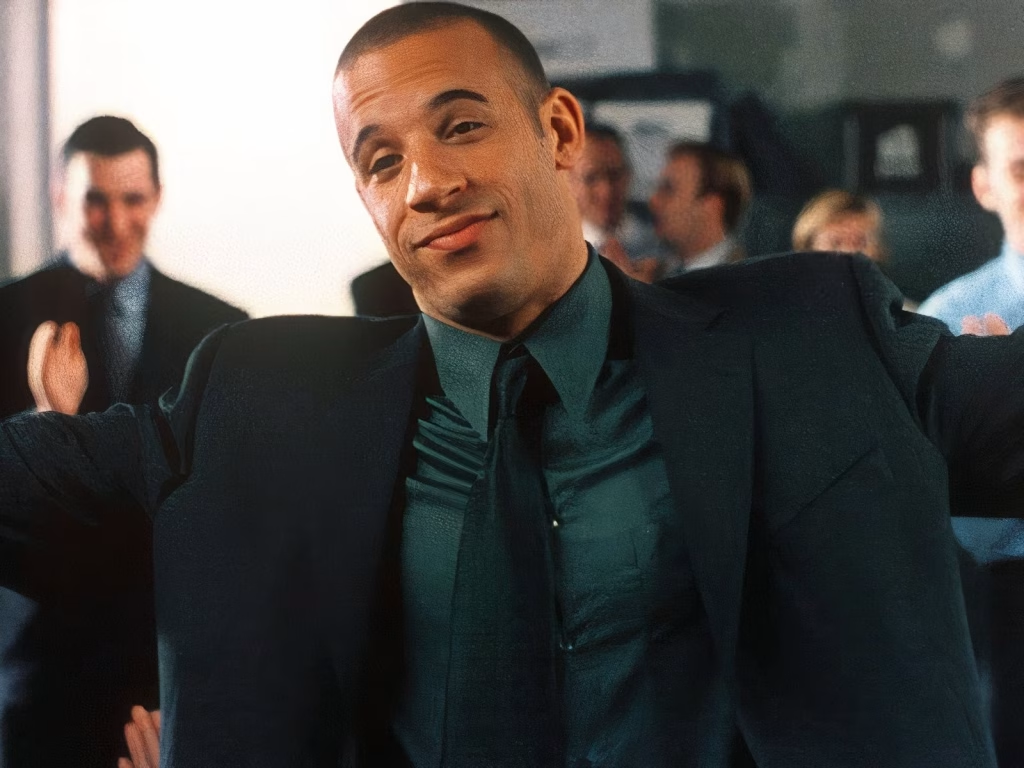
That said, the part — Private Adrian Caparzo — paid $100,000. Boot camp training with Tom Hanks, Giovanni Ribisi, Edward Burns, and Barry Pepper preceded filming. Two years later, Diesel and Ribisi reunited in Boiler Room, where Diesel played Chris Varick — a senior broker who understands the machine’s mechanics and moral cost but stays because leaving would mean becoming someone he no longer knows how to be. In 2001, The Fast and the Furious paid him $2 million to play Dominic Toretto. The franchise would eventually gross over $7 billion. The salary escalation from $100,000 to $2 million to $47 million per film is the steepest earnings curve of any actor in the canon.
The Climb: Turning Down $25 Million and the Cameo That Bought a Franchise
Notably, the decision that defines Vin Diesel’s career — and separates him from every other action star of his generation — occurred in 2003, when he turned down a reported $20 to $25 million to reprise Dominic Toretto in 2 Fast 2 Furious. The sequel was guaranteed money. Nevertheless, the franchise was a proven commodity. Every financial advisor, every agent, every rational calculation said take the check. Diesel declined. He wanted to make The Chronicles of Riddick, a big-budget science fiction film built around a character he had originated in the cult hit Pitch Black (2000). Riddick was his passion project — the role he cared about, the franchise he wanted to own. Chronicles bombed at the box office. The industry concluded he had made a catastrophic error. The industry was wrong.
In 2006, Universal was struggling to save the Fast franchise with The Fast and the Furious: Tokyo Drift. Test screenings were poor. Executives needed a connection to the original films. They begged Diesel for a surprise cameo in the final scene. Diesel agreed. His appearance lasts slightly over one minute.
Additionally, he refused a traditional acting fee. Instead, he demanded that Universal relinquish all ownership and cinematic rights to the Riddick franchise. The studio, desperate, agreed. Diesel traded sixty seconds of screen time for an entire intellectual property. In 2013, the first Riddick film under his ownership arrived: a budget $40 million, gross of $100 million. The cameo-for-franchise swap is the single most sophisticated deal in the Wall Street cinema canon — and it was executed by a man playing a character who, in Boiler Room, understood exactly how the pump-and-dump worked. The difference is that Diesel’s trade created value rather than extracting it.
The Success Formula: Backend Points, One Race Films, and How a $2 Million Salary Became $54 Million
Vin Diesel’s wealth is not primarily the product of acting fees. It is the product of ownership. His production company, One Race Films, has produced multiple installments of the Fast and Furious franchise, ensuring that Diesel profits not just as an actor but as a principal stakeholder in the commercial performance of each film. The distinction between salary and equity is the distinction between working for someone and owning something — the exact lesson that Wall Street‘s Carl Fox never learned and Gordon Gekko exploited. Diesel learned it without the Oscar or the MBA. He learned it at the door of the Tunnel, where the bouncer gets paid by the hour and the owner gets paid by the night.
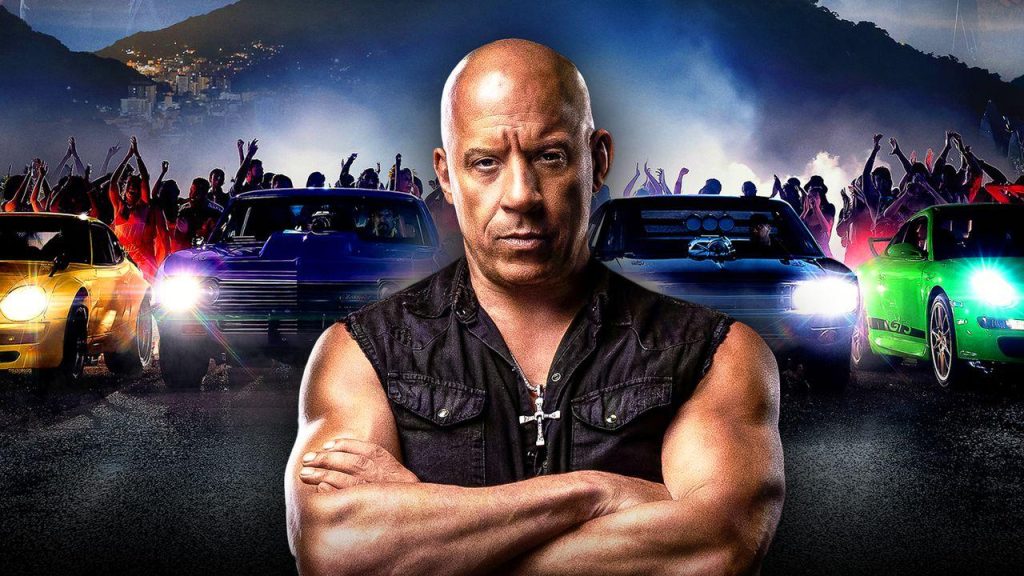
The numbers tell the story of the strategy. The Fast and the Furious (2001): $2 million salary. Fast Five (2011): $15 million. Furious 7 (2015): base salary plus backend equity points that netted him approximately $47 million — the film grossed $1.5 billion worldwide. The Fate of the Furious (2017): $54.3 million total compensation, driven largely by his producer’s cut of a film that crossed $1.2 billion. Across all Fast and Furious installments, Diesel’s cumulative earnings from the franchise alone are estimated at over $150 million. Add the Riddick franchise he owns outright, the $13 million earned voicing three words (“I am Groot”) across the Marvel Cinematic Universe’s Guardians of the Galaxy films, and the xXx franchise, and the total career earnings approach $300 million on films that have grossed over $11 billion worldwide.
Behind the Numbers
The formula is replicable in theory and almost impossible in practice. It requires three conditions: a franchise with global appeal, a star whose absence demonstrably damages the franchise’s value (proven by the weak performance of sequels made without him), and the willingness to walk away from guaranteed money in the short term to secure ownership in the long term. Diesel satisfied all three. He walked away from $25 million in 2003. He traded a cameo for a franchise in 2006.
Furthermore, he returned to Fast and Furious as both star and producer, ensuring that every subsequent installment made him richer not just as an employee but as an owner. Ben Affleck built Artists Equity on the same principle — creative talent should own equity, not rent it. Diesel arrived at the same conclusion a decade earlier, without the Harvard-adjacent pedigree or the Oscar. He arrived at it from the door of a nightclub, where the math is simpler: the guy checking IDs goes home with a few hundred. The guy whose name is on the building goes home with everything else.
What He Built: Groot, Paul Walker, and the Franchise as Family
The Fast and Furious franchise has generated over $7 billion in worldwide box office. Diesel has appeared in ten of its films. His performance as Dominic Toretto — a character whose dialogue consists largely of variations on the word “family” — resonates with global audiences in a way that transcends the films’ quality, which ranges from serviceable to absurd. Toretto is not a complex character. He is a simple one, drawn with the broad strokes required by a franchise that plays in every country on earth. The simplicity is the product, not the limitation. Diesel understood, before most actors of his generation, that the global action market rewards consistency over range. His contemporaries — Affleck, Damon, DiCaprio — pursued the auteur path: different directors, different genres, the Oscar as the ultimate validation. Diesel pursued the franchise path: same character, same values, same audience, compounding returns.
The death of Paul Walker on November 30, 2013, during the production of Furious 7, is the emotional center of the franchise and of Diesel’s public life. Walker was killed in a car accident while a passenger in a Porsche Carrera GT. The irony — an actor famous for driving fast cars dying in one — is the kind of cruelty that Hollywood normally processes through tabloid coverage and then forgets. Diesel refused to forget.
What the Record Shows
Moreover, he named his third daughter Pauline in Walker’s honor. He has spoken publicly and repeatedly about Walker’s influence on his life, his career, and his understanding of what the word “family” actually means when it is not being used as a marketing slogan. Furious 7 wrapped up using a combination of Walker’s existing footage and digital effects applied to his brothers, Cody and Caleb, who served as stand-ins. The film grossed $1.5 billion worldwide — the franchise’s highest total — and its final scene, in which Toretto and Walker’s Brian O’Conner drive side by side before their roads diverge, is one of the few moments in blockbuster cinema where the grief on screen is indistinguishable from the grief behind it.
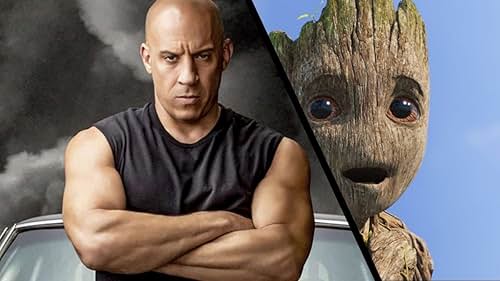
Diesel’s voice performance as Groot in the Marvel Cinematic Universe adds a peculiar footnote to a career built on physical presence. He earned a reported $13 million across multiple films for delivering the same three words in varying emotional registers: “I am Groot.” The casting is inspired: the most physically imposing action star of his generation, reduced to a voice inside a tree, discovering that the smallest performance can be the most expressive. The role requires no muscles, no stunts, no car chases. It requires the ability to communicate longing, humor, sacrifice, and love through three syllables. Diesel does it. The Dungeons and Dragons enthusiast — he wrote the foreword for the game’s 30th anniversary book — who spent his childhood in a Manhattan artist’s co-op, performing in his stepfather’s theater company, was always more than the physique suggested. The physique just arrived first.
The Soft Landing: $225 Million and the Bouncer Who Became the Owner
Vin Diesel’s net worth stands at approximately at $225 million. He has been in a relationship with Mexican model Paloma Jiménez since 2007. They have three children: Hania Riley, Vincent Sinclair, and Pauline. He collects muscle cars — a 1969 Dodge Charger Daytona, a 1970 Chevrolet Chevelle, a Lykan Hypersport — with the devotion of a man whose franchise rests on on them. He maintains a relatively private life for someone whose films have been seen by virtually every person on earth with access to a movie theater. Notably, he does not appear on magazine covers for his relationships. He does not generate tabloid content. He promotes his films, parents his children, and prepares for the next installment of the franchise that has defined the twenty-first century’s global action market.
The Boiler Room connection is the skeleton key to understanding Diesel’s career. Chris Varick is a broker who stays inside a corrupt system because leaving would mean starting over as someone he doesn’t recognize. Diesel played the role in 2000, one year before The Fast and the Furious made him a star. He then spent the next twenty-five years doing the opposite of what Varick does: instead of staying inside someone else’s system, he built his own. One Race Films. The Riddick ownership trade. Backend equity points on every Fast film.
Behind the Numbers
Consequently, the progression from $2 million employee to $54 million owner. Every spoke in the Wall Street cinema canon tells a story about people trapped inside financial systems. Diesel is the spoke that tells the story of a person who escaped one. The bouncer who invented a name because Mark Sinclair didn’t sound dangerous enough became the man who owns his own franchise because $25 million didn’t sound permanent enough. The name was a costume. In fact, the ownership is real. The $225 million is what happens when a kid who broke into a theater gets a script instead of a police report, and spends the next forty years making sure he never has to break into anything again.
Related: Boiler Room True Story: The Long Island Pump-and-Dump That Hollywood Told Twice · Giovanni Ribisi Net Worth · Ben Affleck Net Worth · Wolf of Wall Street True Story · The Wall Street Movies That Rewired How America Thinks About Money
If you’ve ever understood that owning a piece of something is worth more than being paid to show up for it — then you already know why Social Life Magazine exists. We cover the people who build, not just the people who perform. Reach out to our editorial team to be featured.
Want to position your brand alongside the culture that understands ownership? Submit a Paid Feature and let our editors build something worth reading.
The Deeper Story
Join 82,000+ subscribers who get our take on luxury, culture, and the Hamptons scene before anyone else. Subscribe to our email list.
Experience the intersection of sport, style, and status at Polo Hamptons — Bridgehampton’s premier luxury polo event, now in its seventh year with BMW as title sponsor.
Never miss a print issue. Subscribe to Social Life Magazine and get five summer issues delivered from Memorial Day to Labor Day.
Love what we do? Support Social Life Magazine and help us keep covering the culture that matters.
Author

Written by
Recent Posts

He’s Got Millions. He Still Flinches at the Bill.

Streamlining Ground Station Data Pipelines for Deep Space Missions

The Coordination Problem That Kills Growing Marketing Teams
Why Personalized Skincare Is Replacing One-Size-Fits-All Beauty Products
The Return of the Transatlantic Crossing
Categories
- Art
- Articles
- Business of Luxury
- Celebrities
- Culture
- Entertainment
- Events
- Faces of Summer 2026
- Fashion
- Fashion & Style
- Featured
- Finance
- Food, Spirits, Wine
- Hamptons
- Hamptons Celebrities
- Health
- Health & Beauty
- Lifestyle
- Luxury Lifestyle
- Press
- Profiles
- Real Estate
- Technology
- The Chronicles
- Travel
- Uncategorized
- Weddings