
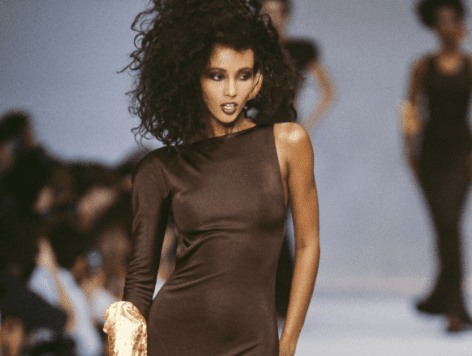
She was standing in the lobby of a Manhattan hotel in 1994, watching a cosmetics executive explain why her business idea would fail. The market was too small, he said. Black women didn’t spend enough on beauty products to justify a dedicated line.
Iman smiled. She had heard variations of this dismissal her entire career. Too exotic for American covers, too African for European runways—too much of everything the industry claimed it didn’t want.
Three decades later, that cosmetics line she launched anyway generates millions annually. Her total net worth sits at $200 million. The executive who doubted her retired into obscurity years ago.

The Myth Everyone Believed
The story the culture tells about Iman is simple: discovered by photographer Peter Beard in Nairobi. Lied about being a goat herder to generate mystique. Became one of the most photographed faces of the 1970s and 80s. Married David Bowie. Lived glamorously ever after.
That narrative obscures everything interesting about how she built her fortune. Iman understood something her peers never grasped: the modeling industry would extract maximum value from her image while paying minimum rates. The real money lived elsewhere.
The Reality Behind the Glamour
Born Zara Mohamed Abdulmajid in Mogadishu, Somalia, she spent her childhood navigating worlds. Her father was a diplomat. Her mother was a gynecologist. She attended boarding school in Egypt starting at age four. By the time Beard encountered her in 1975, she was studying political science at the University of Nairobi.
The “discovery” story was manufactured drama. Beard needed narrative to sell. Iman needed entry into an industry that barely acknowledged Black models existed. They both understood the transaction.
Within weeks of arriving in New York, she commanded $8,000 per shoot while her peers averaged $1,000. Not because she was more beautiful. Because she controlled her own mythology. That’s leverage.
The Leverage Moment That Changed Everything
By the late 1980s, Iman had worked with every major designer: Yves Saint Laurent, Calvin Klein, Gianni Versace. She had appeared on more magazine covers than most models dream of. She had also hit modeling’s inevitable ceiling.
The industry wanted younger faces. The obvious move was graceful retirement into marriage and motherhood. Instead, Iman made a calculation that would define her financial future.

Finding the Gap
Every department store cosmetics counter in America featured the same shades: colors designed for Caucasian skin tones. Women of color improvised. They mixed foundations, adjusted undertones, accepted imperfect matches. An entire market segment was being ignored by billion-dollar beauty conglomerates.
In 1994, Iman launched Iman Cosmetics, targeting women with skin tones the industry had dismissed. The skeptics who predicted failure watched as the brand became one of the top-selling color cosmetics lines on the Home Shopping Network.
She didn’t just sell makeup. She sold representation. That’s a different business model entirely.
The Compounding Effect of Strategic Marriage
In 1990, Iman met David Bowie at a dinner party. They married two years later. For the next 24 years until his death in 2016, they maintained one of music and fashion’s most private partnerships.
The privacy was strategic. Every celebrity couple of that era monetized their relationships: joint interviews, matching endorsements, reality television offers. Bowie and Iman refused all of it. They understood that scarcity increases value.
The Estate Position
When Bowie died, his estate was valued at approximately $230 million. According to his will, Iman received their SoHo penthouse apartment plus half of the remaining estate. In January 2022, Bowie’s estate sold his publishing catalog for $250 million. Iman’s share resulted in approximately $125 million before taxes.
But here’s what the tabloid accounting misses: Iman didn’t need that money. Her cosmetics line, her Global Chic fashion collection for HSN, her ongoing consulting work had already secured her financial independence. The Bowie inheritance was addition, not foundation.

The Legacy Architecture
Today, Iman operates with a portfolio that her 1970s peers could never have imagined. Her cosmetics line continues to generate revenue. Her fashion collections have sold millions of pieces. She serves on multiple boards and commands substantial speaking fees.
More importantly, she owns these assets. Unlike models who license their names for one-time payments, Iman retained equity positions. That’s the difference between being paid for work and owning the work itself.
What She Owns vs. What She Represents
The breakdown tells the real story:
Owned assets: Iman Cosmetics brand equity, Global Chic inventory and licensing, SoHo real estate valued at approximately $30 million, Bowie estate holdings including ongoing music royalties, personal investment portfolio.
Representation value: Cultural ambassador status for Somali diaspora, living symbol of fashion industry transformation, editorial credibility with major publications, philanthropic positioning with UNICEF and other organizations.
The second category generates the first. That’s how dignity compounds into dollars.
The Hamptons Connection
While Iman’s primary residence remains the SoHo penthouse she shared with Bowie, her social orbit intersects regularly with the Hamptons scene. Her daughter Alexandria Zahra Jones, born in 2000, has appeared at East End events. The fashion industry connections that defined Iman’s career remain concentrated in the summer social calendar of Southampton and East Hampton.
For readers who understand the codes, Iman represents something specific: wealth that doesn’t need to announce itself. She could attend any Hamptons benefit and command the room through presence alone. That she rarely does says everything about her relationship to visibility.

The Investment Philosophy
What separates Iman from her contemporaries isn’t luck or marriage. It’s a consistent approach to value creation:
Own, don’t rent. When the industry offers licensing deals, negotiate equity instead. When brands want your face, require participation in the business.
Address ignored markets. The biggest opportunities exist where established players refuse to look. Women of color weren’t an afterthought to Iman. They were her primary market.
Protect the asset. Her image, her privacy, her relationships all received the same careful management. Nothing was commodified unnecessarily.
Compound through restraint. Each refusal increased the value of each acceptance. Every turned-down interview made the rare appearance more valuable.

The Final Calculation
At 69 years old, Iman possesses something few in her industry ever achieve: complete optionality. She doesn’t need the next campaign, the reality show, or to monetize grief and trade on nostalgia.
Her $200 million fortune is significant. But the real wealth is simpler: she can do exactly what she wants, when she wants, with whom she wants. In an industry that treats models as disposable commodities, that independence is the ultimate leverage.
The executive who doubted her cosmetics line in 1994 was right about one thing. The market was underserved. He just drew the wrong conclusion about what that meant.
Related Articles
- Beverly Johnson Net Worth 2025: The Barrier-Breaker’s Blueprint
- Naomi Campbell Net Worth 2025: The Gatekeeper’s Empire
- Tyra Banks Net Worth 2025: The Reinvention Engine
For features, advertising, and partnership inquiries, visit sociallifemagazine.com/contact. For exclusive events, see polohamptons.com. Subscribe to our print edition for full profiles delivered to your door.
Author

Written by
Recent Posts

What the Best-Dressed Crowd in the Hamptons Reveals About Taste

Why Celebrities and Investors Gravitate Toward the Same Rooms

Why Polo Continues to Attract Power Across Generations

Why Multi-Generational Wealth Still Gathers at Polo

What Executives Actually Remember After a Great Afternoon
Categories
- 2025 Social Life Events
- Access to Digital + Physical Magazine
- Art
- Articles
- Beauty & Skincare
- Beauty & Wellness
- Business Strategy
- Celebrities
- Chronicles
- Event Photos
- Events
- Family
- Fashion
- Fashion & Style
- Featured
- Food & Beverage
- Food, Spirits, Wine
- Hamptons Celebrities
- Health
- Health & Beauty
- Home & Design
- Home & Living
- Lifestyle
- Luxury Lifestyle
- Press
- Profiles
- Real Estate
- Technology
- The Chronicles
- Travel
- Trending
- Uncategorized
- Weddings
- Wellness