
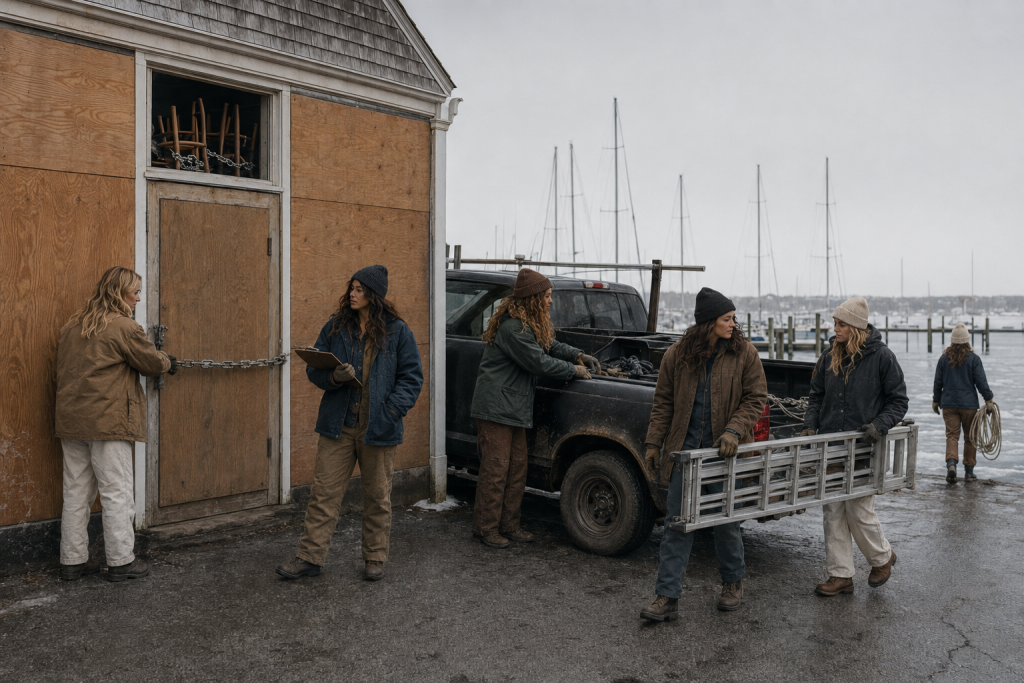
Chloë Sevigny plays Tatum, and Tatum is the reason this show is worth a book.
She is the year-rounder. Hollis’s childhood friend, still on the island, still there in February when the restaurants close and the ferry gets ugly. Everyone else flies in. Tatum was already home.
The character the summer colonies never write
American wealth drama has a standard local. He fixes something, he says something wise, and then he leaves the frame. His job is to authenticate the protagonist’s taste.
Tatum refuses that job. She arrives at the weekend in the middle of a cancer scare, she is not grateful for the invitation, and she does not exist to certify anyone. When the finale confirms that the lump was not benign, the show does something almost unheard of. It gives the local character a plot that has nothing to do with the rich people.
That is the first honest year-rounder in a decade of summer-colony television.
The East End version of the same person
Everyone on the East End knows Tatum. She runs the front of house in Sag Harbor from April to October. She is the third generation in Springs, and her grandfather framed half the houses now listed at $9 million. Her kid goes to school with the kids who arrive in June and leave in September.
She has watched her town become a product. Also, she cannot afford to live in the product.
The numbers make it concrete. A $2.5 million median means the ordinary house on the East End is now priced for somebody whose income does not come from the East End. That is not a housing market. It is a replacement.
Why the summer people need her more than she needs them
Here is the part the seasonal class rarely says at dinner. The entire fantasy runs on year-round labor.
Somebody opens the house in May and closes it in October. Somebody has the plumber’s cell number. Someone knows which nursery actually delivers, which caterer will take a Tuesday, and which contractor will answer in January when a pipe splits. That knowledge is capital, and it is held almost entirely by people who cannot buy in.
Because the knowledge is invisible, it gets priced at nothing. Because it is priced at nothing, it keeps leaving.
The February test
Here is a reliable way to sort anyone in a summer colony, and it takes one question. Where were you in February?
February is when the restaurants close, the beaches turn hostile, and the population drops by an order of magnitude. Nobody performs in February, because there is no audience for it.
Anyone who can answer that question honestly holds a form of standing that money does not produce. So the test is not about virtue. Rather, it is about which people the place actually belongs to when the place stops being profitable.
What the year-round economy is worth
Consider what a single seasonal house requires across twelve months. Opening and closing, landscaping, pool service, plumbing, electrical, a caretaker, alarm monitoring, and a person who will drive over during a nor’easter.
Multiply that by thousands of houses. The result is an entire economy that exists to keep empty buildings ready, and it employs people who increasingly commute in from further west because they cannot live near the work.
That commute is the real story of the East End in this decade. Because the labor keeps moving away, response times lengthen, prices rise, and the fantasy gets more expensive to maintain each year. Nobody has priced that into a listing yet.
What Tatum knows about the guest list
The most quietly devastating fact in the show is structural. Tatum is invited to a weekend that takes place in her own town.
Think about what that requires. Her home became a destination, and then she had to be summoned into it by someone who arrived later and stayed less. She accepts, of course, because Hollis is genuinely her friend. Still, the geometry is humiliating and the show knows it.
Any year-rounder on the East End who has been invited to a party thrown by a family that bought in 2021 has felt exactly this. You are a guest at your own address.
Author

Written by
Recent Posts
How to Reduce Frown Lines: Treatments, Habits, and Long-Term Strategies

French Heritage Society
The Rise of Premium Supplement Brands
Manocha Bespoke
5 Ways To Make Money From Items You Already Own
Categories
- Art
- Articles
- Business of Luxury
- Celebrities
- Culture
- Entertainment
- Events
- Faces of Summer 2026
- Fashion
- Fashion & Style
- Featured
- Finance
- Food, Spirits, Wine
- Hamptons
- Hamptons Celebrities
- Health
- Health & Beauty
- Lifestyle
- Luxury Lifestyle
- Press
- Profiles
- Real Estate
- Technology
- The Chronicles
- Travel
- Uncategorized
- Weddings