
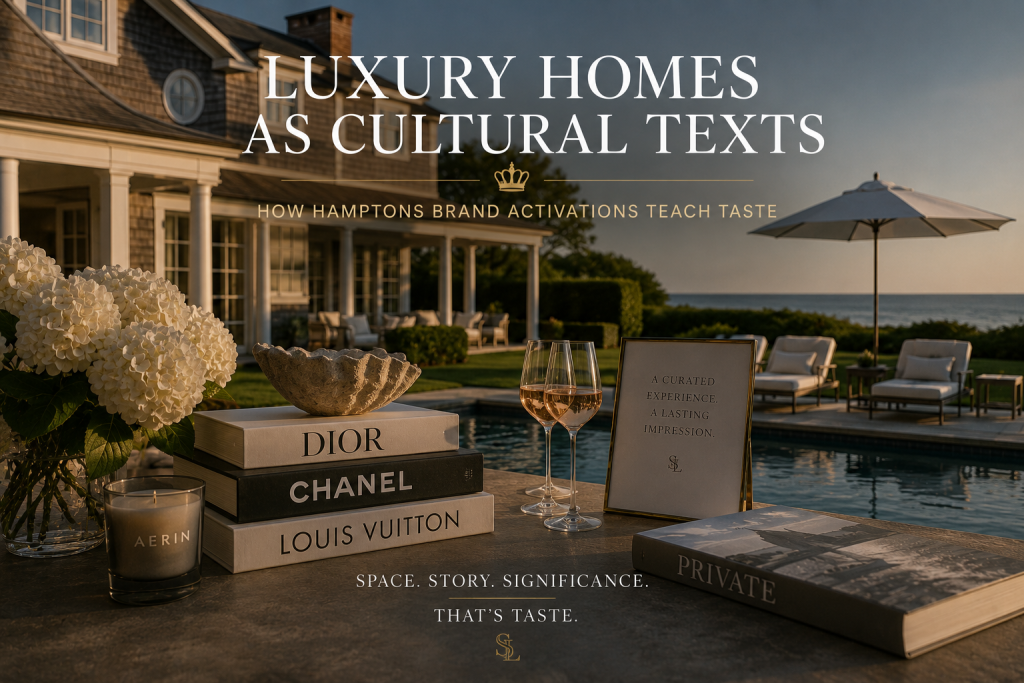
The smartest marketing move on the East End this summer is not a billboard, a takeover, or a pop-up. It is a guest room. A Hamptons brand activation staged inside an actual house, on an actual porch, over an actual weekend, now outperforms almost every conventional placement a luxury brand can buy out here, and the reasons run deeper than novelty. A house teaches what a media plan cannot, which is the code.
Camille Paglia read buildings and paintings as arguments about power, a method our series hub applies to the whole East End in how taste becomes power in the Hamptons. Apply the same reading to a Sag Harbor guest house with a brand inside it and you find something closer to a school than a campaign. Here is how the classroom works, and why the tuition pays.
The Problem the House Solves
Luxury brands arrive in the Hamptons with a recurring wound. They can buy visibility instantly, yet visibility is precisely what the local hierarchy discounts. A banner on Route 27 announces need. A store on Main Street announces ambition. Neither one grants the thing the brand actually came for, which is standing among people whose approval moves markets.
Standing cannot be purchased directly, because the East End prices it in time and context rather than dollars. But standing can be borrowed. A house with the right address, the right rooms, and the right guest list lends its accumulated context to whatever sits inside it. That loan is the entire activation business, properly understood.
A Room Is an Argument
Paglia insisted that every aesthetic object makes a claim, and rooms make the densest claims of all. Consider a candle. On a shelf in a SoHo store, it is inventory, one option among forty. On a marble console in a Sag Harbor sitting room, beside someone’s reading glasses and a sweating glass of rosé, the same candle becomes evidence of a life. The product has not changed. The argument around it has.
Context is not packaging, in other words. Context is meaning. A brand activation that understands this stops decorating the house with product and starts casting the product in the house’s ongoing story. Guests should discover the brand the way they discover a host’s taste, gradually, by living alongside it.
Immersion Beats Instruction
Nobody learns the Hamptons codes from a deck. Agencies have tried for decades, and the decks always miss, because codes are embodied knowledge, like accent or posture. The only reliable transmission method is immersion. A brand team that spends a weekend inside a correctly run house absorbs a hundred calibrations no brief could carry. How loud the music sits. When dinner actually starts. Which gestures of hospitality land as generous and which land as trying.
This is aesthetic pedagogy, teaching taste by exposure rather than explanation. The house is the faculty. Its habits, its objects, and its guests do the instructing, while the brand believes it is merely hosting a summer event. The best activations are the ones where the client leaves changed.
The Guest List Is the Media Plan
An activation house does not need a thousand visitors. It needs the correct forty. Out here, reach is a vanity metric and density is the real one, because the East End operates through witnessed moments among people who already hold standing. One editor, two founders, a committee chair, and a collector on a porch at golden hour produce more durable value than any impression count a platform can report.
So the guest list is the media plan, and building it is the hardest work in the category. Names must be earned through relationships rather than rented through lists. This is also why the activation business belongs to hosts with tenure, not to agencies with budgets. The room follows people it already trusts.
The Weekend Arc
A house activation runs on rhythm, and the rhythm has a shape. Friday evening opens quietly, drinks and a small dinner, the brand present but silent. Saturday builds through the day, a lunch, an outing, perhaps the polo field itself, with the house as base camp. Saturday night carries the peak, the dinner where the brand’s story finally gets told, briefly, by a person rather than a screen. Sunday closes soft, coffee and papers and unhurried goodbyes.
Notice what never happens in that arc. No presentation. Not one step-and-repeat. At no point do guests feel converted from company into audience. The instant a weekend starts performing, the spell breaks and the house becomes a venue, which any hotel could be.
The Polo Weekend Multiplier
Timing compounds everything above, and this month offers the proof. Polo Hamptons runs July 18 and July 25 at the Fishel Estate in Bridgehampton, and a house activation anchored to those dates borrows the field’s gravity. Guests arrive Friday already holding Saturday plans of unimpeachable quality. The house becomes the before and the after, the place where the sideline’s introductions get a second act over dinner.
Because the field supplies the occasion, the house is freed from manufacturing one. That division of labor matters more than it sounds. Events invented by brands must justify themselves, while events attached to institutions inherit justification. A brand hosting a polo weekend house is not asking anyone to attend its marketing. It is offering hospitality around something real, and the room can tell the difference blindfolded.
The Photography Problem, Solved
Luxury brands spend heavily to fake what a house produces for free, which is context that photographs true. Studio work reads as studio work, especially to this audience. A house weekend generates imagery no set can match, since the settings are real, the people are real, and the light off Sag Harbor at seven in the evening has no synthetic equivalent.
Still, discipline applies. One photographer, working quietly, produces the archive. Guests are never posed, and phones stay largely in pockets by unspoken agreement, because the absence of performance is what makes the images rare. The result is a season of content with the one quality money cannot art-direct, which is that it actually happened.
Anatomy of a Porch That Worked
The pattern, drawn from seasons of these weekends, runs like this. A European house goods brand takes a Sag Harbor property for a July weekend, anchored to the polo dates. Forty guests cycle through, never more than eighteen at once. The brand’s objects furnish the house without labeling it, and the founder tells the story once, at Saturday dinner, in four minutes.
By Labor Day the ledger reads as follows. Two retail conversations opened by guests, not chased. One editor commissioning a fall piece on her own initiative. A dozen households now using the product because they left with it, and speaking of it because they use it. Nothing in that ledger appears in a weekend recap deck, yet all of it is the point.
What It Costs, What It Returns
Priced honestly, a serious house activation runs against the same budget lines as a season of conventional placement, and the comparison clarifies quickly. Placement buys exposure that expires. The house buys three assets that compound. First, relationships with named individuals who now associate the brand with a weekend they enjoyed. Second, photography with real context, worth a year of content. Third, and largest, the brand’s own education in the codes, which improves every dollar it spends out here afterward.
The return shows up in February, not August. It arrives as a call taken, an introduction offered, an invitation extended to the next room up. Brands that measure activations in weekend impressions are reading the wrong ledger entirely.
Choosing the House
Not every pretty property qualifies, because the asset is context, and context is specific. The house needs an address with standing, rooms that photograph as lived-in rather than staged, and above all an operator who holds real relationships on the East End. A gorgeous rental with a cold guest list is a stage set. A modest house with the right forty people is an institution for the weekend.
Ask one question before signing anything. Who, exactly, will be on the porch? If the answer is a demographic, walk away. If the answer is names, and the names make you sit up, the house is doing its job before the deposit clears.
The Calendar Is Half the Asset
An activation house in February is a house. In July it is a position, and the position appreciates by the week. The Hamptons season compresses a year of social capital formation into roughly fourteen weeks, bracketed by Memorial Day and Labor Day, with the polo dates and the benefit calendar as its load-bearing beams. A brand that books around those beams inherits their traffic.
Late arrivals learn this expensively. By June, the correct guests hold full calendars, and a house without an anchor event is competing against institutions for attention. The operators who do this well begin building weekends in March, matching brands to dates the way a gallerist matches artists to fairs. Houses are inventory. The calendar is the market.
Three Mistakes That Sink the Weekend
Failure in this format follows patterns, and three recur. First, over-branding the rooms, since a house that reads as a showroom forfeits the borrowed intimacy it was rented for. Second, over-inviting, because sixty guests turn a porch into a venue and a venue into an obligation. Third, chasing coverage during the weekend itself, given that the guests most worth having are precisely the ones who came because coverage was not the point.
Each mistake shares a root, which is impatience. The house format pays on relationship time, not campaign time. Brands that need August numbers should buy August media. Brands building a decade on the East End should buy the porch.
The Paglia Test
Every activation should pass a simple audit borrowed from the critic herself. Does the weekend treat guests as initiates or as targets? Initiates are being taught a world, and they can feel the respect in that. Targets are being sold a product, and they can feel that too, usually within an hour. The entire premium of the house format collapses the moment guests feel targeted.
Taste, Paglia argued, is power made visible without force. A great activation is persuasion made invisible without pressure. The house that gets this right does not look like marketing at all. It looks like a very good summer, remembered warmly, with a brand somewhere inside the memory.
Where The Conversation Continues
This piece is part of our series on East End status machinery, anchored by the Paglia hub on taste and rank. For the field where these codes get enforced in public, read the Polo Hamptons gatekeepers piece. For why print coverage completes what a weekend begins, see online discovery versus print consecration. Social Life Magazine operates activation properties in Sag Harbor with the guest lists described above. Inquiries move faster in July than the porches suggest.
Author

Written by
Recent Posts

AI for personal finance: where PennyGuard fits

How to Pick a Homecoming Dress for Your Body Type (and Feel Amazing in It)

World Cup Injury Attorney for Vancouver Events
What a 3-Carat Engagement Ring Actually Costs in 2026: The Real Numbers
The Skincare Habits That Make a Real Difference Over Time
Categories
- Art
- Articles
- Business of Luxury
- Celebrities
- Culture
- Entertainment
- Events
- Faces of Summer 2026
- Fashion
- Fashion & Style
- Featured
- Finance
- Food, Spirits, Wine
- Hamptons
- Hamptons Celebrities
- Health
- Health & Beauty
- Lifestyle
- Luxury Lifestyle
- Press
- Profiles
- Real Estate
- Technology
- The Chronicles
- Travel
- Uncategorized
- Weddings