
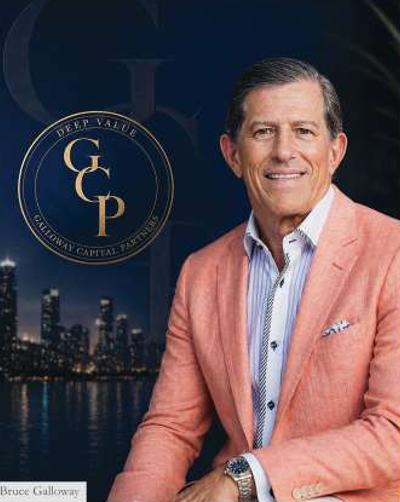
In an age increasingly shaped by algorithms and artificial intelligence, one lifelong value investor believes the most compelling opportunities still begin with something technology cannot replicate: human judgment.
On a summer afternoon in the Hamptons, conversations often drift toward the future. Artificial intelligence. Disruptive technologies. The next transformative investment trend.
Bruce Galloway has heard them all.
After decades as an investor, corporate executive, and activist shareholder, he has come to appreciate a simple reality: while markets evolve, human nature rarely does. In today’s increasingly automated world, that may be creating some of the most compelling investment opportunities of all.
Long before algorithms began influencing markets, Galloway was captivated by numbers.
Growing up in New York, he devoured almanacs and encyclopedias, not simply to satisfy his appetite for information, but to uncover patterns, relationships, and hidden connections. Numbers fascinated him. So did probabilities.
That fascination eventually led him to the stock market.
While most teenagers spent their free time elsewhere, Galloway was studying financial statements and valuation metrics. He was drawn to a deceptively simple idea: if a business was worth more than its market price, eventually investors would recognize the discrepancy.
Even at thirteen, he was already thinking like a value investor.
Armed with little more than his modest weekly allowance, Galloway developed an early talent for poker and turned his winnings into nearly $3,000. His aunt, a stockbroker, gave him a copy of the S&P 500, which he read cover to cover before investing in what he believed were the six most undervalued companies in the index.
It was an early lesson that would help shape the rest of his career.
His affinity for mathematics earned him admission to Stuyvesant High School, where he achieved a perfect score on the mathematics SAT. He later attended Hobart and William Smith Colleges on a full scholarship. By college, he was already teaching fellow students the principles of fundamental and technical analysis.
More than half a century later, that same philosophy remains at the heart of his investment approach.
When Irrationality Creates Opportunity
Today’s market operates very differently from the one Galloway first encountered as a teenager.
Trillions of dollars now move automatically through index funds and ETFs. Algorithmic strategies react to headlines in milliseconds. Artificial intelligence increasingly influences everything from trading decisions to capital allocation. The growing influence of automated strategies can amplify momentum and crowding effects, at times pushing valuations away from underlying business fundamentals.
For Galloway, this irrationality can create opportunity, provided an investor is willing to do the work.
Smaller public companies often become overlooked by Wall Street regardless of improving operations, strengthening balance sheets, or attractive valuations. Companies making meaningful progress may remain largely ignored simply because they fall outside the criteria that drive automated capital flows or traditional research coverage. In essence, they are abandoned by Wall Street. To Galloway, it represents fertile ground.
We believe some of the best opportunities arise when markets become highly irrational and overly focused on trends and lose sight of fundamentals.
Since 2018, Mr. Galloway has been generating annualized net returns in excess of 50%.
That strategy is the cornerstone of Galloway Capital Partners, the Miami Beach-based investment firm he leads today.
Looking Beyond the Headlines
The firm’s strategy begins by identifying businesses that appear significantly undervalued relative to their assets, earnings potential, or long-term prospects.
But finding a statistically cheap stock is only the beginning.
The more important question is what might cause the market to recognize that value.
At Galloway Capital, considerable time is devoted to evaluating potential catalysts, from operational improvements and debt reduction to strategic transactions, management changes, and capital allocation initiatives.
The goal is not simply to purchase undervalued businesses. It is to identify situations where there is a realistic path toward revaluation.
In many ways, the firm’s approach reflects the same curiosity that first attracted Galloway to investing decades ago: understanding where perception and reality diverge.
Opportunity in Action
The firm’s philosophy becomes most visible when examining investments where market sentiment diverged sharply from underlying fundamentals.
One recent example is Chegg, Inc. (NYSE: CHGG). As artificial intelligence transformed the education technology landscape, investors rapidly abandoned the company. The stock became a symbol of disruption, and market sentiment turned overwhelmingly negative. For many investors, that was the end of the story.
For Galloway and his team, it was the beginning of the research process.
Their view was not that Chegg’s challenges were insignificant. Rather, they believed investors may have become so focused on the risks that they overlooked the company’s assets, brand recognition, customer relationships, and ability to adapt to a new and transformative business segment.
That search for disconnects between perception and reality lies at the heart of the firm’s investment philosophy.
The same mindset drove Galloway’s investment in WW International, Inc. (Nasdaq: WW). While many investors focused on the challenges facing traditional weight-management companies in the GLP-1 era, the firm saw a globally recognized wellness brand trading at a valuation it believed did not fully reflect its balance-sheet progress, brand equity, and long-term potential.
Similarly, Galloway’s investment in Babcock & Wilcox Enterprises (NYSE: BW) in June 2025, when the shares traded at approximately $0.60 per share, reflected another hallmark of the firm’s approach: identifying businesses where market perception had become disconnected from underlying value. As fundamentals improved and investor interest improved, the market’s view of the company changed dramatically, and the stock climbed to approximately $17 per share, an increase of more than 2,700%.
Each represented a business facing meaningful challenges, but also possessing catalysts the broader market may not have fully appreciated. Whether driven by operational improvements, strategic repositioning, balance-sheet initiatives, or changing industry dynamics, these situations exemplify the type of opportunities Galloway seeks to uncover.
The firm has also been an active shareholder in companies including Noodles & Company, WidePoint Corporation, PodcastOne, and GSI Technology, reflecting its strategy that constructive engagement can help accelerate the recognition of value.
At first glance, these businesses have little in common. They span wellness, restaurants, infrastructure, cybersecurity, media, identity technology, and education.
What connects them is not industry exposure. It is the pursuit of overlooked value.
The Next Great Distortion
If algorithmic investing created one generation of market inefficiencies, artificial intelligence may be creating the next.
Entire industries can fall out of favor almost overnight while others attract extraordinary amounts of capital based largely on future expectations. Companies can be revalued in hours, often before investors have fully considered the long-term implications.
For Galloway, the environment feels surprisingly familiar.
The firm’s research increasingly focuses on businesses whose market valuations appear disconnected from their future potential, whether they have been left behind by Wall Street, changing narratives, or are positioned to benefit from technologies the market has yet to fully appreciate.
The market is remarkably efficient at noticing what’s popular. It’s often less efficient at recognizing what’s changing.
For patient investors willing to look beyond consensus thinking, those distortions may create the next generation of opportunity.
Building a Team Around the Idea
To execute that vision, Galloway assembled a team with complementary strengths.
Gary Herman brings decades of experience in restructurings, strategic transactions, and value creation. His practical, execution-oriented perspective helps the firm identify pathways for unlocking shareholder value.
Away from the markets, Herman is a licensed commercial pilot, a pursuit that mirrors his professional approach. Flying demands preparation, adaptability, and sound judgment when conditions change unexpectedly. Whether navigating headwinds in the air or uncertainty in the markets, he brings the same discipline and steady perspective to helping companies stay on course.
The Long Game
The team has navigated multiple market cycles, from the crash of 1987 and the technology boom to the financial crisis, the pandemic, and today’s AI-driven markets.
Their conclusion is surprisingly simple.
Technology will continue to reshape markets. New trends will emerge. Machines will grow faster and smarter.
But businesses are still built by people.
And businesses that improve operations, strengthen balance sheets, generate cash flow, and create value for shareholders tend to be rewarded over time.
For Bruce Galloway, the most compelling opportunities often appear when markets forget that.
In an era increasingly dominated by automation, finding the gap between perception and reality remains as valuable today as it was when a thirteen-year-old investor first put his poker winnings to work.
And in markets increasingly defined by speed, Galloway continues to believe that patience remains one of the few enduring competitive advantages.
Author

Written by
Recent Posts
Getting the Size Right on a Valley Dreams Zip Hoodie
The Traffic Patterns Hiding Inside the Accident Data
The Smart Way to Give Your Unused Jewelry a Second Life

Katsuya Brentwood and Haute Living Honor NBA Star Kawhi Leonard at Private Dinner

The Accountability System Quietly Protecting Your Parents’ Care
Categories
- Art
- Articles
- Business of Luxury
- Celebrities
- Culture
- Entertainment
- Events
- Faces of Summer 2026
- Fashion
- Fashion & Style
- Featured
- Finance
- Food, Spirits, Wine
- Hamptons
- Hamptons Celebrities
- Health
- Health & Beauty
- Lifestyle
- Luxury Lifestyle
- Press
- Profiles
- Real Estate
- Technology
- The Chronicles
- Travel
- Uncategorized
- Weddings