
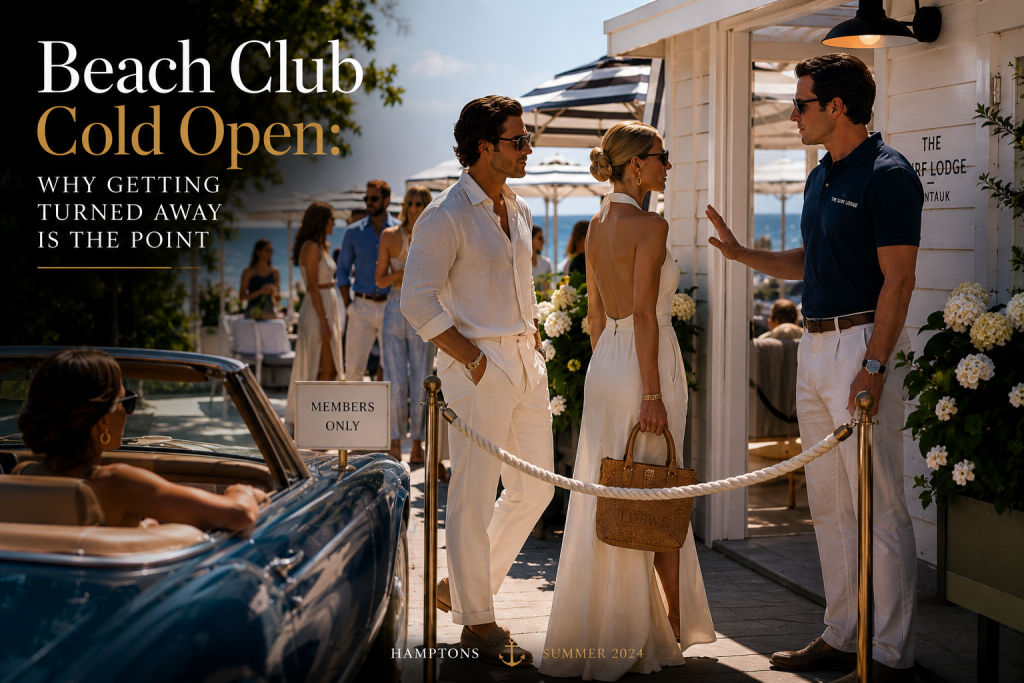
The first scene happens before you say a word. You step out of the car, the gravel does its thing, and a young person in linen looks at you for exactly one second. That second is the cold open at the beach club, and it is the most honest review you will get all summer. The rope has not moved yet. Still, the verdict is already in.
A cold open, in film, is the scene that runs before the credits. It tells you what kind of story you are in. The beach club runs the same trick at the rope, since the rope is theater and you are the audition. So the question is never whether you can afford the place. The question is whether the door decides you belong before you open your mouth.
Out here that one second carries more weight than the wire transfer behind it. The season is short and the rooms are small. So the door learns to read fast, because it has to, and the reading rarely misses by much.
Treat this piece as the door’s playbook, read from the wrong side of the rope. Learn what the one-second look is grading, and the grading stops feeling like luck. So the next cold open goes differently, because you finally know which scene you are standing in. And you stop auditioning for the wrong one.
The Rope Is a Sorting Machine
A rope is a cheap piece of hardware doing very expensive work. It costs nothing and decides everything. Because it can stop anyone, it confers value on everyone it lets through. So the rope is not security. It is a sorting machine that runs in public, where the sorting is half the show.
Notice the design. The line stays visible. So does the decision. People inside can watch the people outside, and that sightline is the point, not an accident of the floor plan. By contrast, a place that hides its door has nothing to sort and nothing to sell.
The machine also runs on memory. A regular gets waved through, while a stranger gets the pause, since the pause is how the door tells everyone watching that a stranger was here. So the same rope means two different things on the same night. To one person it is a greeting. To another it is a test.
Out here the machine is everywhere once you learn to see it. The wider grammar of luxury status codes is built from a hundred small ropes like this one. So the beach club is not unusual. It is just the most literal version of a sort that happens at every dinner, every lunch, every lawn.
What the Door Sees Before You Speak
The person at the rope is reading a language you may not know you are speaking. First the ease. Do you move like you have been here, or like you are checking the address against your phone? Ease cannot be faked for long, since the body keeps its own books.
Then the company. Who did you arrive with, and does that person nod at anyone? A single nod from the right shoulder does more than any black card. Because belonging is borrowed before it is owned, the door reads your companions as a credit reference.
Last the restraint. A loud watch and a fresh logo read as effort, and effort reads as outside. Of course the regulars are not dressed down by accident. They are dressed down on purpose, because the quiet outfit says the club is not the biggest room they will be in today.
None of these tells live in your bank balance. They live in the body, the company, and the wardrobe, which is exactly why money struggles to buy them fast. So the door is not snobbish about wealth. It is fluent in something wealth cannot purchase on a deadline.
The Membership You Can’t Apply For
Here is the cruel part for the newly arrived. The best version of the beach club has no application. There is no form, no fee schedule, no portal where money changes the answer. Instead there is a person who already knows you, or there is not.
This drives founders a little insane, and understandably so. They have spent careers turning closed doors into open ones with a wire. But the rope does not take wires. It takes time, and proximity, and the slow accumulation of being seen with the right people until the door stops checking.
There is often a literal membership too, with dues and a board. Yet the dues are the easy part, since the board is really voting on whether you fit. So the check clears long before the question of belonging does, and the gap between those two moments is where the newcomer sweats.
So the membership is really a reputation, held by other people, about you. You cannot buy it any more than you can buy a good name. The mechanics of that wall get taken apart in the art of the no, where the refusal itself turns out to be the asset.
Why Rejection Is the Marketing
A club that never turns anyone away has a problem money cannot fix. It has no story. Because nobody was denied, nobody inside feels chosen, and chosen is the entire product the rope was built to sell.
So the rejection is not a failure of hospitality. It is the marketing, performed live, at the door, in front of the very people it is meant to flatter. The man who gets waved through past a waiting couple feels the lift instantly. After all, his yes only means something because their no is standing right there.
This is why the velvet rope outlived the velvet. The hardware is symbolic now, yet the sorting is real. A brand that grasps this stops buying banners and starts buying the rope, which is the same instinct that makes the guest list itself the product at the right kind of event.
Founders sometimes try to short-circuit this with generosity, buying the round for the whole bar. But the open hand reads as the open door, and the open door has no story. So the gesture lands as effort, and effort is the one currency the rope marks down on sight.
The Rope Has More Than One Tier
Clearing the rope is not the finish line. It is the first of several. Once you are inside, a second sort begins, since the lawn has its own geography and not every chair is equal.
So watch where the staff seat the easy ones. The good tables face the water and the worse ones face the lot, and nobody ever announces the rule. By contrast, the newcomer takes whatever chair is open and never learns that the chair was a verdict too.
This tiering is the whole reason the cabana row reads like a leaderboard. Where you sit is a published ranking, and the ranking updates every weekend. That logic gets mapped in full at the cabana index, where a brand can buy its way onto the right rung if it reads the ladder correctly.
So the rope is really the first of many ropes. Clear it and a new one appears, drawn in chairs instead of velvet. The season is ropes all the way down, and the people who relax are the ones who stopped expecting a final door.
What Founders Misread at the Door
The smartest people get this wrong in the same three ways. First, they read the rope as an obstacle, when the rope is the product they came to buy. So they try to remove it, and removing it would destroy the thing they wanted.
Second, they confuse being let in with being wanted. A wave-through on a slow Tuesday is not the same as a greeting on a packed Saturday, since the door has more to spend on a quiet night. By contrast, the regular gets the warm read regardless of the crowd.
Third, they keep score in dollars. The door keeps score in time, in faces, in who vouched. Because the two ledgers do not convert, the founder feels cheated while the door feels nothing at all. Closing that gap is slow work, and it is the only work that pays out here.
Reading the Room From Outside It
Getting turned away is not the end of the education. It is the start of it, since the view from outside the rope is the clearest view you will ever get. From there you can see exactly what the door wants, because the door is busy showing you.
So watch who clears it without slowing down. Watch who gets the half-second longer look. Notice how the easy ones never glance back at the line, while the anxious ones cannot stop checking whether anyone clocked the wave-through. That tell is the difference between belonging and performing it.
The parties you cannot reach run on this same outside-looking-in feeling, and they run on it deliberately. That whole machinery gets mapped in the parties you can’t get into. Until you can read the rope cold, the season will keep reading you first.
So treat each rejection as field research, not as a referendum on your worth. Note what the door rewarded in the people it loved. Note what it punished in the people it stalled. Do that twice and the pattern stops being mysterious, since the rope was never random in the first place.
How to Stand at the Rope
None of this means you should fake it, because fakery is the loudest tell at the rope. The fix is slower and better. Stop arriving as a buyer and start arriving as a guest of someone the room already trusts.
So bring the right one person before you bring the wallet. Be early, be calm, be the one who does not perform the wait. And if the answer is still no this season, take the no as a reading, not a wound, since next summer the door has a longer memory than you think.
The rope rewards patience the way the market rewards conviction. Hold the position long enough and the door stops sorting you and starts greeting you. That shift, from sorted to greeted, is the only membership the beach club actually sells.
So keep a long memory of your own. The face that greeted you warmly this year is worth a quiet thank-you next year, since the rope runs on relationships that compound. The people who win at the door are rarely the richest. They are the ones who treated last summer as an investment.
Where the Conversation Continues
A fish does not notice the water, and the man stuck outside the rope does not notice he is still treating the door like a checkout line. The people inside crossed that water years ago. Reading the difference is the whole skill, and it is the one we trade in.
If you would rather be greeted than sorted, start with the contact page. We answer the people who already understand which side of the rope this is about.
Brands that want the room instead of the banner should look at a paid feature. Because the placement is editorial, it clears a rope a logo never could.
Want the address before the line forms? Get on the insider list. So far it is the earliest wave-through we hand out.
For the rope that opens in your favor, there is Polo Hamptons on July 18 and 25 in Bridgehampton. Since the seats are few, the seat itself does the talking.
Readers who want the door read for them all year can take a subscription. After all, the cold open is easier when someone hands you the script.
And if you have ever stood outside a rope and felt it, you can support the work. Of course the door still decides. We just like your odds better now.
Author

Written by
Recent Posts
The ‘Share Location’ Protocol: Digital Safety Habits for Night Classes

Are Outdated University Career Centers Completely Misjudging What Employers Want From College Graduates?

‘Twas the Night Before Polo
Clear Braces: What Are They & When Should You Choose Them
ESA Letter California: How to Get One Fast and Stay Legally Protected
Categories
- Art
- Articles
- Business of Luxury
- Celebrities
- Entertainment
- Events
- Faces of Summer 2026
- Fashion
- Fashion & Style
- Featured
- Finance
- Food, Spirits, Wine
- Hamptons
- Hamptons Celebrities
- Health
- Health & Beauty
- Lifestyle
- Luxury Lifestyle
- Press
- Profiles
- Real Estate
- Technology
- The Chronicles
- Travel
- Uncategorized
- Weddings