
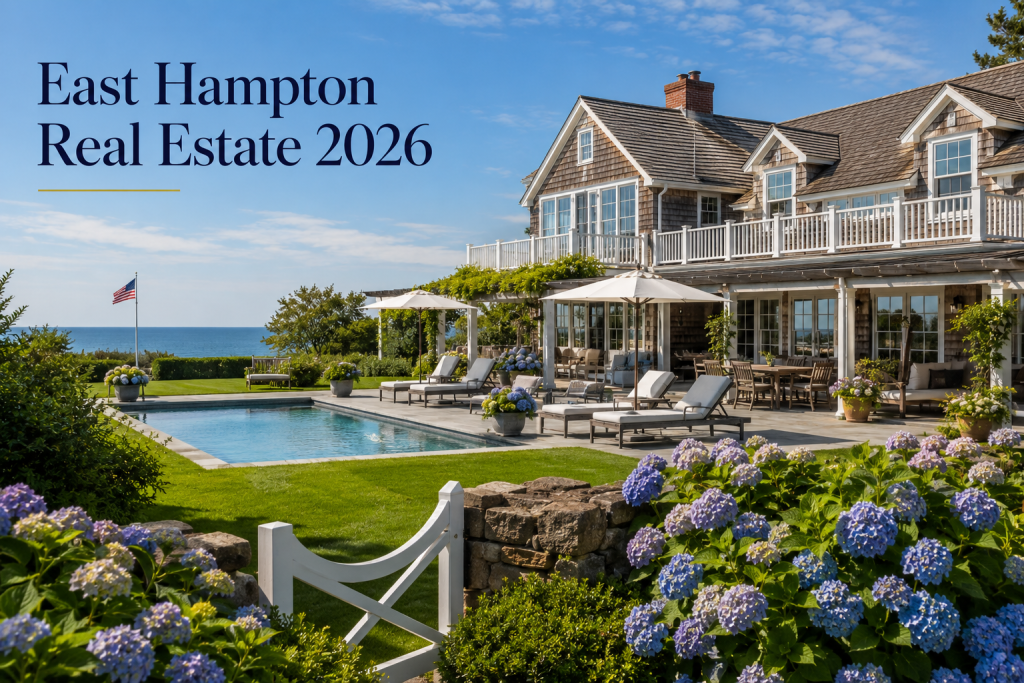
The Address That Answers Before You Ask
East Hampton real estate does not operate like other markets. Instead, prices here are not set by comparable sales, square footage formulas, or interest rate calculations. They are set by proximity: to the ocean, to the pond, to the club, and to the people who already live on your street. Indeed, the Q1 2026 numbers confirm what insiders already understood. The median sale price for luxury homes on the East End rose 30 percent to $13 million. Also, overall median prices topped $2 million, up 13 percent year over year. Similarly, sales volume surged 86 percent. East Hampton Village recorded seven transfers in the $20 million and above category, tying Bridgehampton for the most on the South Fork.
A family office principal from Park Avenue (the kind who manages $2B in multigenerational wealth and whose grandfather summered in East Hampton before the hedge fund era existed) reviews the numbers over breakfast at Sant Ambroeus on Newtown Lane. He is not surprised. Inventory remains 46.5 percent below pre-pandemic levels. Holding power is strong. Sellers are wealthy enough to wait. Certainly, the only properties that trade are the ones forced by what brokers call the three Ds: death, divorce, or distress. Everything else stays in the family, because in East Hampton, the family is the address.
He closes the listing on his phone and finishes his espresso.
The property is $44.5 million. He could write the check today.
His advisor says the timing is wrong. The advisor is correct about the market.
He is incorrect about the client.
Timing is for traders. This is a generational acquisition.
His daughter will summer here. His granddaughter will inherit the membership application.
He picks up the phone and calls the broker.
The conversation lasts ninety seconds. Both men know what this is.
Lily Pond Lane: The Celebrity Corridor That Wrote the Mythology
Lily Pond Lane runs east from Ocean Avenue toward Georgica Beach, approximately one mile of oceanfront and pond-front estates that have defined East Hampton’s identity for over a century. Notably, the street’s oldest home dates to 1874. J. Greenleaf Thorp designed many of the original estates in the early 1900s (the same architect behind Grey Gardens and the Georgica Road compound Calvin Klein sold for $85 million in 2021). Consequently, current pricing runs between $25 million and $70 million, depending on ocean frontage, lot size, and which side of the street you occupy.
David Geffen’s oceanfront compound, purchased for $70 million in 2016, anchors the top of the range. Jon Bon Jovi bought at $7.6 million in 2004 (the E.C. Potter House, one of the street’s developer-era originals). Martha Stewart owned the 1874 house (the oldest on Lily Pond Lane) until selling to Kenneth Lerer for $16.5 million in 2021. In 2025, 33 Lily Pond Lane closed at $39 million with 171 feet of ocean frontage and a lit tennis court that was one of the last approved before the village changed its lighting rules. However, unlike Meadow Lane in Southampton (which concentrates finance billionaires behind fortress-like hedgerows), Lily Pond Lane cultivates something more porous. Residents tend toward community involvement. The beach access is shared. Proximity creates encounters that Meadow Lane’s architecture actively prevents.
Georgica Pond: Where Entertainment Royalty Parks Its Dynasty
Georgica Pond is a freshwater lake covering approximately 290 acres, and the estates that ring it compose the most powerful residential address cluster in the Hamptons. Beyonce and Jay-Z purchased “Pond House” for $26 million in 2017. Similarly, Steven Spielberg has been a resident for decades. Ronald Perelman holds one of the largest positions. Tom Ford bought “Lasata” (Shinnecock for “place of peace,” Jackie Kennedy’s childhood summer home) for $52 million in 2023, acquiring both a trophy property and a piece of American cultural heritage. The Whittle estate sold for $64.67 million in 2024, the area’s most recent top transaction before 2026.
In contrast to Lily Pond Lane’s media-and-celebrity profile, Georgica attracts entertainment industry principals: the people who greenlight the movies, not the people who star in them. The shared waterfront creates natural connections. Indeed, neighbors wave from kayaks. They encounter each other walking to Georgica Beach. They cross paths at Nick and Toni’s on Friday nights. Essentially, Georgica Pond is the Hamptons’ closest approximation to a creative colony, except that the creative output is measured in billions, not canvases. For anyone studying the Hamptons real estate hierarchy, the distinction is critical: Meadow Lane is finance. Lily Pond Lane is celebrity. Georgica Pond is power.
Further Lane: The Record-Breaking Western Section
Further Lane straddles East Hampton and Amagansett, and its western section (before it crosses into Amagansett proper) holds the Rosenstein compound, the road’s most expensive combined transaction at $147 million. The lane was originally laid out as one of three parallel farm roads during the 1648 settlement, running east from Egypt Lane across the Eastern Plain. Still, today it connects oceanfront estates to agricultural land in a way that no other East End address can replicate. Also, the tax structure matters: properties in East Hampton Village carry both village and town taxes, while Further Lane properties in Amagansett carry town-only taxes, creating a meaningful cost differential on eight-figure holdings.
The lane’s appeal is geographic rather than social. Buyers here want acreage, privacy, and the specific quality of light that the Eastern Plain produces when late-afternoon sun hits the potato fields. Compared to Lily Pond Lane’s village proximity or Georgica Pond’s waterfront community, Further Lane offers isolation as luxury. For a tech founder from SoHo (the kind who sold a company for $400M and wants a compound where the nearest neighbor is a quarter-mile away), Further Lane is the answer. Notably, the Hamptons power rankings consistently place Further Lane in the top three addresses on the entire East End.
Dune Cottage: The $72 Million Sale That Opened 2026
On March 6, 2026, the estate at 43 East Dune Lane closed for $72 million, making it the priciest deal on the East End this year. Originally listed in June 2024 at $120 million (the most expensive listing in the Hamptons at the time), the property last asked $84.9 million before closing at a 40 percent discount from the original price. The seller was Ann Tenenbaum, who had owned the home with her late husband Thomas H. Lee, a private equity pioneer considered one of the architects of leveraged buyouts. Ultimately, Lee died in February 2023. Yet the buyer has not been publicly identified.
However, the property’s history is more remarkable than its price. The original estate was built in 1910 as part of the Wiborg family compound. Sara Murphy, the Jazz Age socialite often cited as a literary inspiration for F. Scott Fitzgerald, inherited it through the Wiborg line. Lee Radziwill (Jacqueline Kennedy’s sister) and her husband Herbert Ross later owned the house. Jerry Seinfeld had a signed contract for $19 million in 1999, but Radziwill and Ross backed out. Lee and Tenenbaum purchased in 2001 for $16.2 million. Subsequently, Ben Krupinski rebuilt the residence in 2016. Today, the 11,000-square-foot main house sits on 3.6 acres with 225 feet of oceanfront, situated between the Atlantic, Hook Pond, and the Maidstone Club golf course. Specifically, Dune Cottage is where American wealth, American aristocracy, and American real estate converge. Every owner answered the same question differently. The house kept asking.
The Village Core: Where Main Street Proximity Commands a Premium
Not every significant East Hampton real estate transaction involves oceanfront or pond-front estates. The village core (properties within walking distance of Main Street, the restaurant scene, Guild Hall, and the Newtown Lane shopping corridor) commands its own premium. Buyers here prioritize convenience over acreage: the ability to walk to dinner, to stroll the historic district, to reach the 1770 House without a car. Village-core pricing typically ranges from $3 million to $15 million, depending on lot size, condition, and proximity to the commercial center.
For a cosmetic dermatologist from the Upper East Side (the kind who built a $20M practice on Park Avenue and wants a summer base where patients become social acquaintances), village-core East Hampton is the ideal positioning. She can walk to Tutto Caffe for morning espresso, stop at BookHampton, and run into three clients before noon. Certainly, this social compression is the village core’s true product. Indeed, the house is secondary. The proximity is the asset. In comparison, Sag Harbor’s village core offers a similar walkability at slightly lower price points, while Southampton’s estate section south of the highway prices walkability out of the equation entirely.
The Zoning Shift: What the Mega-Mansion Cap Means for Buyers
New zoning regulations cap new construction at 7 percent of lot area plus 1,500 square feet. This restriction has created a scramble for grandfathered oversized homes that were built before the cap took effect. In practical terms, a buyer who wants a 10,000-square-foot house on a one-acre lot can no longer build it. Instead, that buyer must find an existing property of that size, which further constrains an already tight inventory. The result is a bifurcated market: new construction for buyers who accept the cap, and a premium for pre-existing large homes that exceed it.
Meanwhile, brokers report a secondary trend: buyers moving north of the highway to towns like North Sea, Noyack, and Water Mill, where wooded lots offer serenity and value without the oceanfront premium. Still, for the buyer whose definition of East Hampton real estate requires a south-of-highway address with ocean access, the supply constraint is the dominant factor. Inventory is up 30 percent year over year, which sounds like relief until you realize it is still 46.5 percent below pre-pandemic levels. After all, a 30 percent increase from historic lows is still historically low.
East Hampton vs. the Field: Where the Money Ranks
Each Hamptons village attracts a different type of capital. Southampton concentrates old money and institutional finance along Gin Lane and Meadow Lane, with median estate-section pricing north of $20 million. Bridgehampton draws entrepreneurial wealth and the event-adjacency crowd, with Sagaponack functioning as its ultra-premium annex. Sag Harbor attracts cultural capital: writers, artists, media executives who value harbor charm over ocean frontage. Amagansett splits between Further Lane oceanfront estates and the deliberate informality of its village core.
East Hampton holds positions across every tier. Lily Pond Lane competes with Meadow Lane. Georgica Pond competes with nobody. Further Lane’s western section holds the single most expensive combined transaction on the East End. The village core offers walkability that only Sag Harbor can match. Dune Cottage’s $72 million sale sits between Bridgehampton’s $58 million January transfer and the Rosenstein compound’s $147 million cumulative position. Ultimately, East Hampton real estate does not compete with any single village. It competes with all of them simultaneously, and the power rankings reflect this: East Hampton addresses appear in every category, at every price point, in every tier. That range is the point. Also, that range is why the money keeps arriving.
Where the Conversation Continues
Social Life Magazine has covered East End real estate for 23 years, five summer issues per season, 25,000 copies each, distributed from Westhampton to Montauk in the restaurants, hotels, and beach clubs where buyers and sellers actually gather. Fall and winter issues (15,000 copies each) go directly to Upper East Side doorman buildings. The audience reading this page is the audience making these transactions.
If your brand serves the East Hampton real estate audience (luxury furnishings, architecture, landscape design, interior design, private banking, insurance, legal services), a paid feature in Social Life Magazine places you inside the conversation. Specifically, the publication’s distribution footprint reaches both the buyer and the broker. Submit a paid feature here.
Polo Hamptons 2026 returns to 900 Lumber Lane in Bridgehampton on July 18 and 25, with BMW North America as title sponsor and Christie Brinkley as host. Notably, half the cabana holders at Polo Hamptons own property on this page. Sponsorship packages are available at polohamptons.com.
Subscribe to Social Life Magazine for year-round coverage of the addresses, transactions, and power dynamics that shape the East End. Subscribe here.
East Hampton real estate is not bought with money alone. It is bought with time, with lineage, with patience, and (occasionally) with the willingness to pay $72 million for a house that has been answering questions since 1910.
Author

Written by
Recent Posts

AI for personal finance: where PennyGuard fits

How to Pick a Homecoming Dress for Your Body Type (and Feel Amazing in It)

World Cup Injury Attorney for Vancouver Events
What a 3-Carat Engagement Ring Actually Costs in 2026: The Real Numbers
The Skincare Habits That Make a Real Difference Over Time
Categories
- Art
- Articles
- Business of Luxury
- Celebrities
- Culture
- Entertainment
- Events
- Faces of Summer 2026
- Fashion
- Fashion & Style
- Featured
- Finance
- Food, Spirits, Wine
- Hamptons
- Hamptons Celebrities
- Health
- Health & Beauty
- Lifestyle
- Luxury Lifestyle
- Press
- Profiles
- Real Estate
- Technology
- The Chronicles
- Travel
- Uncategorized
- Weddings