
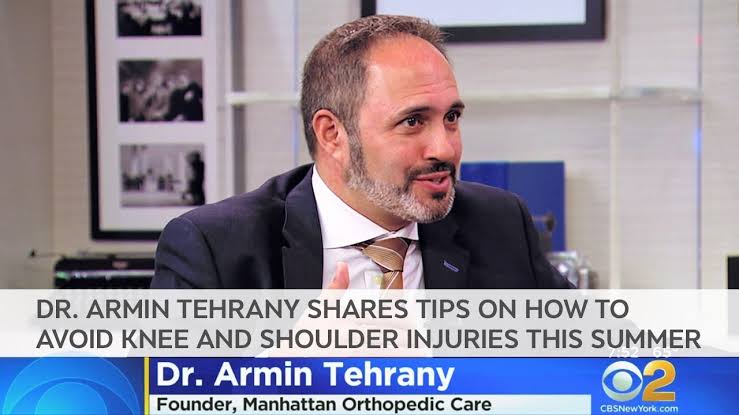
Dr. Armin Tehrany Has Been Fixing the Hamptons Weekend Warrior Since Before You Had a Pickleball Court
The shoulder didn’t fail during the match. It failed on Sunday morning, reaching for a coffee cup. That’s how it usually goes. You spend three hours on a court in Bridgehampton swinging overhead, lunging for a ball you had no business chasing, running angles your body hasn’t run since 2011, and the body waits until Monday to send the invoice.
Dr. Armin Tehrany has been collecting those invoices for twenty years. Founder of Manhattan Orthopedic Care, honorary surgeon to the NYPD, assistant clinical professor at Mount Sinai, and the kind of doctor whose patients refer one another the way people pass along a good restaurant in a neighborhood nobody else has found yet. He is also, improbably, an executive film producer. But we will get to that.
Right now, the rotator cuffs need his attention.
The Pickleball Reckoning Is Real
Five years ago, Dr. Tehrany almost never heard the word pickleball in a consultation. Today it shows up constantly, not because the sport is dangerous, but because of who is playing it. “The problem is that it’s attracting people who haven’t played competitive sports in years,” he says. “They suddenly spend three hours running for balls, twisting, lunging, and serving overhead.”
The injuries accumulating on his intake forms read like a catalog of the East End’s most optimistic weekends: rotator cuff tears, biceps injuries, meniscus tears, ACL injuries, Achilles ruptures, tennis elbow, arthritis flare-ups. Still, he won’t blame the sport. The sport is innocent. The ambition is the problem.
Padel has joined the conversation too. The courts went up fast, the skill curves are deceptively gentle, and the startup confidence convinces people they are better athletes than nine months behind a desk has left them. They are not.
The July Pattern Nobody Talks About
There is, in fact, a Hamptons summer injury. It is not dramatic. It is not a collision or a fall. It is the cost of compression, of trying to do everything at once after doing almost nothing for months.
“Someone spends nine months behind a desk in Manhattan, goes out east for the weekend, and suddenly they’re playing pickleball in the morning, paddleboarding in the afternoon, golf the next day, and maybe lifting weights before dinner,” Dr. Tehrany says. The pattern spikes every July, same as the traffic on 27.
Your body, he points out, does not know you are on vacation. Heat, dehydration, and the particular psychological need to extract full recreational value from a summer house rental form a reliable injury triangle. The body is not refusing the ambition. It is just billing for it late.
What 60 Actually Looks Like
Staying active into your 60s and beyond is realistic. That part is not the problem. The problem is the assumption that the body can absorb the same preparation gaps it tolerated at 35.
Dr. Tehrany is direct about this. The fastest way to wreck a shoulder at 60 is to ignore the small signals it was sending at 58. A little night pain. Some lost range of motion. A subtle weakness reaching overhead. Those are not inconveniences to push through. Those are early warnings that a small, repairable problem is about to become a large, complicated one.
“If you push through that for months,” he says, “a small repairable problem can become a much bigger one.” The math is simple. The execution requires admitting you felt it.
The Recovery Math Has Changed
In 2006, Dr. Tehrany became the first orthopedic surgeon in the five boroughs to perform needle arthroscopy in an office setting. The procedure allows diagnosis of shoulder and knee problems with no incisions, less tissue disruption, and recovery timelines that would have seemed implausible to a surgeon a generation ago.
For a certain kind of patient, the one who cannot disappear for three months without the business noticing, this changes everything. Desk work returns quickly. Everyday function returns sooner than expected. The gap between “something is wrong” and “I am back to normal” has compressed in ways that genuinely reward getting evaluated early rather than waiting for the problem to announce itself more loudly.
Indeed, the advance he describes most readily is not the procedure itself. It is the shift in recovery psychology it enables.
On Peptides: Manage Your Expectations
The wellness circuit out east is running hard on BPC-157 and similar recovery compounds. Dr. Tehrany is measured about this. He does not dismiss the curiosity, but he draws a clear line between interesting lab data and clinical evidence.
“Some lab and animal studies are interesting, but we still don’t have strong human clinical data showing that peptides like BPC-157 reliably heal rotator cuffs, meniscus tears, or arthritis,” he says. The principle he returns to is structural: if a tendon is torn, no peptide reattaches it. Chemistry cannot substitute for architecture. If something sounds too good to be true in this conversation, he suggests, it probably is.
The Mistake Smart People Make
High pain tolerance is not the same as a small problem. Dr. Tehrany has seen enough variation to understand that the amount of pain a patient reports is almost entirely unreliable as a proxy for severity. Some people are in tremendous pain from a modest injury. Others are walking around with major tears because their threshold is high and their ego is higher.
“Pain is only one piece of the puzzle,” he says. “Loss of strength, function, motion, and stability are often more important.” The people who wait the longest, in his experience, are often the people who are most successful at tolerating discomfort in other areas of their lives. That is not, in this context, a virtue.
Rest It or Scope It
The decision rule he offers is practical. If pain is improving week over week, conservative care, physical therapy, and time often handle it. But if there is significant weakness, if you cannot lift the arm, if the knee locks or buckles, if the pain is waking you at three in the morning after several weeks, it is time to be evaluated.
His stated goal before any conversation about surgery is to identify exactly who can avoid it and who cannot afford to wait. Those are two different patients. The mistake is treating them the same way.
The NYPD, the Films, and What Resilience Actually Sounds Like
Dr. Tehrany has been the NYPD’s honorary orthopedic surgeon long enough that the relationship developed organically. He made clear early in his career that he had particular respect for military and paramilitary professionals. Officers started referring one another after watching his outcomes. Trust built the way trust builds in closed professional communities, slowly and then completely.
What he took from operating on police officers, firefighters, and service members is a specific lesson about what people actually want from recovery. “They rarely ask, ‘When will I be pain-free?’ They ask, ‘When can I get back to work?'” That reordering of priorities, function before comfort, changed how he thinks about every operation. The MRI looks good is not the outcome. Being able to do your job is the outcome.
The film work, through his production company Precision Cut Productions, runs on a parallel instinct. Films that are based on truth can reach people a surgical practice never will. He has been involved in productions he respects with collaborators he admires, and he finds that appealing for exactly the reason you would expect from someone who spent twenty years watching people learn hard lessons the expensive way.
The Billboard Over Montauk Highway
If he could put one sentence over the highway for every weekend warrior heading east this summer, it would be this:
“Don’t stop playing because you’re getting older. Play smarter so you never have to stop.”
That is not a slogan. That is the clinical conclusion of two decades of watching people make the same mistake in the same season, and still root for them anyway.
Dr. Armin Tehrany is the founder of Manhattan Orthopedic Care, with offices at 515 Madison Avenue in Manhattan and 91 New Dorp Lane in Staten Island. He is a Top Doc honoree in New York Magazine, honorary surgeon to the New York City Police Department, and assistant clinical professor of orthopedic surgery at the Icahn School of Medicine at Mount Sinai. Book a consultation at mocnyc.com.
Author

Written by
Recent Posts

The Hidden Work Behind a Seamless Hotel Weekend
Choosing Scratching Furniture for a British Shorthair
Bile Reflux vs. Acid Reflux: Why Your Antacid Isn’t Working
Annie Watt Photography Agency 20th Anniversary Celebration and Exhibition in NYC | New York, NY

Denise Fraile: Connecting People, Inspiring Purpose
Categories
- Art
- Articles
- Business of Luxury
- Celebrities
- Culture
- Entertainment
- Events
- Faces of Summer 2026
- Fashion
- Fashion & Style
- Featured
- Finance
- Food, Spirits, Wine
- Hamptons
- Hamptons Celebrities
- Health
- Health & Beauty
- Lifestyle
- Luxury Lifestyle
- Press
- Profiles
- Real Estate
- Technology
- The Chronicles
- Travel
- Uncategorized
- Weddings