
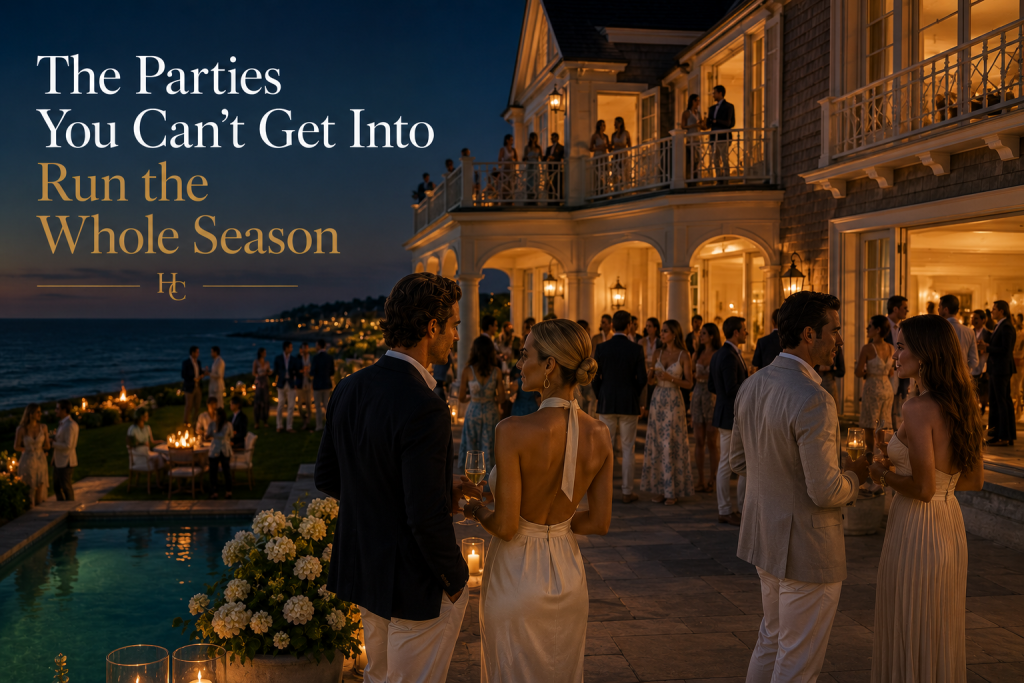
There is a party every summer that everyone talks about and almost nobody attended. You hear about it on Monday. Someone saw a photo, someone knows someone who went, and the details stay just blurry enough to grow. By Wednesday the party is a legend, and the legend is bigger than the night could ever have been. It is one of the parties you can’t get into, and it owns the week.
These are the parties you can’t get into, and out here they run the whole season. They set the pecking order without anyone admitting there is one. So the gate does the work that the music and the catering only pretend to do. The night itself barely matters, since the value lives in the not-getting-in.
Treat this as anthropology, because that is what it is. A small group decides who belongs, and the rest of the East End organizes itself around the verdict. So the unreachable party is not a snub. It is the engine, and the engine runs on want.
The newly rich feel this engine before they understand it. They can buy the house two doors down and still not get the text. That gap, between owning the street and missing the party on it, is the whole subject of this piece.
So this is a field guide to the most exclusive thing the season sells, which is the party with your name left off it. Read it as a map, not a complaint. Because once you see the engine clearly, you stop chasing the smoke and start building your own fire. And the people who build fires never have to chase smoke again.
The Myth Does the Work
The party you cannot reach is mostly a story, and the story is the product. Because you were not there, your imagination fills the room, and imagination always overbuilds. So the legend grows in exactly the place where the facts are missing.
This is why the hosts who matter say so little afterward. Silence keeps the myth intact, while a recap would shrink it to a normal night with warm rosé. By contrast, the open party posts everything and dies by Tuesday, since a party you can fully see is a party you no longer need.
The math is almost unfair. The fewer people who attend, the more people who talk, and talk is the only marketing that carries status. So a host who wants the season to whisper for a month simply invites a dozen and tells no one else.
That is the same refusal that powers the whole cluster. The no creates the want, and the want creates the myth. The deeper mechanics of that trade get taken apart in the art of the no.
Why You Hear About It on Monday
Notice the timing. You never hear about the real party before it happens. You hear about it after, once it is too late to ask, since the lateness is part of the design.
A party advertised in advance is a party seeking guests. A party you only learn about Monday is a party that had all the guests it wanted. So the timing itself is a status signal, and the signal says you were never on the list to begin with.
This is why the printed invitation has quietly lost its rank. The text beats the card, the whisper beats the text, and the silent assumption that you already know beats them all. Because the best invite barely looks like one, the people who need a formal invitation are telling on themselves.
So the Monday story is doing a job. It tells the whole region who was inside and who was not, without a single rude word. After all, nobody had to turn you away if you never knew the door was there.
The Photo You Were Not In
There is always one photo. It leaks on Sunday night, slightly out of focus, and it does more work than a full album ever could. Because you can see just enough, you fill in the rest, and the rest is always better than the truth.
The single image is a tease, not a record. It proves the party happened without letting you in, so it deepens the want instead of ending it. By contrast, the brand that floods the feed with coverage kills the mystery and the status in the same post.
So the smart hosts let one frame escape and lock the rest. The leak looks like an accident, yet nothing about it is. The photo is bait, and the bait is aimed at exactly the people who were not there.
This is the whole economy of the unseen. You are not meant to see the party. You are meant to see that you missed it, since missing it is the feeling the host is actually selling.
The Geography of Exclusion
Exclusion has an address out here, and the address is half the point. The legendary parties tend to sit behind hedges on lanes most people only drive past. Think Meadow Lane in Southampton, Further Lane in East Hampton, Gin Lane where the ocean does the gatekeeping for you.
These streets are private in a way money alone cannot crack. A nine-figure exit buys the house, but it does not buy the neighbors, and the neighbors are the party. So the geography sorts people before any host lifts a finger.
The hedges matter too, since a high hedge is a sentence. It says what happens here is not for the road. By contrast, the visible lawn party is performing for passersby, and performing for passersby is a tell that the hosts still need an audience.
This is the same map that runs every other code out here. The whole grammar of place and rank gets laid out in luxury status codes, and the unreachable party is just its loudest expression.
The water itself is a gate too. An oceanfront party has no road behind it, only sand and a long private drive, so arriving uninvited is nearly impossible by design. Because the land does the bouncing, the host barely needs a doorman at all.
FOMO Is the Feature, Not the Bug
People treat the fear of missing out like a flaw in the system. It is not a flaw. It is the system, running exactly as intended, since the want is the whole renewable resource here.
So the host does not fear your envy. The host farms it. Each person left out becomes a small broadcaster of the party’s importance, and a hundred broadcasters cost the host nothing at all. Because the excluded do the advertising, exclusion is the cheapest marketing in the Hamptons.
This is the cruel elegance of it. The more you want in, the more value you hand to the people keeping you out. So your longing is not a private feeling. It is a contribution to someone else’s standing.
The same engine runs at the rope, just faster and in public. You can watch it work in real time at the beach club cold open, where the want forms the instant the door pauses.
When the Legend Beats the Night
Here is the secret the insiders rarely share. The legendary party is often a perfectly ordinary night. The food was fine, the crowd thinned by eleven, and someone’s dog ate a canape off the table.
So the legend is not a report of how good it was. It is a measure of how badly you wanted in. Because the want does the inflating, the myth floats free of the evening, and the evening cannot drag it back down.
This is why chasing the party is a trap. Even if you got in, the real night could never match the version in your head, since your head built it out of longing rather than facts. So the door protects the host twice, once by keeping you out and again by keeping the myth perfect.
The lesson is almost freeing. The party you cannot reach is not better than yours. It is only better defended, and defense is a thing you can learn to do too.
Who Gets the Text
So who actually gets in? Rarely the richest person in the room. Usually the most connected one, since the invite tracks relationships rather than balances.
The text goes to the person who makes the party better by being there. It goes to the friend, the talent, the one who knows everyone and flatters no one. Because the host is protecting a feeling, not filling a quota, the list rewards charm and history over net worth.
This is the lesson the new arrivals resist hardest. They keep trying to buy a seat at a table that was never selling seats. So the wire goes out and nothing comes back, since the table runs on a currency the wire cannot carry.
The same truth runs every curated room out here, where the list itself is the asset. That logic gets unpacked in full at the guest list is the product, and it explains why the text matters more than the money.
So the text is a quiet ranking of the whole season. Get it early and you are core to the night. Get it late and you are filler, while never getting it at all means the host built the evening without you in mind.
How to Stop Chasing and Start Hosting
There is a way off the outside of the rope, and it is not more chasing. The move is to stop trying to get into other people’s parties and start running one of your own. Because the person who controls a door stops fearing every other door.
So build a small, sharp room and protect it. Invite a dozen of the right people, say nothing publicly, and let Monday do the talking. The first time your party is the one people hear about late, the season tilts in your favor.
So start absurdly small. Eight people, one long table, no announcement and no photographer at the door. Because the room is tight, the night gets talked about, and the talk is the thing that turns a quiet dinner into a coveted door.
This is the quiet graduation. You go from wanting the text to sending it, and sending it is the only cure for the wanting. After all, the people you envy were once outside a hedge too, learning the same lesson you are learning now.
So the goal was never to crash the legendary party. The goal is to become one. Once you do, the chasing stops, because you finally hold the thing everyone else is chasing.
Where the Conversation Continues
A fish does not notice the water, and the chaser does not notice that wanting in is the very thing keeping him out. The hosts crossed that water long ago and stopped flinching at closed doors. Reading the difference is the whole game, and it is the one we play for a living.
If you would rather host than chase, start with the contact page. We help the people ready to stop waiting on someone else’s text.
For the version that makes you the story rather than the audience, look at a paid feature. Because it is editorial, it does what no Monday rumor about you ever will.
Want to hear about the right nights before Monday? Get on the insider list. So far it is the earliest text we send.
For the room where you are already on the list, there is Polo Hamptons on July 18 and 25 in Bridgehampton. Since the seats are few, being there is the whole point.
Readers who want the season decoded all year can take a subscription. After all, the parties you can’t get into are easier to read once someone explains the map.
And if you have ever heard about a party too late, you can support the work. Of course the hedges still stand. We just hope you are behind one soon.
Author

Written by
Recent Posts

Everyone Called Him a Genius. But He Felt Like a Fraud.
The Two-House Year: What Seasonal Residents Learn After the First Season
Trade Show Booth Decisions: What to Rent, What to Build, and What to Skip
Find Your Ideal Solar Battery Size in Minutes
How to Explore Rome Comfortably Between Check-In and Departure
Categories
- Art
- Articles
- Business of Luxury
- Celebrities
- Culture
- Entertainment
- Events
- Faces of Summer 2026
- Fashion
- Fashion & Style
- Featured
- Finance
- Food, Spirits, Wine
- Hamptons
- Hamptons Celebrities
- Health
- Health & Beauty
- Lifestyle
- Luxury Lifestyle
- Press
- Profiles
- Real Estate
- Technology
- The Chronicles
- Travel
- Uncategorized
- Weddings