
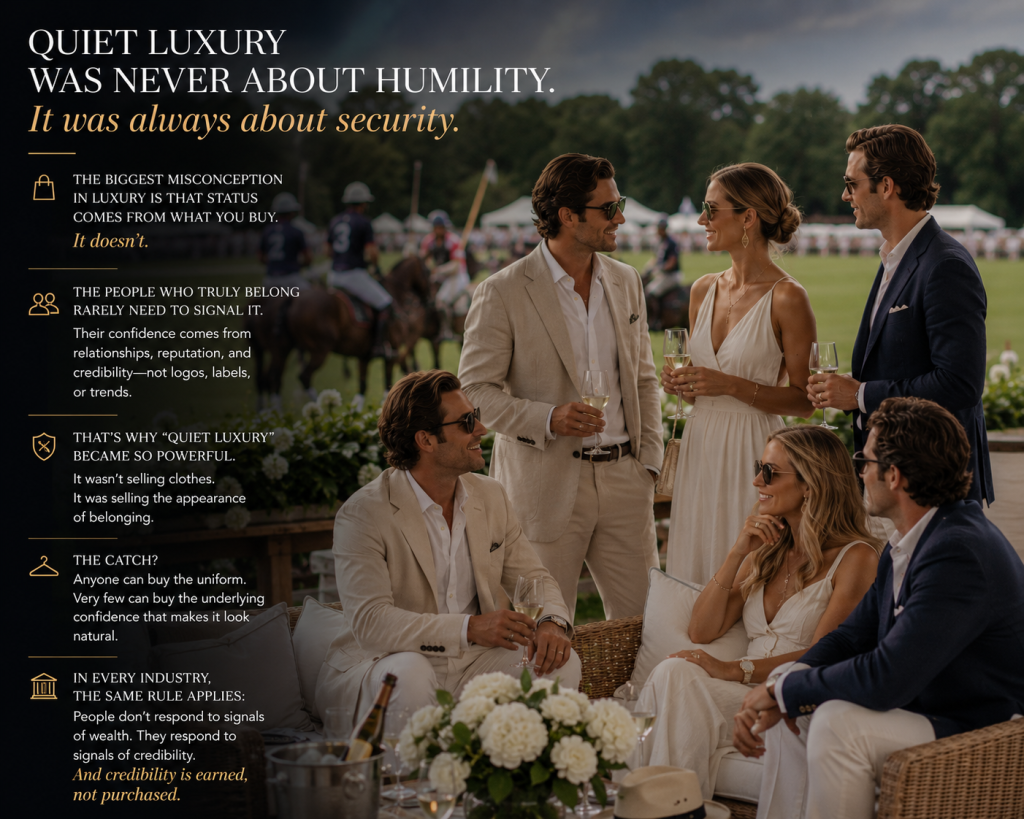
You were told quiet luxury meant buying less and buying better. No logos, just quality, a wardrobe of expensive basics that whisper instead of shout. It sounded almost humble, almost democratic. That story was the con. Quiet luxury was never about restraint for its own sake. It was always a status weapon, dressed up as good taste.
Here is the part the trend pieces left out. The whole point of looking like you are not trying is that only certain people can pull it off. Cashmere is not the signal. Security is, and security cannot be ordered online.
So this piece takes the con apart. It shows what quiet luxury really is, why it works as exclusion even while posing as modesty, and why no amount of correct shopping gets a newcomer in. For the version everyone was sold, the brands and the basics, see our quiet luxury brands guide. This is the version nobody admits.
The Story You Were Sold
The marketing was irresistible. Quiet luxury arrived as the antidote to logo culture. Stop chasing flash, the story went, and invest in timeless, well-made things instead. Buy the perfect coat once. Let quality speak. It felt like wisdom, and partly it was.
The trend spread because it flattered everyone. It promised that taste could replace spending, that you could look rich by being discreet rather than loud. So millions bought the quiet pieces, the unbranded knits, the muted palette. They followed the recipe to the letter.
But a recipe everyone can follow cannot, by definition, sort anyone. So if quiet luxury were really just buy-better minimalism, it would confer no status at all. The fact that it still sorts people, hard, is the first clue that the public story was never the real one.
And for a while, the recipe even worked socially. Early adopters did read as tasteful, because the signal was still rare. But rarity was the active ingredient, not the clothes. So the moment the look went mass, the magic drained out of it, exactly as a status signal always does.
What It Actually Is
Strip away the marketing and here is the mechanism. Quiet luxury signals distance from necessity. The ability to not announce your wealth proves you never worry about whether people know it. Loud signaling is for people who still need the confirmation. Silence is for people who never did.
That is why the look reads as power, not modesty. Choosing to be unreadable is only available to people secure enough to be misread and not care. The newcomer cannot afford that risk, because being underestimated still costs him something. So he signals, and the signal gives him away.
This is the same code we cataloged in the hub on reading old money Out East. Quiet luxury is just that code sold at retail, minus the one ingredient that makes it work. You can buy the sweater. You cannot buy the indifference, and the indifference is the entire point.
There is a tidy proof of all this. Take the exact same sweater and put it on two people, one secure and one anxious. The fabric is identical. But the room reads them oppositely, because it was never reading the fabric. It was reading the person wearing it.
The Con, Named
So name the con plainly. Quiet luxury was sold as humility and functions as exclusion. It looks like the most accessible luxury trend ever, because the items are simple and the rules sound learnable. In practice it is the least accessible, because the real entry fee is not money.
The trick lives in that gap. Anyone can buy the uniform. Almost nobody can wear it the way it is meant to be worn, with the unconscious ease that says you were always this comfortable. So the aesthetic admits everyone at the cash register and rejects most of them at the door.
And the cruelty is that it never announces the rejection. There is no velvet rope, no bouncer, no obvious gate. There is only a room that quietly fails to warm to you, for reasons it will never explain. The con works precisely because it looks like no con at all.
For a brand, this is the dangerous part. You can sell someone the entire quiet-luxury wardrobe and still leave them outside the code. So the product moves, the customer pays, and the promise quietly fails to deliver. That gap between sale and standing is the con working exactly as designed.
Stealth Wealth Is a Flex, Not a Retreat
Look at the billionaires who dress like they just lost everything. The faded tee, the beat-up sneakers, the watch nobody can place. It reads as humility to outsiders. To anyone fluent, it reads as the loudest flex in the room.
Because here is the message underneath the rags. I am so far beyond needing to prove anything that I can dress like this and lose nothing. That is not retreat. It is dominance, performed through subtraction. We took the full anatomy apart in why stealth-wealth billionaires dress broke.
So stealth wealth is the purest form of the con. The clothes cost a fortune and refuse to say so, which only the truly secure can risk. Meanwhile the striver in the obvious luxury reads as the one who still has something to prove. The rags win, because only the rich can afford to look poor on purpose.
For a brand, stealth wealth is a warning label. You cannot bottle dominance and sell it in a basic tee. The customer buys the tee and still reads as anxious, because the dominance was never in the cotton. So selling the look is easy. Transferring the security is the part no brand can ship.
The Trend That Ate Itself
There is a final twist worth knowing. Quiet luxury got too popular to keep working. Once every aspirational shopper owned the muted palette, the muted palette stopped sorting anyone. So the trend cannibalized its own signal. The more people performed it, the less it meant.
When that happens, the real insiders simply move. They abandon the marker the moment it goes mainstream, because a code everyone speaks is no longer a code. The whole point was scarcity, and popularity is the enemy of scarcity.
So by the time a trend reaches the explainer pieces, the people who set it have already left. The newcomers arrive to a party that ended quietly. They are wearing the right thing one full season too late, which is its own kind of tell.
This is why chasing the aesthetic is a losing game by design. The target moves on purpose. So the only stable strategy is to stop chasing markers and own the thing markers point at, which is real standing that does not expire when the trend does. That asset is the one thing the churn can never reach.
Why the Con Works on New Money Twice
Here is the double bind for the newly rich. The con takes them twice. First it sells them the aesthetic, the quiet pieces and the muted palette, at full price. They buy in, believing the uniform is the ticket.
Then it excludes them anyway. Because they wear the uniform as a costume, correctly but consciously, the room still reads the effort. So they paid the entry fee and got turned away at the same door. The money left their account. The standing never arrived.
This is the same machine that runs the logo tax, only inverted. The logo tax charges for looking new. Quiet luxury charges for trying to look old. Reading the room correctly is the only real defense, which is exactly the skill we teach in how to read a room in Southampton.
The bind is almost elegant in its cruelty. Try too little and you look careless. Try too much and you look new. So the newcomer is squeezed from both sides, with no correct amount of effort available to him. Only time and placement dissolve the trap, never a bigger budget.
The Tell Inside the Con
Even inside quiet luxury, the sorting continues. Two people can wear the identical unbranded coat and read completely differently. The difference is the wear, the history, the unconscious way one of them treats it like nothing special.
The newcomer’s version is too perfect. Everything coordinated, nothing worn, the whole look acquired this season. The insider’s version has accidents in it, the genuine frays of use, because real restraint is not curated. It accumulates. We ranked those object-level tells in what the tote and the watch actually say.
So the con has a con inside it. Master the aesthetic and a finer test simply replaces the coarse one. This is exactly the old-money versus new-money line that never quite closes, which we mapped in new money versus old money. There is always one more tell.
So the lesson repeats at every level. Beat the obvious tell and a subtler one appears. The game does not end when you dress correctly, because the game was never really about the dressing. It was always about who you are when nobody is grading the outfit.
How to Actually Win the Game
So if shopping cannot win it, what can? Stop chasing the aesthetic and build the thing underneath it. The asset was never the cashmere. It was the security, the placement, the sense of belonging that lets a person wear anything and read as right.
That security comes from being placed, not from being purchased. The right rooms, the right associations, the right vouching, those are what generate the indifference the look only imitates. We laid out how that machinery actually runs in the old money playbook.
None of this means the clothes are worthless. Wear what you like. Just stop expecting the uniform to do the work that only belonging can do. So buy the coat if you love the coat, then go earn the room, because the room was always the actual purchase.
So the way to beat the con is to stop playing the surface and start earning the depth. Quit optimizing the outfit. Get placed by the rooms that confer real standing, and let the wardrobe become an afterthought, the way it already is for everyone the con was built to flatter and exclude. Own the room, and the closet sorts itself out. The con only ever beat the people who were still shopping for a way in.
Where The Conversation Continues
There is an old story about two young fish who get asked how the water is. They have no answer, because they have always swum in it. Quiet luxury is exactly that water. The people who have it never notice the code, while the people chasing it mistake the uniform for the thing. Now that you can see the con, you can stop buying it.
If you would rather build the standing than rent the look, start the conversation here. The right introduction does more than any wardrobe ever will.
If you want the room to read you as already secure, look at a paid feature in Social Life Magazine. A feature places you, and placement is the one thing the quiet uniform cannot fake.
If you would rather learn the codes before you spend another dollar on the aesthetic, join the Social Life email list. The list is where the quiet intelligence goes out first.
If you want to watch the con performed flawlessly in the open, the gates open in July at polohamptons.com. BMW takes the title spot, Christie Brinkley hosts, and the cabanas go the way scarce things always go.
If you want the magazine itself, in your hands and in the right buildings, take out a subscription. Five summer issues, the season documented exactly as it is ranked.
And if the work itself is something you want to keep alive, you can support it directly. Independent eyes on the codes are rarer, and more necessary, than they have ever been.
Author

Written by
Recent Posts

Everyone Called Him a Genius. But He Felt Like a Fraud.
The Two-House Year: What Seasonal Residents Learn After the First Season
Trade Show Booth Decisions: What to Rent, What to Build, and What to Skip
Find Your Ideal Solar Battery Size in Minutes

How to Explore Rome Comfortably Between Check-In and Departure
Categories
- Art
- Articles
- Business of Luxury
- Celebrities
- Culture
- Entertainment
- Events
- Faces of Summer 2026
- Fashion
- Fashion & Style
- Featured
- Finance
- Food, Spirits, Wine
- Hamptons
- Hamptons Celebrities
- Health
- Health & Beauty
- Lifestyle
- Luxury Lifestyle
- Press
- Profiles
- Real Estate
- Technology
- The Chronicles
- Travel
- Uncategorized
- Weddings