
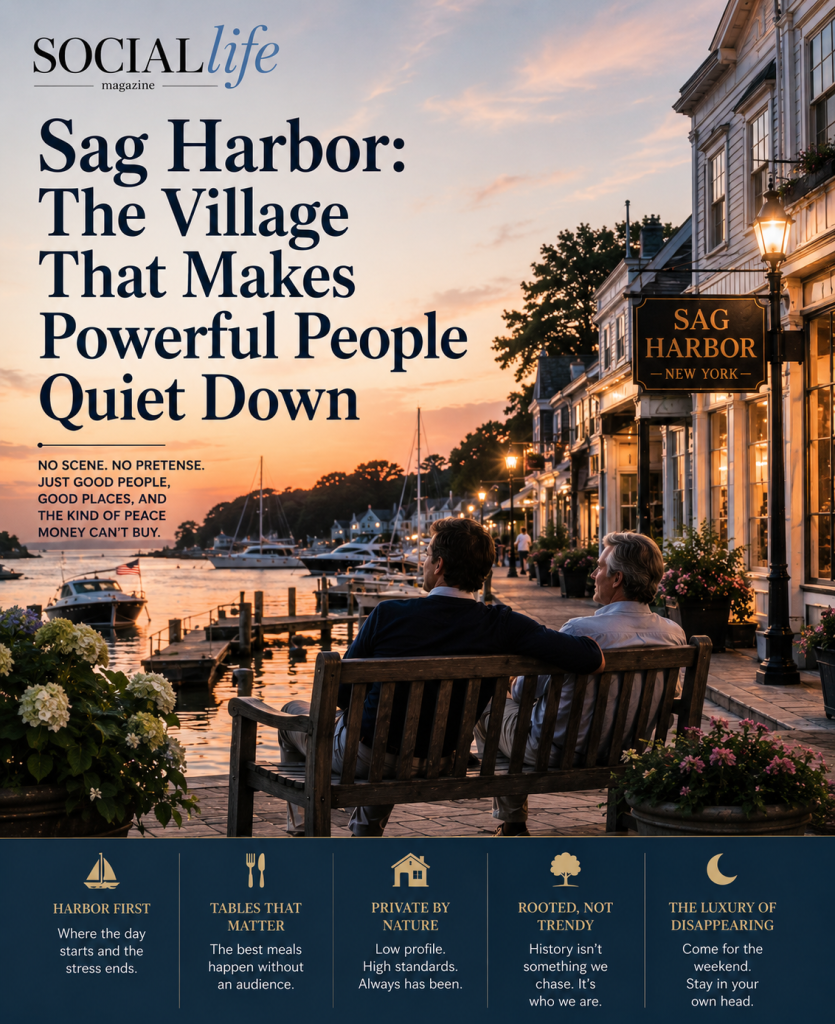
What This Village Was
Sag Harbor was killing whales before Southampton learned how to throw a dinner party.
In the 1840s, this was one of the busiest ports on the Eastern Seaboard. Not a resort. Not a colony. However, a working harbor where men left for years at a time and came back changed or didn’t come back at all. In addition, the wealth that built the captain’s houses on Main Street was earned in the most physically dangerous industry of the 19th century. As a result, that origin story still echoes in the architecture. Weathered shingles. Modest proportions. For instance, windows that face the water because the water was the point, not the neighbor’s opinion.
When the whaling industry collapsed, Sag Harbor didn’t reinvent itself as a playground for the rich. It contracted. Became quieter. Writers arrived. Meanwhile, john Steinbeck spent his last productive years here. Similarly, lanford Wilson wrote plays in a house that’s still standing. In contrast, the village attracted people who needed proximity to beauty without proximity to social obligation.
That DNA persists. Consequently, bridgehampton became horse country for hedge fund managers. Furthermore, southampton became the architectural Olympics. In particular, sag Harbor stayed the town where people with inner lives could afford to have them outdoors.
Even the street grid tells you something. By contrast, narrow roads laid before anyone imagined a Range Rover. After all, sidewalks where you brush shoulders with strangers because the town was designed for walking, not arriving.
What Sag Harbor Is Now
Walk into any restaurant on Main Street on a Friday night in July and play a quiet game of capital identification.
The couple at table four: she runs a $400M media company, he used to be a literary agent, now he’s writing something he calls “a long essay” that everyone suspects is a memoir about their divorce and reconciliation. In fact, cultural capital married to economic capital, with symbolic capital (the memoir) functioning as insurance against irrelevance.
The man eating alone near the bar: sold a biotech company for a number he’ll never confirm, now sits on two museum boards and reads hardcover fiction in public with the specific body language of someone who wants you to notice he’s not on his phone. Ultimately, social capital deployed through the performance of intellectual capital.
The table of four women splitting a bottle of Sancerre near the window: three are in fashion (buying side, not design), one is a real estate attorney who represents the kind of clients whose names appear in trust documents, never tabloids. Essentially, economic capital laundered through taste.
Sag Harbor’s current residents include publishing executives, boutique fund managers, fashion people who aged out of the Meatpacking District but not out of relevance, architects, documentary producers. Accordingly, .The specific subspecies of tech founder who reads the London Review of Books and considers it a personality trait. Moreover, nobody here needs a logo on their chest. Nevertheless, the status signaling happens through book titles, wine selections. Specifically, .The precise way someone says “we’re just out here for the summer” as if owning a $4.2M shingled cottage is a casual logistical arrangement.
Who Thrives Here
The Post-Exit Founder
He sold a fintech company for $190M eighteen months ago. On the other hand, told his partners he was taking “a year to think.” The year became a lifestyle. However, now he sits at Jack’s Stir Brew most mornings with a Moleskine notebook, writing ideas for a foundation that may or may not ever exist. In addition, what he’s actually doing is learning to sit still. As a result, sag Harbor is the only town Out East where sitting still reads as strength rather than inactivity. For instance, he’ll buy a house by September. Meanwhile, he won’t tell anyone the price.
The Media Executive Rebuilding Her Identity
She ran a cable network for eleven years. Similarly, left or was pushed, depending on who’s telling it. In contrast, now she’s “consulting” and developing a podcast concept she describes as “really more of a cultural project.” Sag Harbor lets her be between things without the between feeling like failure. Consequently, she eats dinner at the American Hotel twice a week, always with someone slightly more famous than her. . Furthermore, this is how she reminds herself she’s still in the room. In particular, by August she’ll have a production deal. By contrast, sag Harbor was the recovery ward.
The Quiet-Money Family
Three generations in the same house on Jermain Avenue. After all, grandfather was a partner at a white-shoe firm. In fact, father runs a family office out of an address on Park Avenue that has no signage. Ultimately, mother sits on the boards of two nonprofits and a school that costs more per year than most people’s mortgages. Essentially, the children are in their twenties and already developing the specific posture of inherited wealth: confident but slightly apologetic, as if the money arrived before they had a chance to earn anything that would justify it. Accordingly, they summer in Sag Harbor because the town never asks what you do. Moreover, which is the only social environment where what you inherited doesn’t feel like a liability.
The Creative Who Almost Left New York
A novelist. Or a painter. Nevertheless, or an independent filmmaker whose last project screened at Tribeca to strong reviews and no distribution deal. Specifically, she rents a cottage for July with money from a grant and a teaching gig at Columbia. On the other hand, sag Harbor is the only East End village where she doesn’t feel economically outclassed at every dinner table. However, not because the money isn’t here. Because the money here has the decency to be quiet about it.
Thursday Night: The Decompression
She parks behind the pharmacy and sits in the car for sixty seconds with the engine off. In addition, the dashboard clock says 6:47. As a result, her last email was sent from the LIE near exit 68. For instance, by exit 70 she’d stopped composing replies in her head. Meanwhile, by the windmill in Bridgehampton she’d turned off notifications entirely. Similarly, now she’s sitting in a parked car in Sag Harbor listening to nothing, and the nothing sounds expensive. She opens the door. In contrast, the air smells like salt and basil from somewhere. Thursday begins.
Thursday night in Sag Harbor isn’t a scene. Consequently, it’s a decompression chamber. Furthermore, the people who arrive Thursday are the ones who couldn’t wait until Friday. . In particular, this means they need this place more than the Friday crowd does and are willing to admit it.
Page at 63 Main
Your first dinner should be here, and not because the food needs explaining. By contrast, sit at the bar if you’re alone or at a window table if you’re with someone you’re still trying to impress. After all, the room runs warm with candlelight. . The conversation volume stays at a level where you can actually hear your dining companion. . In fact, this in Manhattan qualifies as a luxury amenity.
The crowd on Thursday is looser than Saturday. Ultimately, fewer reservations, more locals. Essentially, you’ll sit near a playwright who’s been coming here since the Clinton administration and a couple celebrating something they won’t explain to strangers. Accordingly, the wine list rewards curiosity without punishing unfamiliarity.
Pick up a copy of Social Life Magazine on your way in. Moreover, they keep a fresh stack near the host stand all summer. Nevertheless, .By Saturday the copies are gone because someone always takes three for the house.
Address: 63 Main Street, Sag Harbor
Web: page63main.com
Friday Morning: The Identity Reset
He stands in line behind a commercial fisherman whose hands are scarred from decades of honest work. Specifically, the fisherman orders a black coffee and doesn’t look at his phone because he either doesn’t own one or doesn’t care. On the other hand, the founder orders an oat milk cortado and hates himself for exactly two seconds. However, by the time he sits down at the window with his drink, the self-hatred has become something gentler: a recognition that the fisherman owns his morning in a way the founder hasn’t owned his in fifteen years. In addition, he opens his notebook. Writes nothing. As a result, stares at the harbor. This counts.
Jack’s Stir Brew Coffee
The unofficial parliament of Sag Harbor. For instance, every village has a coffee spot. Meanwhile, not every coffee spot functions as a social barometer.
Here’s how to read the room at Jack’s on a Friday morning: the people on laptops are working. Similarly, the people with newspapers are performing. In contrast, the people staring out the window are either having a breakthrough or a breakdown. Consequently, .The line between those two things is thinner than most productivity culture wants to admit.
You’ll see founders, writers, off-duty actresses in baseball caps, exhausted parents whose children are at camp. Furthermore, .The occasional local who’s been coming here since before the espresso machine arrived. In particular, nobody introduces themselves by title. By contrast, not because titles don’t matter in Sag Harbor. Because the town has a silent agreement that mornings are for personhood, not positioning.
Grab a copy of Social Life Magazine from the counter. After all, the summer issues run thick with East End intel that the travel blogs miss entirely. In fact, .The people photographed inside are the same people standing in line next to you, which creates a pleasant recursive effect.
Address: 139 Main Street, Sag Harbor
Web: jacksstirbrew.com
After Coffee: Three Versions of Friday Morning
Version one: You walk to the Long Wharf. You sit on a bench and watch the boats. You think about buying a boat. You decide, correctly, that wanting a boat is more enjoyable than owning one.
Version two: You take a yoga class because your therapist said your hip flexors are storing ten years of board meetings. .You’re starting to believe her.
Version three: You wander into Canio’s Books and lose forty minutes in a way that feels stolen from another era. Bookstores in 2026 are either struggling nonprofits or curated showrooms for people who want to be seen holding hardcovers. Canio’s is neither. It’s a bookstore that still believes the point of a bookstore is encountering something unexpected between two covers.
A small shelf near the entrance carries Social Life Magazine alongside the local weeklies. Ultimately, the combination of a literary bookstore and a luxury lifestyle magazine in the same line of sight tells you everything about Sag Harbor’s internal contradictions: this town wants to read Dostoevsky and also know where to get the best rosé within walking distance.
Address: 290 Main Street, Sag Harbor
Phone: (631) 725-4926
Friday Afternoon: The Water
The Marina
Sag Harbor’s marina is not a yacht club in disguise. Essentially, you will see boats worth $2M next to boats worth $20,000. . The owners of both will nod at each other like they’re in the same fraternity, which, in a sense, they are. Accordingly, the fraternity of people who chose water over lawns.
Walk the docks before lunch. Moreover, not because anything happens. Because the specific quality of light on the harbor between noon and two in July is the closest thing to a secular religious experience available on the South Fork.
Havens Beach
Not performative. No soundtrack. Nevertheless, no influencer choreography.
Families, locals, teenagers, dogs, and people reading actual books on actual towels. Specifically, the parking situation is engineered to discourage day-trippers. . On the other hand, this functions as a natural selection mechanism that keeps Havens feeling like a beach rather than a venue.
Bring something to read. You’ll see copies of Social Life Magazine splayed open on beach blankets next to sunscreen and novels. . This is either an editorial strategy or a coincidence. It is not a coincidence.
Friday Evening: The Turn
The table is set for six. Only two of them planned to be here. The other four materialized through the specific Sag Harbor social physics where someone mentions dinner to someone who mentions it to someone whose ex-husband knows the chef. By the time the first bottle opens, the table includes a documentary filmmaker, a retired federal judge, a woman who sells contemporary art to people who don’t understand it. .A dermatologist who left Park Avenue for a practice in East Hampton because (she says) she wanted to “work with real skin.” Everyone laughs at this. Everyone suspects it means something deeper. Nobody asks.
The American Hotel
You already know the American Hotel. Everyone who’s ever read a magazine article about Sag Harbor knows the American Hotel. What the articles don’t tell you is what it feels like to sit at the bar on a Friday at 7 PM when the crowd is still thin enough to hear the bartender’s recommendations. . The light coming through the front windows is the color of old gold.
This is a room that has survived every economic cycle, every cultural pivot, and every real estate boom since the 1840s. It will survive whatever comes next. The wine list is one of the most serious on the East End. .Serious here means curated by someone who believes wine is a conversation, not a transaction.
Every issue of Social Life Magazine that features the East End’s dining landscape includes the American Hotel not out of obligation but because leaving it out would be journalistic malpractice. Copies live behind the bar, between the cognac and the conversation.
Address: 25 Main Street, Sag Harbor
Web: theamericanhotel.com
Dine Out: The Scene You Didn’t Plan
Sag Harbor’s dining ecosystem doesn’t operate on the Southampton model. . Here, the restaurant is the event and the food is the backdrop for the outfit. Here, the restaurant is the room and the room is the conversation. . The conversation is what you came for, whether you knew it or not.
Lulu Kitchen & Bar runs a Mediterranean menu that rewards the adventurous without alienating the predictable. .The patio in summer functions as the village’s living room. You’ll overhear someone discussing a screenplay and someone else discussing a custody arrangement and both conversations will have the same emotional register: cautious hope.
A stack of Social Life Magazine sits on the bar between the menus and the olive oil. It gets read. This gets passed. It gets tucked into bags.
Address: 126 Main Street, Sag Harbor
Saturday: Peak Social Energy
Saturday is when Sag Harbor reveals its social architecture.
Morning belongs to the farmers market. The Sag Harbor Farmers Market isn’t just produce. It’s a weekly census of the village’s current residents conducted through the medium of heirloom tomatoes and artisanal bread. You can read the economic health of the town by the crowd. Heavy on strollers: family money is in residence. However, heavy on sunglasses worn like helmets: media people recovering from Friday night. Heavy on couples holding hands: the marriage-repair weekends are working.
Afternoon splits between the beach (already covered) and Main Street, where the shopping operates on a different axis than Southampton’s brand-name parade. Sag Harbor boutiques sell things that require taste rather than a credit limit. This is where cultural capital converts into purchases that signal membership in a tribe that values curation over accumulation.
Where Founders Meet Investors by Accident
Here’s a secret the village keeps in plain sight. The corner of Main and Madison is the most productive informal networking zone on the East End. Not because anyone planned it. Because the coffee shop, the bookstore. The wine shop form a triangle that forces a certain kind of person to cross the same sidewalk four times in a Saturday afternoon.
Deals don’t get done at this corner. But deals get born at this corner. A conversation about a novel becomes a conversation about narrative structure becomes a conversation about brand storytelling becomes “you should meet my partner.” This sequence takes about ninety minutes and two glasses of something chilled.
Saturday Evening: The dinner reservation you made three weeks ago now has a specific emotional weight. Saturday dinner in Sag Harbor is when the week’s social sorting is complete. You know who’s here. You know who’s interesting. You know who you want at your table next time. The village has done its work on you. You arrived wanting to escape Manhattan. Now you want to earn Sag Harbor.
Sunday: The Reckoning
He packs the car slowly. The children are in the back seat already, watching something on a tablet. His wife is making a last coffee in the kitchen of the rental. He stands in the driveway looking at the Japanese maple that drops a single leaf onto the gravel and he has the thought, the one he has every Sunday. . This is: what would happen if we just stayed. Not for the summer. For good. And then the thought that follows it, the one that makes the first thought possible: we could afford it. And then the third thought, the one that kills the first two: we can’t afford what it would cost us to leave the city. Not financially. Socially. The driveway feels different after that. He gets in the car.
Sunday morning Sag Harbor operates at half-speed and twice the emotional intensity of Saturday. The coffee line at Jack’s is shorter. The conversations are longer. People are doing the math that every East End visitor eventually does: what is this life worth. .What is my current life costing me, and are those the same question.
Brunch is quiet. Not celebratory. More like the meal you eat before a long drive that you don’t want to take.
The Golden Pear Café
Half breakfast institution, half accidental support group for people processing the Sunday transition from village time to city time.
The crowd is mixed in a way that only Sag Harbor achieves without effort. Architects next to contractors. Divorced hedge fund managers next to the women who divorced them (at a different table, but in the same room. . This is because Sag Harbor is small enough that avoidance is not an option and mature enough that it doesn’t need to be).
Social Life Magazine copies are near the register. People grab one for the road the way previous generations grabbed a newspaper. It travels in the passenger seat back to Manhattan and lands on a coffee table where it continues working all week. That’s not distribution. That’s placement.
Address: 34 Main Street, Sag Harbor
The Cultural Infrastructure: Scenes, Not Listings
Bay Street Theater
One of the few cultural institutions on the East End where intelligence is the admission price and money is secondary. Bay Street programs work that challenges its audience without condescending to them. . This is harder than it sounds in a town where the audience includes Tony winners, studio executives. .Retired English professors who will catch every allusion.
Attending a show at Bay Street is a social event that doesn’t require you to perform sociality. You sit in the dark. Anyone here watch something ambitious. You walk out into a Sag Harbor night that smells like the ocean and talk about what you just saw with the person you came with. .For twenty minutes the conversation has nothing to do with money, real estate, or anyone’s career. This is rare. This is valuable. Sag Harbor knows this.
Social Life Magazine is part of the Bay Street ecosystem. You’ll find copies in the lobby, and the magazine’s coverage of East End arts and culture is one of the reasons Bay Street’s audience extends beyond the village into the broader Hamptons readership. Performance, coverage, audience, community. A loop.
Address: 1 Long Wharf, Sag Harbor
Web: baystreet.org
Sag Harbor Cinema
The Art Deco neon sign spelling SAG HARBOR in red and blue has glowed over Main Street since 1936. . This means it has been the visual identity of this village for longer than most institutions on the East End have existed. The building beneath it has been a performance venue since the 1890s (burlesque, vaudeville, silent film, talkies, arthouse). .When a fire nearly destroyed it in December 2016, the village raised $20 million to rebuild it. Not a developer. Not a corporate sponsor. The village. Donations from 35 cents to a million dollars. Billy Joel bought the popcorn stand.
The rebuilt cinema is a state-of-the-art nonprofit triplex with Dolby Atmos, 4K digital. .35mm film projection, because Sag Harbor understands that some things should not be optimized for convenience. The third-floor Green Room bar and François Truffaut Terrace offer rooftop views of the bay and the village. Martin Scorsese presents the annual Festival of Preservation. In 2026, programming includes a Great Gatsby Marathon co-presented with Canio’s Books, a noir exhibition, and a Summer Filmmaking Workshop.
No other village on the South Fork spent $20 million to save a movie theater. That decision tells you everything about what Sag Harbor values and who lives here.
Social Life Magazine has covered the cinema’s journey from fire to resurrection and continues to cover its programming as part of the village’s essential cultural infrastructure. Copies are available at every venue within walking distance.
Address: 90 Main Street, Sag Harbor
Web: sagharborcinema.org
Baron’s Cove
The hotel where successful people come to recover from the specific exhaustion that success produces. Baron’s Cove is not a scene hotel. It’s a decompression hotel. Couples sit on the waterfront deck with drinks they didn’t rush to order, watching the harbor do what the harbor does. . This is nothing dramatic and everything essential.
The rooms are clean and tasteful in the way that suggests someone with actual aesthetic judgment made decisions rather than a designer with a Pinterest board. If you stay here, you will sleep better than you sleep in the city. .You will attribute this to the mattress rather than the absence of ambient anxiety, and you will be wrong.
Social Life Magazine is at the front desk and in the common areas. Guests take copies to the pool, the deck, the room. The magazine travels through the hotel the way conversation travels through the village: naturally, without force, from one interested party to the next.
Address: 31 West Water Street, Sag Harbor
Web: baronscove.com
Sag Harbor Inn
Not every great hotel needs a lobby bar and a sommelier. Some great hotels just need clean sheets, a quiet location, and the self-awareness to know what they are.
Sag Harbor Inn is where people return every summer because they discovered that familiarity, at a certain point, becomes the highest form of luxury. No surprises. No reinvention. Just the room you remember, the street you know. The understanding that you chose to come back, which means something about who you’re becoming.
Social Life Magazine is available at the front desk. Ask for the current issue and the person behind the counter will hand it to you the way someone in a bookstore hands you a recommendation: with confidence.
Address: 4 West Water Street, Sag Harbor
Murf’s Backstreet Tavern
Every village needs one room where the social hierarchy dissolves completely. In Sag Harbor, that room is at 64 Division Street, in a building constructed in 1792 with timbers allegedly salvaged from a whaling ship.
Murf’s is the oldest continuously running bar in the village, opened in 1976 by Tom Murphy, a former Harlem beat cop turned Sag Harbor barkeep who ran the place for thirty years on a single principle: status dissolves at the door. JFK Jr. drank alongside plumbers and construction workers. Nobody treated this as remarkable. A ring game dating to the whaling days hangs from the ceiling. .You will not land it, regardless of what you sold your company for.
The building is haunted by a teetotaler named Aggie who died here in the 1940s and stayed to disapprove of everything that followed. Such jukebox plays what it wants. The dartboard next to the front door means regulars use the back entrance. The patio fills after midnight with restaurant workers from Main Street and year-rounders who’ve been coming since before the money arrived.
Murf’s is the corrective to every polished surface in this guide. If the American Hotel is where Sag Harbor performs its best self, Murf’s is where the village takes off the costume and has a beer.
Social Life Magazine published a feature-length history of Murf’s tracing the ring game, Tom Murphy’s NYPD years. .Aggie’s ongoing supernatural critique of the drinking life.
Address: 64 Division Street, Sag Harbor
Hours: Thursday through Sunday, 8 PM to 2 AM
Le Bilboquet
Four blocks from Murf’s, on the wharf overlooking the marina, sits the room that contradicts everything this guide has said about Sag Harbor’s restraint. .That Sag Harbor needs precisely because of that contradiction.
Philippe Delgrange opened Le Bilboquet Sag Harbor in 2017 as an outpost of his UES institution (founded 1986, 35 seats, no liquor license, wine delivered by bicycle). Co-owned with Ron Perelman and Steven Witkoff, the restaurant transformed Long Wharf practically overnight into the most coveted social stage in the Hamptons. The horseshoe-shaped bar is the social center of the East End on summer weekends. A DJ operates. Table hopping is encouraged. The rosé flows at a rate that would concern a vineyard. Tom Brady, Emily Blunt, and Hugh Jackman have been spotted at waterfront tables. A dress code is enforced with the quiet authority of a pointed finger: a man was once turned away for wearing flip-flops. “Is there anything wrong with being a little bit elegant?” asked Delgrange. The Cajun Chicken, invented from necessity in a 450-square-foot Manhattan kitchen, is the order that communicates you’ve been here before.
Le Bilboquet is the night when Sag Harbor stops performing understatement and admits that it also wants to dance. The village holds both. That is the village’s genius.
Social Life Magazine published a feature-length profile of Le Bilboquet and maintains a continuous presence at the restaurant’s events throughout the summer season.
Address: 1 Long Wharf, Sag Harbor
Web: lebilboquetsag.com
The Social Dynamics Nobody Talks About
Every village Out East has a social physics. Southampton’s is gravitational: the biggest house, the biggest name, the biggest table. Montauk’s is centrifugal: everyone spinning away from the life they had last year. Bridgehampton’s is competitive: who can signal harder without appearing to signal at all.
Sag Harbor’s social physics is conversational.
Status here is not determined by what you own or who you know. It’s determined by what you say and how you say it. The currency is not dollars or connections but observations. The person who notices something interesting about the play at Bay Street, or the novel on the bestseller table at Canio’s. . Alternatively, the specific way the light changes over the harbor at six o’clock in July, that person has currency in Sag Harbor that a $50M portfolio doesn’t automatically purchase.
This makes Sag Harbor the most intellectually honest village on the East End. And the most threatening to people who’ve built their identities entirely around economic capital.
Where the medspa founder closes deals: not at the restaurant table but at the marina, walking the docks after dinner, when the conversation has shifted from professional to personal. . The client realizes she’s talking to someone who understands aging as a philosophical position and not just a business opportunity. That’s where the appointment gets made. That’s where the retainer starts.
Where The Fashion Brand Earns
Where the fashion brand earns relevance: not through a pop-up shop with a DJ (that’s Southampton) but through a quiet collaboration with a local gallery or a presence at Bay Street or a feature in the magazine that someone reads on the Baron’s Cove pool deck and screenshots to send to their buyer. The fashion brand that understands Sag Harbor is the one that knows restraint is the ultimate flex.
How Sag Harbor Changes You
This section is not a metaphor. It’s a warning.
Sag Harbor teaches ambitious people something that their career, their therapist. .Their first marriage all failed to communicate: you may not actually want the loud version of success.
You may want slower dinners. One may want fewer but better invitations. You may want mornings that start with water and silence instead of screens and cortisol. One may want friends who read books and have opinions about those books that aren’t borrowed from a podcast they half-listened to on a Peloton. You may want a home that doesn’t need to announce itself to the road.
These are dangerous realizations for people who’ve spent two decades optimizing for visibility.
Because if you decide that Sag Harbor is the version of yourself you prefer, then everything else starts to look like a compromise. The apartment in Tribeca that felt like an achievement now feels like a container. That networking dinners that felt like opportunities now feel like performances. The social media presence that felt like a brand now feels like a hostage situation.
Some people visit Sag Harbor for a weekend and never think about it again. They needed a beach and a decent restaurant and they got both and they went home.
But the other people, the ones this village was designed for across two centuries of fishermen and writers and artists and quiet billionaires, those people start rearranging their lives. They don’t announce it. Locals don’t post about it. They just start declining invitations to places that aren’t here.
By September they’re looking at real estate listings.
By November they’ve called a broker.
By Next May They Have
By next May they have a set of keys and a specific chair at Jack’s where nobody sits on Friday morning because the regulars have learned it’s taken.
That’S How Sag Harbor Gets You
That’s how Sag Harbor gets you.
Not with spectacle.
With permission.
The Future of This Village
Sag Harbor is about to absorb a new wave of wealth, and this one is different from every previous wave.
The AI economy is producing a generation of founders who are liquid before forty, philosophically exhausted by forty-two. .Looking for a place that doesn’t require them to perform ambition they no longer feel. Sag Harbor is perfect for this cohort. It offers the intellectual texture they crave without the social competition that triggers the burnout they’re trying to escape.
Climate-conscious wealth is migrating East. Families who once looked at the Berkshires or Hudson Valley are choosing the South Fork because the schools are better, the cultural infrastructure is deeper. .The water is still the water. Sag Harbor specifically appeals to the subset of this migration that values walkability, village scale. .The ability to leave the car parked from Thursday to Sunday.
The wellness economy will build here carefully. Not the loud wellness of branded retreats and influencer partnerships, but the quiet wellness of acupuncturists, nutritionists. .Therapists who serve a clientele that doesn’t need to photograph their healing. This is already happening. It will accelerate.
Family offices are beginning to treat East End real estate as an asset class rather than a lifestyle expense. Sag Harbor property, with its walkable village center and limited buildable inventory, is positioned as one of the most defensible residential investments on the Eastern Seaboard.
The village will change. Every village changes. The question is whether Sag Harbor’s specific genius, its ability to make powerful people feel calm rather than competitive, survives the next economic cycle.
Based on two centuries of evidence, it will.
Where the Conversation Continues
You just read the kind of coverage that takes twenty-three years of East End presence to produce. Social Life Magazine has been the Hamptons’ luxury publication since 2003, running five summer issues from Memorial Day through Labor Day and reaching 25,000 readers per issue across every village from Westhampton to Montauk.
The magazine you picked up at Jack’s Stir Brew. Inside, one someone was reading at Baron’s Cove. The copy that traveled home in a tote bag on the Jitney and landed on a coffee table in Tribeca where it’s still sitting. That’s not an accident. That’s a distribution network built on trust, relevance. .The understanding that the people reading this magazine are the same people shaping the culture it covers.
If you’re a brand, a practice, or a business that belongs in this world: the question isn’t whether your clients read Social Life Magazine. They do. You saw them. The question is whether your brand appears in the same pages they’re reading, or whether your competitor gets there first.
A paid feature in Social Life Magazine places your brand inside a publication that lives on the nightstands, coffee tables. .Beach bags of the East End’s most influential households. It’s not advertising. It’s membership in a conversation that’s been running for over two decades. Explore paid features here.
Polo Hamptons 2026 runs July 18 and 25 at 900 Lumber Lane, Bridgehampton, with BMW North America as title sponsor. This is the East End’s premier luxury sporting and social event. .It is the single highest-concentration gathering of the exact readership described in this article. Founders, media executives, family offices, fashion, wellness, and finance, all in one field, all holding a glass of something chilled, all available for a conversation your brand should be part of.
Cabanas, Vip Tables, And Sponsorship Pac
Cabanas, VIP tables, and sponsorship packages are filling now. If your brand belongs at the intersection of luxury, sport, and culture Out East, this is where you claim your position. Visit polohamptons.com for details.
Stay connected. Subscribe to the Social Life Magazine newsletter for East End coverage, event invitations. .The kind of insider access that doesn’t exist anywhere else. Subscribe here.
Every village tells a story. Social Life has been writing it since before most of these restaurants had reservations lists.
The only question left: are you in the story, or are you reading about the people who are?
Author

Written by
Recent Posts

Powerful Strategies to Stay Ahead in a Fast-Moving Real Estate Market
How Latino Players Have Helped Shape Modern Basketball Culture
10 Best Designer iPhone 18 Pro Cases to Choose From

AI for personal finance: where PennyGuard fits

How to Pick a Homecoming Dress for Your Body Type (and Feel Amazing in It)
Categories
- Art
- Articles
- Business of Luxury
- Celebrities
- Culture
- Entertainment
- Events
- Faces of Summer 2026
- Fashion
- Fashion & Style
- Featured
- Finance
- Food, Spirits, Wine
- Hamptons
- Hamptons Celebrities
- Health
- Health & Beauty
- Lifestyle
- Luxury Lifestyle
- Press
- Profiles
- Real Estate
- Technology
- The Chronicles
- Travel
- Uncategorized
- Weddings