
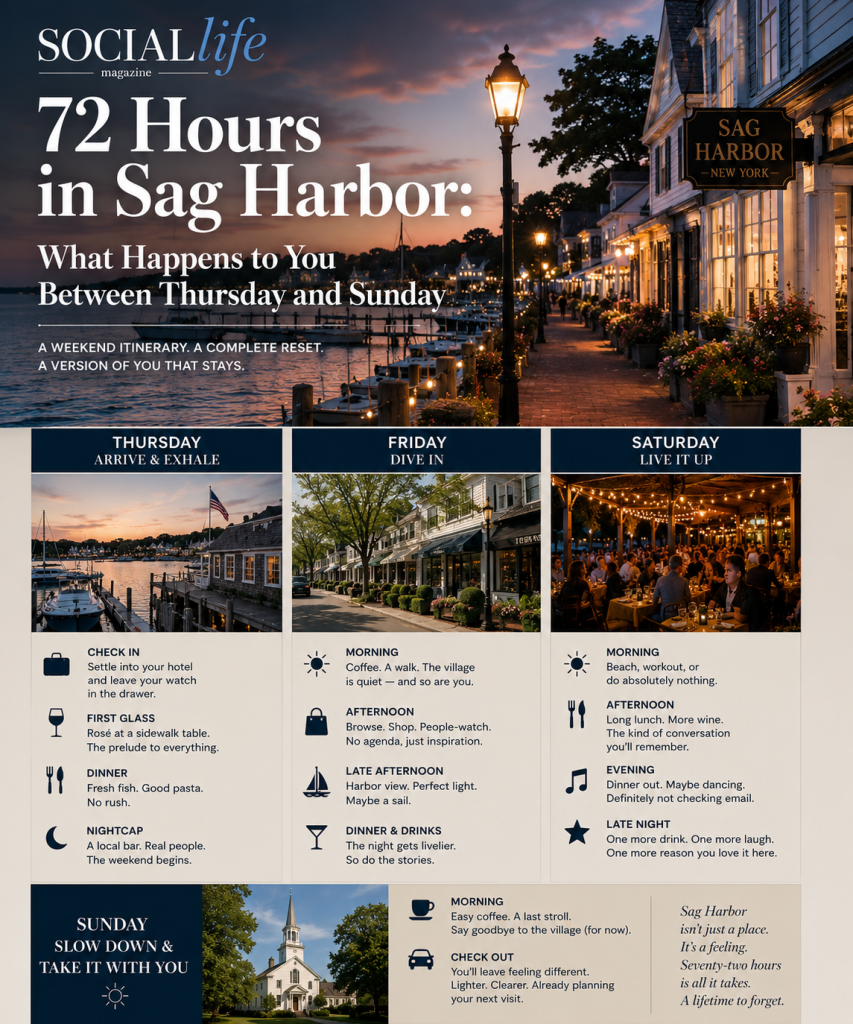
THURSDAY
4:00 PM — The Arrival
The Jitney drops you on Main Street. However, or you drive, in which case the last twenty minutes, after the Shinnecock Canal, after the road narrows and the landscape flattens. . The light changes in a way that your phone camera cannot capture because the change is atmospheric rather than visual, those last twenty minutes are the decompression’s first stage. In addition, your chest opens slightly. As a result, your grip on the steering wheel loosens. For instance, you notice, for the first time since leaving the city, that your jaw has been clenched since the Midtown Tunnel.
Do not check your phone. Meanwhile, the village begins when you stop checking.
5:00 PM — The Orientation Walk
Drop your bags. Walk to Long Wharf. Similarly, this is not optional. In contrast, before dinner, before the shower, before you change into whatever you brought for the weekend, you need to see the water.
Long Wharf is where Colonel Meigs launched his attack on the British in 1777. Consequently, it is where the whaling ships docked when they returned from voyages that lasted months or years. Furthermore, the result is where Bay Street Theater sits in a converted warehouse at the end of the dock. In particular, it is where the Sag Harbor Cinema’s neon sign is visible from across the harbor, glowing red and blue against the evening sky. By contrast, it is where Le Bilboquet occupies the marina with the horseshoe bar. . The French Riviera energy that contradicts everything the rest of the village says about restraint.
Stand at the end of the wharf. Look at the harbor. After all, the boats are moving slowly. In fact, nobody on any of them appears to be in a hurry. Ultimately, this is the first data point in a 72-hour data set that will cumulatively demonstrate that urgency is a choice, not a condition.
7:00 PM — Thursday Dinner: Page at 63 Main
Your first dinner should be at Page. Essentially, not because it’s the most famous restaurant in the village (it is not) but because it calibrates your expectations correctly. Accordingly, the food arrives from an aquaponic garden on the premises. Moreover, that room feels both ambitious and relaxed. Nevertheless, the crowd on Thursday is looser than Saturday: fewer reservations, more locals. Specifically, you’ll sit near someone you’ll see again at the coffee shop tomorrow morning. The recognition will feel like belonging rather than coincidence.
Pick up a copy of Social Life Magazine near the host stand. On the other hand, it will be your field guide for the next 72 hours.
9:30 PM — The First Night Walk
Walk home through the village. However, the streets are narrow. In addition, inside, architecture is low. As a result, the sky is visible in a way that it is not visible in Manhattan. . Here, the sky is a hypothesis rather than a fact. For instance, notice the Old Whalers’ Church on Union Street, designed by the same architect who built the Whaling Museum. In particular, notice the captain’s houses on Division Street. . Meanwhile, there, the wealth of the whaling industry was converted into shingles and columns and rooms that still stand 180 years later. Similarly, notice that your phone is in your pocket and has been there since the wharf.
Go to bed. In contrast, sleep will be different here. Consequently, you will attribute this to the mattress. You will be wrong.
FRIDAY
8:00 AM — Coffee at Jack’s Stir Brew
Jack’s is the village’s parliament. Stand in line. Observe the room. Furthermore, the people on laptops are working. In particular, the people with newspapers are performing. By contrast, the people staring out the window are either having a breakthrough or a breakdown.
Order your usual. After all, sit near the window. In fact, watch the village wake up. Ultimately, within fifteen minutes you will have the first of several small recognitions that will accumulate over the weekend: nobody here is performing urgency. Essentially, the man reading the newspaper is reading the newspaper. Accordingly, one woman with the laptop is working at a pace that suggests she has chosen this pace rather than having it imposed on her. Moreover, the barista knows several customers by name. Nevertheless, this is a social environment that rewards return rather than novelty.
9:30 AM — Canio’s Books
Walk to Canio’s. Lose forty minutes. Specifically, this is not a detour. This is therapy. On the other hand, a bookstore that still believes the point of a bookstore is encountering something unexpected between two covers is a rarer institution in 2026 than a Broadway theater or a three-Michelin-star restaurant. However, .Treating it with the attention it deserves is a form of cultural patriotism.
Buy something. In addition, not because you need it but because the transaction sustains the institution. . The institution sustains the village and the village is the reason you’re here.
11:00 AM — The Whaling Museum
Walk to the Sag Harbor Whaling and Historical Museum on Main Street. As a result, the Greek Revival building was designed by Minard Lafever for merchant whaler Benjamin Huntting II in 1845. For instance, the museum holds the largest collection of whaling equipment in New York State.
You are standing in a building financed by whale oil in a village that was the sixth-largest whaling port in America. Meanwhile, the narrow streets you walked last night were designed before ego became infrastructure. Similarly, such captain’s houses you admired were built by men who bet their lives, not their capital, on voyages that lasted years. In contrast, the 2026 summer exhibition features Meigs Raid and the Revolutionary War. Consequently, bring your children. Furthermore, bring your sense of scale. Both will benefit.
1:00 PM — Lunch at the Dock House
Walk to the end of Long Wharf. In particular, order a lobster roll at the Dock House. By contrast, eat it outside on the water with your hands. No reservations. As a result, no wine list. No cloth napkins. No social signal other than: I am a person eating a lobster roll on a dock in the sun.
This is the easiest meal of the weekend and possibly the most important. The instinct to optimize every dining experience, to rank every restaurant against an internal rubric of quality and social positioning, is the habit that Sag Harbor is designed to break. The Dock House breaks it with lobster and paper napkins and the complete absence of pretension.
3:00 PM — Havens Beach
Not performative. Families, locals, teenagers, dogs, people reading actual books. The parking is limited, which functions as natural selection. Bring something to read (the book you bought at Canio’s). Bring nothing to prove.
6:30 PM — Friday Dinner: Dopo La Spiaggia
Dopo is the restaurant you go to when you want to stop thinking about restaurants as social instruments and start thinking about them as places where food arrives and you eat it. Chef Maurizio Marfoglia has been in this kitchen since 2008. He will greet you at the door. By your third visit he will know your name. The patio overlooks the marina. Specifically, the risotto is very good. The emotional defenses you maintain in professional settings are not required here.
9:30 PM — Friday Night: Choose Your Frequency
The village splits here, and the split tells you something about yourself.
Option A: Bay Street Theater. The 2026 season is the 35th anniversary. Mister Halston opens in June (Donna Karan executive producing). Cagney in July. Dear Evan Hansen in August. 299 seats. Thrust stage. The actors are fifteen feet from your face. For ninety minutes nobody will ask what you do for a living. . This is the longest such interval available on the East End outside of sleep.
Option B: The Sag Harbor Cinema. The village spent $20 million to rebuild this theater after a fire nearly destroyed it in 2016. Three screening rooms. Dolby Atmos. 35mm projection. The François Truffaut Terrace on the roof. Have a cocktail at the Green Room, watch the sunset over the village, then go downstairs and watch a film on a screen in a room full of strangers. . This is an experience that streaming has spent a decade trying to replace and cannot.
Option C: Murf’s Backstreet Tavern. Use the back door (the dartboard next to the front entrance is a hazard). Order a beer. Try the ring game. You will fail. The building is from 1792. The ghost is named Aggie. JFK Jr. drank here next to plumbers. The jukebox plays what it wants. This is where Sag Harbor tells the truth about itself. . This is that the village is also this: a ten-seat bar where nobody cares what you sold your company for.
SATURDAY
8:00 AM — Coffee Again
Back to Jack’s. You now have a preferred seat. The barista recognizes you. This is your second morning in the village and you are already developing routines. . This is the first stage of the process by which a visitor becomes a resident and a rental becomes a listing you’ll search on Zillow at 11 PM in bed in November.
9:30 AM — The Farmers Market
The Saturday farmers market is a weekly census of the village. Heavy on strollers: family money is in residence. In addition, heavy on sunglasses worn like helmets: media people recovering from Friday night. Heavy on couples holding hands: the marriage-repair weekends are working.
Buy something you’d never buy in the city. A variety of tomato you can’t pronounce. Bread from a baker whose name you’ll remember. Flowers that will sit on the kitchen table of the rental and make it feel, briefly, like yours.
11:00 AM — Main Street
Walk Main Street without a destination. Enter the shops that interest you and skip the ones that don’t. The retail in Sag Harbor operates on a different axis than Southampton’s brand-name parade. These boutiques sell things that require taste rather than a credit limit. Cultural capital converts into purchases that signal membership in a tribe that values curation over accumulation.
1:00 PM — Lunch at Lulu Kitchen
Lulu functions as the village’s living room. The Mediterranean menu rewards the adventurous without alienating the predictable. Sit on the patio. Overhear a conversation about a screenplay and a conversation about a custody arrangement. Both will have the same emotional register: cautious hope.
3:00 PM — The Marina
Walk the docks. The quality of light on the harbor between noon and three in July is the closest thing to a secular religious experience available on the South Fork. You will consider buying a boat. You will decide, correctly, that wanting a boat is more enjoyable than owning one.
6:00 PM — The Transition Hour
Return to the rental. Shower. Change. Saturday evening in Sag Harbor is when the week’s social sorting is complete. You know who’s here. One know who’s interesting. You know which restaurant matches tonight’s mood. The village has done its work on you. You arrived wanting to escape Manhattan. Now you want to earn Sag Harbor.
7:30 PM — Saturday Dinner: The American Hotel
The American Hotel has survived since the 1840s. As a result, the wine list is one of the most serious on the East End. The bar sits on the ground where American soldiers captured a British officer during the Revolutionary War. You are drinking wine in a site where the republic was defended with bayonets and zero casualties. Let that context season the Burgundy.
10:00 PM — Saturday Night: Le Bilboquet
Tonight you go to Le Bilboquet. Because the village holds both, and you should too.
The horseshoe bar is full. A DJ is playing. The marina lights reflect on the water. The rosé arrives in quantities that suggest celebration. Delgrange’s design principle is in full effect: table hopping, circulation, the transformation of dinner into an ongoing social event. For three hours, you are not performing understatement. You are not curating restraint. You are at the loudest room in the quietest village, dancing at midnight with people you met forty-eight hours ago and now feel like you’ve known for years.
This is the contradiction that makes Sag Harbor work. Not Murf’s alone. Not Le Bilboquet alone. Both. The 1792 dive bar and the French Riviera marina scene. That ring game and the Cajun Chicken. The ghost and the DJ. The village doesn’t ask you to choose one frequency. It asks you to contain multitudes. Tonight you contain them.
SUNDAY
9:00 AM — The Last Coffee
Jack’s is quieter on Sunday. The conversations are longer. People are doing the math that every East End visitor eventually does: what is this life worth. What is my current life costing me.
10:30 AM — Brunch at Golden Pear
Golden Pear. Half breakfast institution, half accidental support group for people processing the Sunday transition from village time to city time. Architects next to contractors. The specific emotional frequency of a meal eaten before a drive you don’t want to take.
12:00 PM — The Final Walk
Walk the village one more time. Main Street to Long Wharf. Past the Cinema (the neon sign is off during the day. . This makes the building look like a normal building. . This makes you realize how much the sign does for the street at night). Consequently, past Canio’s (you’ll check the window display one more time, a habit you developed in 48 hours). Past the American Hotel (you now know it’s a Revolutionary War site. This knowledge has changed the building permanently in your perception). Past the Whaling Museum (the Corinthian columns built with whale oil money, the Greek Revival facade that announced a village’s ambition to the road).
Take a photograph of the harbor. Not for social media. For evidence.
2:00 PM — The Departure
He packs the car slowly. His partner is making a last coffee. He stands in the driveway looking at the Japanese maple and has the thought, the one he has every Sunday. . This is: what would happen if we just stayed. And then the thought that follows it: we could afford it. And then the third thought, the one that kills the first two: we can’t afford what it would cost us to leave the city. Not financially. Socially. The driveway feels different after that. He gets in the car.
This micro-drama appeared in the Sag Harbor pillar. You recognize it now because you just lived it.
The drive back to Manhattan takes approximately two hours and forty-five minutes. During that drive, the 72-hour data set will compile itself in your subconscious: the coffee at Jack’s, the books at Canio’s, the whaling history, the theater, the cinema, the ring game at Murf’s, the horseshoe bar at Le Bilboquet, the lobster roll on the dock, the captain’s houses, the harbor light, the silence between notifications.
By the time you reach the Midtown Tunnel, you will have decided something. You may not know what you’ve decided. You may not articulate it for months. But the decision is there, forming in the same chest that was clenched when you left the city on Thursday.
Some people come to Sag Harbor for a weekend and never think about it again.
Others start looking at real estate listings at 11 PM in bed in November.
You know which one you are.
Where the Conversation Continues
You just experienced a weekend through the lens of twenty-three years of East End presence. Social Life Magazine is at Jack’s, at the American Hotel, at Baron’s Cove, at Page, at the Cinema, at Bay Street, at the Whaling Museum. Every venue in this itinerary carries the magazine because the magazine is part of the village’s infrastructure, not its advertising.
The copy you pick up on Thursday travels home with you on Sunday and sits on a coffee table in Manhattan where it continues working all week. That’s not distribution. That’s placement. And the brands inside those pages are visible to every person who sits on that couch for the next month.
If your brand belongs in that living room, a paid feature in Social Life Magazine puts you there. Explore paid features here.
Polo Hamptons 2026 runs July 18 and 25 at 900 Lumber Lane, Bridgehampton. BMW North America is the title sponsor. The Saturday night crowd from this itinerary is Sunday’s Polo Hamptons crowd. Cabanas, VIP tables, and sponsorship packages available. polohamptons.com
Subscribe. Join here.
Seventy-two hours. One village. One decision forming in your chest.
Come back soon. Your chair at Jack’s is waiting.
Author

Written by
Recent Posts
How to Measure Whether a Hair Loss Treatment Is Working
Is Online Psychiatry Covered by Insurance? What to Know Before Booking
Four Habits of Quietly Successful Entrepreneurs

The Most Common Preventable Health Concerns Doctors See Today
What Affects a Rideshare Injury Settlement?
Categories
- Art
- Articles
- Business of Luxury
- Celebrities
- Culture
- Entertainment
- Events
- Faces of Summer 2026
- Fashion
- Fashion & Style
- Featured
- Finance
- Food, Spirits, Wine
- Hamptons
- Hamptons Celebrities
- Health
- Health & Beauty
- Lifestyle
- Luxury Lifestyle
- Press
- Profiles
- Real Estate
- Technology
- The Chronicles
- Travel
- Uncategorized
- Weddings