
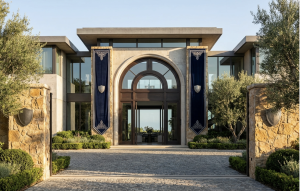
Creating a stunning entrance requires blending historical authority with modern restraint. By incorporating heraldry, antique lighting, and sculptural focal points, a simple doorway becomes a curated arrival experience, perfect for a formal estate dinner or a grand gala.
The experience begins long before the threshold.
The deliberate crunch of a gravel drive signals an escape from the outside world, heightened by the scent of cedar and the distant sound of a string quartet.
When the entrance finally comes into view, it should stand symmetrical and architecturally commanding. Luxury event professionals understand that the arrival is not a preamble; it is the opening act.
Celebrated events borrow from a visual language centuries older than modern trends to establish immediate confidence. Old-world glamour is not mere nostalgia. Principles like heraldry and sculptural weight have commanded attention for five hundred years.
The following four curatorial moves adapt these historic strengths for a distinctly modern moment.
1. Let Heraldry Do the Heavy Lifting
Every great entrance carries a symbol. In the fifteenth century, the heraldry displayed at a noble household’s gates told guests exactly whose world they were entering.
This same communicative power translates effectively into modern entryway décor, suggesting legacy without narrating it. Custom monogram banners flanking a foyer create the ceremonial symmetry of a gatehouse.
For event curators seeking historically accurate pieces to anchor these designs, authentic medieval armor provides a sense of physical permanence that complements stone crests. Sourcing such statement pieces from specialists like Medieval Collectibles ensures the material quality necessary to establish a truly grand atmosphere.
The principle is simple: pairs anchor a space.
Two vertical banners or lanterns create an architectural rhythm that instinctively slows a guest’s pace. Restraint remains operative; one strong heraldic motif accomplishes more than an abundance of competing details.
2. Set the Mood with Antique Lighting
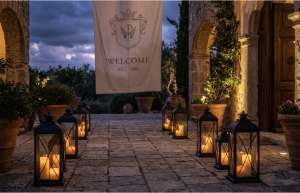
Architecture establishes location, but light establishes atmosphere. Antique-style lighting is the most transformative tool available to a host, shifting an entrance from a decorated doorway to an immersive experience through quality, temperature, and placement.
Research indicates that warm tones reduce stress, making guests feel immediately at ease. The medieval great hall utilized firelight for this purpose, creating a flickering warmth that made guests appear luminous and the architecture look dramatic.
Modern design achieves this effect without open flames. Wrought iron lanterns suspended at varying heights create a rhythm that draws the eye forward.
Wall-mounted torch sconces frame the entrance with bilateral authority, while candlelit clusters at floor level add a “low golden horizon” that grounds the space.
To maintain this aged palette, combine blackened iron and aged brass with ivory linen and deep jewel tones. Hanging banners of velvet or linen counterbalance the heavy stone and metal, adding textural softness and subtle movement.
This layered lighting scheme creates an atmosphere guests will remember long after the evening concludes.
| Pro Tip: Maintain a warm, aged color palette using blackened iron and ivory. The instant a cold-toned light enters the scene, the old-world glamour and architectural depth you’ve built will immediately dissolve. |
3. Style Hosts with Subtle Period Accents
An entrance is a human experience. Sophisticated hosts understand that staff and attendants are as much a part of the visual composition as the décor.
While generic service wear can undermine a space, attendants whose presentation reflects the environment’s intentionality elevate the entire corridor.
This is a design extension, not costuming.
Renaissance courts used attire to reinforce grandeur, and the modern equivalent follows that same logic. Research suggests that clothing style significantly influences trust and the perception of expertise.
Deep-toned velvet waistcoats or structured linen tunics in charcoal carry period references without being overt. For hosts, a personal style choice, like a signet brooch, a velvet cape, or an embroidered sash, carries significant visual weight.
These details signal to guests that they are in the presence of someone who dresses with intention, scaling naturally with the event’s formality.
4. Add a Commanding Sculptural Focal Point
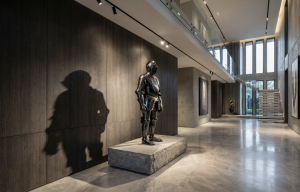
Every great entrance needs one object that stops the eye. It should not merely decorate or complete the area, but actively hold the viewer’s attention.
This is the focal point, acting as the single sculptural statement that transforms an entrance from a designed space into a designed experience. Castle interiors were built around precisely these moments of visual power.
A carved stone figure flanking an archway or a sculptural urn centered within a vaulted entry hall were deliberate architectural punctuations. These elements were specifically designed to communicate status and craftsmanship.
The modern application follows the same spatial logic. A polished bronze bust on a beveled plinth reads with quiet authority in a formal foyer.
A pair of stone urns of commanding scale anchors an entrance with necessary bilateral weight. For the most dramatic and conversation-worthy statement, few objects carry the combined visual and historical authority of a curated historical reproduction.
Treating authentic-looking replica pieces as serious installations resolves budget challenges gracefully. Placing these historical recreations in an event corridor or wedding foyer brings museum-like drama to luxury spaces when correctly positioned and lit.
Base or plinth selection matters to elevate the piece, while strategic lighting creates shadow and dimensional weight.
Flanking botanical arrangements or paired fabric panels ground the focal point beautifully. This ensures it tells arriving guests they have entered somewhere genuinely distinctive.
| Warning/Important: A sculptural focal point loses its impact if it feels ungrounded. Always use a high-quality plinth and strategic lighting to ensure pieces like armor or busts command the room’s respect. |
The Bottom Line
The most photogenic, genuinely remembered entrances of the modern era share a common characteristic. They understand what came before.
Old world glamour, deployed with restraint and intention, is not an aesthetic retreat into the past. It is a recognition that certain visual principles have commanded attention across centuries because they respond to something consistent in human perception.
We are drawn to spaces that feel significant and gatherings that feel considered. Selective borrowing is the operative principle for successful event design.
One heraldic motif executed with material quality is often enough. One antique lantern style held to a consistent palette creates the perfect atmosphere.
One sculptural focal point earns its placement through presence and craft. Guests who arrive at a thoughtfully designed entrance do not simply enter a room.
They enter a moment composed long before their arrival. Begin with one historical element, let it anchor the vision, and the rest will beautifully follow.
| Author Profile: Medieval Collectibles is the leading online retailer of authentic medieval replicas and fantasy collectibles for history enthusiasts, reenactors, and collectors worldwide. |
Author

Written by
Recent Posts
Unlocking the Berkshires
Dalia Forman Design
Alberto Luzzi
How to Pick a Homecoming Dress for Your Body Type and Feel Amazing in It
How to Prepare a Home for Sale When Major Repairs Are Not Affordable
Categories
- Art
- Articles
- Business of Luxury
- Celebrities
- Culture
- Entertainment
- Events
- Faces of Summer 2026
- Fashion
- Fashion & Style
- Featured
- Finance
- Food, Spirits, Wine
- Hamptons
- Hamptons Celebrities
- Health
- Health & Beauty
- Lifestyle
- Luxury Lifestyle
- Press
- Profiles
- Real Estate
- Technology
- The Chronicles
- Travel
- Uncategorized
- Weddings