
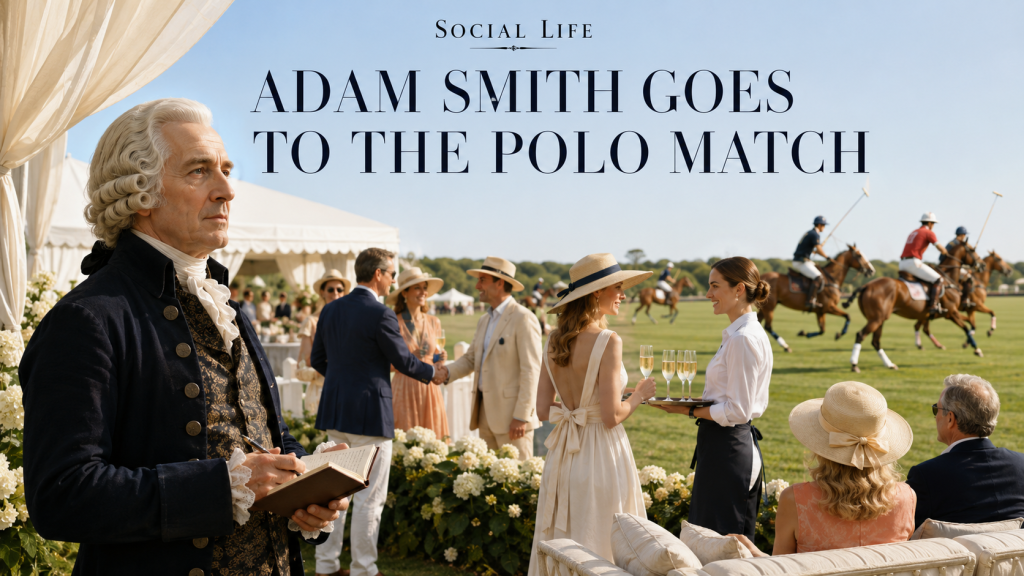
A polo pony reaches thirty miles an hour and stops in about two strides. That is the physical fact at the center of the afternoon, and half the tent never sees it. They are watching each other instead, which is why an Adam Smith polo Hamptons reading beats a sports column. Smith died in 1790, yet he would have read that lawn in under a minute.
Every July the flat farmland north of Montauk Highway in Bridgehampton turns into a grandstand for something other than sport. Eight riders, forty horses, chukkers of seven minutes each. Around them, several hundred people in linen conduct the actual event. That event is a mutual assessment so constant that nobody experiences it as work.
Smith spent a career on exactly that mechanism. Before the economics, he wrote a book about why we care so violently what other people think of us. The Theory of Moral Sentiments landed in 1759 and made him famous across Europe. The Wealth of Nations followed seventeen years later, in 1776, and buried the first book under its own success.
So the polo lawn is not a metaphor for his ideas. Rather, it is a working model of them, staged annually, with catering. Once you see the parts moving, you cannot stop seeing them. That is the risk of reading Smith before you arrive.
What You Are Actually Looking At
Start with the dimensions. A polo field measures 300 yards by 160, the largest playing surface in organized sport. Nothing else out here clears that much open ground for one afternoon. So scale is the first argument the event makes.
Along one side sits the tent. Tables in front, standing room behind, and a rope. That rope works less as a barrier than as a sentence about where you belong. Nobody enforces it aggressively. Everybody reads it instantly.
Behind the tent are the cars, arranged by whoever paid for the day. Title sponsorship generally goes to an automotive brand. So a row of new metal parks where the four o’clock light is best. Every phone on the property finds it within the hour.
Out on the grass, the sport itself is genuinely hard. Riders swing a mallet at a ball the size of an apple while a half-ton animal changes direction underneath them. Most of the field has played since childhood, and a handicap system exists because talent here is measured, not asserted.
Three things are happening at once, then. Athletics on the field, commerce behind the tent. In the middle, the oldest layer of all: several hundred people quietly ranking each other.
Smith Wrote the Manual in 1759
Here is the mechanism, stripped of the seminar tone. Smith argued that we cannot feel another person’s experience directly. We can only imagine ourselves into their position, then feel a thinner version of whatever we find there. He called that imaginative act sympathy.
What turns a private act social is that everyone runs it at once. You imagine how you look to the woman at the next table while she imagines how she looks to you. Both simulations run all afternoon, in both directions, without a pause between chukkers.
That loop carries more weight than any single idea in either book. The long version lives in the piece that reads both of Smith’s books as one system. Everything on the lawn descends from it.
So a polo tent is not shallow. In fact it is dense. Several hundred people model each other continuously, at high resolution. Clothing, posture, who greets whom, and precisely how long the greeting lasts.
Smith thought this was the foundation of moral life rather than a defect in it. Since we learn what is decent by watching reactions, a room of watchers is also a room of instruction.
The Deception That Builds the Tent
Part IV of the 1759 book explains the tent better than any deck. Smith says the imagination overrates the pleasures of wealth. The palace, the carriage, the staff: he thought they promise far more contentment than they deliver.
Then he refuses the obvious conclusion. Instead of telling us to want less, Smith writes that nature imposes upon us for good reason. It is this deception, in his words, which rouses and keeps in continual motion the industry of mankind.
Roads came out of that deception. Also ships, sciences, arts, and cities. His list runs long, and no line of it is ironic.
Apply the argument to one field in Bridgehampton. The tent exists because several hundred people overrate what a July afternoon on that lawn will do for them. Because they overrate it, forty horses got fed and a hundred people got paid. A working farm field also stayed a working farm field for another season.
Smith is not congratulating anyone here. He is describing a load-bearing error, one he considered too useful to correct, though he never pretended it was true.
The Spectator in Every Chair
Smith’s second move is the stranger one. Since we judge others by imagining our way into their position, we learn to judge ourselves by the same trick. We picture how we look to a reasonable observer. He named that figure the impartial spectator.
He is not your mother. Nor is he the crowd, which Smith considered a poor judge. Rather, he is a fair witness assembled from everyone who ever watched you. He also declines the excuses you accept at two in the morning.
Watch him operate at a match. A man checks his phone twice in ninety seconds. Nothing arrived. But a phone gives the hands a job while the eyes finish their sweep of the tent.
Smith also separated being praised from being praiseworthy. That gap accounts for much of the anxiety under the canvas. At least half the room knows the difference. Wanting the first one anyway is the part nobody has ever managed to switch off.
People who ignore the spectator entirely do very well for one season. After that, the room usually adjusts.
The Tent Is a Price Signal
The Wealth of Nations arrives in 1776 with the coldest line in the canon. We do not expect our dinner from the benevolence of the butcher, the brewer, or the baker. Smith says we expect it from their regard to their own interest.
That line is relief rather than cynicism. Since the system never requires anyone to love you, it scales. An economy built on affection stops at the edge of the village.
A table at the polo works on identical terms. Nobody at the farm is doing you a favor. A price gets set, and the price sorts the field into rows. Both sides walk off without owing each other a feeling.
Prices out here are more honest than conversation. A July table costs what July costs. That number tells you more about demand than any survey could. Sponsorship tiers do the same job in a different font.
Guests read the tiers without being told, too. Everyone knows which rope matches which check. Nobody on the property will ever say the figure out loud.
What the Brands Are Really Buying
Sponsors get this wrong when they treat the day as media. A banner buys impressions. Presence buys something else: the imagined approval that attaches to an object. Smith would have identified it faster than any agency.
That is the entire trade. The buyer is not purchasing a watch. Instead, she is purchasing the version of herself the watch produces inside other people’s heads. That reflected version is the pleasure.
Brand-side readers get the fuller version in the case for presence over messaging out here. Smith supplies the theory. July supplies the proof.
So the title sponsor does not need a logo on the scoreboard. A row of cars in good light, keys available, nobody hovering with a clipboard. That reads as belonging. Belonging is the only impression that converts in this market.
Private aviation understands the principle best, particularly because its category cannot be advertised loudly without embarrassing the customer. Quiet placement beats volume every single time.
The Glass in Your Hand
Consider the glass in your hand. Champagne at a polo match costs what it costs partly due to chalk soil, secondary fermentation, freight, and duty. The rest of the number is social, and Smith would have said so without a sneer.
Rose does the same work in a lighter register. A bottle on ice at two in the afternoon announces a whole set of decisions about the day. It reads at forty feet, too, which is the actual specification anyone is buying.
Anyone curious about that pricing should see the numbers behind the most socially engineered bottle on the South Fork. Land and yield explain part of it. Signal explains the rest.
None of this makes the wine fake. In fact the deception funds real vineyards, importers, and restaurants. It also funds several thousand seasonal paychecks between Memorial Day and Labor Day. Smith would have counted every one of those jobs as the point.
Forty Horses and the People Who Know Them
Forty horses arrived long before you did. Grooms were on the property at six, wrapping legs and checking shoes. Some of those animals are worth more than the cars parked behind the tent.
Each player rides several ponies across an afternoon, since one horse gives roughly one chukker of full effort. A groom runs the rotation, the tack, and the cooling. Horses also know exactly how the day is going.
Labor like that is the invisible hand in its original form. Smith’s first use of the phrase appears in the 1759 book. It describes a landlord whose ground feeds thousands of people he never meets. The full account of that morning shift sits in the story of the trucks that reach Route 27 before dawn.
So the most skilled people on the property usually have no table. Anyone who has watched a groom cool out a horse in August heat gets it. Expertise and seating have never been the same measurement.
Guests sense this, generally, and defer to it. A trainer walking a pony through the crowd parts it more efficiently than any security detail.
The Divot Stomp Is the Honest Part
At halftime everyone walks onto the field to stomp divots back into place. Hundreds of people in expensive shoes press torn turf flat with their heels. Those are the most useful ten minutes of the afternoon.
The ritual is practical first. Ponies at speed tear up chunks of grass, and unrepaired ground gets dangerous in the second half. Still, the social function runs alongside the agricultural one.
Watch what happens to the rope. It stops mattering. A fund manager, a groom, and somebody’s fourteen year old work the same twenty square yards. For ten minutes the event has no rows in it.
Smith would have enjoyed this, because fellow feeling comes easiest when nobody performs status. Then the whistle goes. Everyone walks back, and the rope means what it meant before.
Photographers know the stomp gives the best light of the day, too. The pictures that travel furthest are the ones where hierarchy briefly disappeared.
Where Smith Runs Out
Honesty requires naming a limit. Smith is excellent on the psychology and weaker on how the arrangement hardens. Admiring the rich, he wrote, is the great and most universal cause of the corruption of our moral sentiments. Yet he still expected the whole arrangement to settle sensibly over time.
Out here it does not always settle. Some rooms stay shut for reasons unrelated to merit. No amount of imaginative sympathy opens a door a family closed in 1962.
Luck gets underrated in his account, as well. A founder who sold in 2021 and one who sold in 2023 differ by timing more than by talent. Only one of them ends up on the panel.
So take the framework as a lens rather than a defense. Even Smith thought the deception carried a cost. He wanted his reader to see the bill while still enjoying the afternoon.
Both things stay true at once. That is why the books survived, and why the tent keeps filling.
Where The Conversation Continues
Polo Hamptons runs each July in Bridgehampton, and the guest list is the product. Social Life Magazine reaches 25,000 print readers every summer and 82,000 email subscribers. That is broadly the same audience stomping divots at halftime.
Brands come to this field for one of two reasons. Some want the sales lift, and it is measurable. A category partner generally sees the effect in the weeks after the match, not during it. Others want the cultural moment, which is harder to buy and lasts considerably longer.
The best activations never look like advertising. A car parked in good light. Then a bar nobody had to hunt for. A watch on a wrist guests already trust. Smith would call that borrowed approval, and out here it is the most durable asset a brand can hold.
Conversations for July begin in winter, and the field carries a fixed number of positions. Once a category is taken, it is taken for the season. The brand that waited reads about the other one in the July issue instead. Anyone who wants a place on that lawn should start talking while there is still a place left to hold.
Author

Written by
Recent Posts
The New York Women’s Foundation’s 2026 Neighborhood Dinner

Marco Maranghello
The Baker House 1650
MvVO ART Show
Casita Maria Center for Arts and Education
Categories
- Art
- Articles
- Business of Luxury
- Celebrities
- Culture
- Entertainment
- Events
- Faces of Summer 2026
- Fashion
- Fashion & Style
- Featured
- Finance
- Food, Spirits, Wine
- Hamptons
- Hamptons Celebrities
- Health
- Health & Beauty
- Lifestyle
- Luxury Lifestyle
- Press
- Profiles
- Real Estate
- Technology
- The Chronicles
- Travel
- Uncategorized
- Weddings