
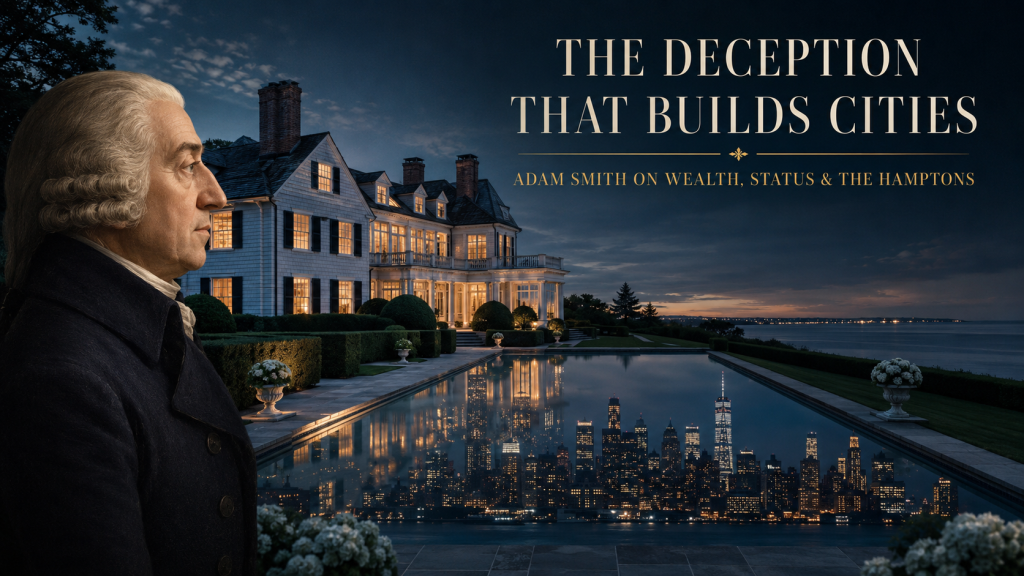
Adam Smith wrote two books. Nearly everyone has heard of one. Almost nobody who quotes him has opened the other, which is a shame, because the second book is the one that explains the Hamptons. It is also the one about you.
The Theory of Moral Sentiments arrived in 1759. The Wealth of Nations followed seventeen years later. Read together, they form the sharpest available framework for wealth and status as one system. Call it the Adam Smith Hamptons problem, because it describes eight miles of the South Fork with unsettling accuracy.
Smith gets remembered as the patron saint of markets. He was something stranger and more useful. Before he was an economist, he was a moral psychologist who spent his life studying why we care so much what other people think of us. Only later did he write the book explaining what all that caring builds.
The answer, in his own words, is cities. Also sciences, arts, roads, and the whole apparatus of civilized life. And he believed the entire structure rests on a deception.
The Book Before the Book
Smith taught moral philosophy at Glasgow. The Theory of Moral Sentiments was his first book, and it made him famous across Europe before he had published a word about trade.
Its opening move is quietly radical. Smith notes that we cannot feel another person’s pain directly. We can only imagine ourselves into their position, then feel a fainter version of whatever we find there. He called that imaginative act sympathy, and he built everything else on top of it.
So the foundation of Smith’s system is not greed. Human beings are constantly running simulations of each other, and that is the load-bearing fact. Every seating chart, every guest list, every carefully casual mention of where you summer is that simulation at work.
He revised the book five times. The sixth and final edition appeared in 1790, the year he died, fourteen years after the economics book. Rather than abandoning ethics for markets, Smith spent his last months making the ethics longer.
Sympathy Is the Oldest Social Technology
Before the virtues, before the famous phrases, there is the mechanism itself.
Smith’s sympathy is not pity. It is the imaginative act of standing in another position and feeling a diluted version of what sits there. We do this constantly, involuntarily, and with everyone, including people we dislike.
What makes it social rather than private is that everyone else is doing it back. You imagine how you look to them while they imagine how they look to you. The whole thing runs in both directions at once, all night, without pause.
That loop is what a Saturday in Bridgehampton actually is. Not a party. Rather, a distributed simulation in which several hundred people spend six hours modeling each other, then drive home and check whether the modeling was accurate.
The Impartial Spectator Lives in Your Head
Out of sympathy Smith derives his central character. Since we judge others by imagining ourselves into their position, we also learn to judge ourselves by imagining how we look to a reasonable observer. Smith named that figure the impartial spectator.
He is not your mother, your board, or your followers. He is a composite you assemble from a lifetime of watching people approve and disapprove. Once installed, he never leaves. He rides shotgun on Montauk Highway and asks whether you actually like the car.
Most people mistake the spectator for anxiety. Smith thought it was conscience, and he considered it the only reliable defense against a life spent performing. But a weak spectator gets overruled by an actual audience.
That overruling is the plot of a certain kind of summer. It is also, not incidentally, the exact mechanism a luxury brand rents when it buys a page. The spectator sitting at table twelve is the one worth studying.
Praised Versus Praiseworthy
Smith then draws a line nobody has improved on since. Man desires not only to be praised, but to be praiseworthy. Those are two different appetites, and they come apart under pressure.
Praise is external. It arrives as an invitation, a table, a tag, a mention in a column. Praiseworthiness is internal. It is the condition of deserving the thing, whether or not a single person notices.
Smith’s claim is that a healthy person wants both but will take the second. Someone in the grip of vanity takes the first and quietly knows the difference. He is unsparing about how common that is.
Out here the distinction has an address. One group buys the table at the benefit. Another wrote a larger check and skipped the dinner entirely. Both names appear on the list, yet only one of them is respected by the other, and everybody involved knows which direction that respect runs. Smith mapped the two Hamptons this produces before the Long Island Rail Road existed.
What The Wealth of Nations Actually Says
The economics book is longer, colder, and far less accurately quoted.
Its core argument is that wealth is not gold sitting in a vault. Wealth is productive capacity, and capacity grows through the division of labor. Smith opens with a pin factory. One worker alone might manage twenty pins a day. Ten workers splitting the task into eighteen operations made forty-eight thousand.
From there he takes apart mercantilism, tariffs, guilds, and the whole apparatus of protection. He argues that a butcher feeds you because it serves him, not because he loves you. That line gets quoted constantly, generally by people who stopped reading a paragraph too early.
Because Smith also wrote this. People of the same trade seldom meet together, even for merriment and diversion, but the conversation ends in a conspiracy against the public. He was never a mascot. He was a critic who happened to believe markets beat the alternatives, which is bad news for a few local cartels.
The Problem Everyone Thinks They Found
Nineteenth-century German scholars noticed the gap and gave it a name. Das Adam Smith Problem. How does the sympathy philosopher become the self-interest economist? It sounds devastating for roughly four minutes.
The objection collapses on two facts. First, Smith never equates self-interest with selfishness. Self-interest in his usage means pursuing your own projects under supervision of that internal spectator. Selfishness is what happens once the spectator gets fired.
Second, and more simply, the chronology destroys it. Smith did not graduate from morals to markets. He published the moral book, then the economic book, then went back and expanded the moral book again in the final year of his life. A man abandoning ethics does not spend his last months adding to it.
Modern Smith scholarship treats the two books as one project. So should anyone using them to read a room.
Two Books, One Question
Strip away the scholarship and both books ask one question about wealth and status. How do strangers coordinate?
The moral book answers from the inside. Strangers coordinate because each one carries an internal spectator who wants their conduct to look reasonable to a neutral observer. Reputation becomes a technology, and propriety becomes its protocol.
The economics book answers from the outside. Strangers coordinate through prices, contracts, and the division of labor, none of which require anybody to love anybody.
Neither answer works alone. Markets without the spectator produce exactly the conspiracy against the public that Smith warned about. But the spectator without markets produces a very polite village that stays poor. Put the two together and you get the arrangement that built the modern world. You also get the peculiar social physics of a beach town in August.
The Deception That Builds Cities
Here is the passage that belongs on the wall of every marketing department between Southampton and Montauk.
In Part IV of the moral book, Smith asks whether wealth actually makes anyone happy. His answer is no. He describes the rich man’s palaces and watches, then calls them baubles and trinkets of frivolous utility. They deliver almost nothing. Of course the pleasure was always in the imagining, never in the owning.
Then Smith does something no modern critic of consumption has the nerve to do. He thanks the illusion.
This deception, he writes, rouses and keeps in continual motion the industry of mankind. It is what first prompted men to cultivate the ground, build houses, found cities, invent sciences, and ennoble human life. The pointlessness of luxury is the engine of civilization.
Sit with that for a moment. Smith believed status-chasing is both an illusion and a load-bearing wall. Remove it and the building comes down. Anyone selling beauty, property, or experience out here is working inside that paradox, so the moral case for the beautiful useless object deserves its own hearing.
The Invisible Hand Was About a Landlord
The famous phrase appears exactly once in The Wealth of Nations. It sits buried in a technical argument about domestic investment, and most people who deploy it have never located the sentence.
Its first appearance in Smith’s work is somewhere else entirely. In the moral book he describes a proprietor surveying his fields. The man’s stomach is no larger than a peasant’s. Since he can consume only so much, the rest flows outward to everyone who builds, plants, maintains, and serves.
Those people, Smith writes, are led by an invisible hand. They end up making nearly the same distribution of life’s necessaries that an equal division of the earth would have produced.
So Smith’s first invisible hand is not a market at all. It is an estate, a landlord, and the workforce that keeps the grounds. That image has a physical address in this zip code, and it drives past your house before dawn.
The Corruption of Our Moral Sentiments
Part I, Section III, Chapter III carries a title that reads like a subtweet across 267 years.
Smith argues that we instinctively admire the rich and the great, while neglecting or despising the poor. That disposition, he says, is the great and most universal cause of the corruption of our moral sentiments. He wrote it in 1759.
But he is not moralizing from a safe distance. Smith thought the instinct was natural, occasionally useful, and socially necessary. Deference to the wealthy is what makes hierarchy stable, so societies quietly run on it. He simply wanted readers to notice the price.
The price is that we begin confusing being admired with being good. Wisdom and virtue get filed under the same heading as wealth and greatness, until nobody in the room can tell the categories apart. Anyone who has watched a party reorganize itself around money that is three weeks old has seen the chapter performed live.
The Poor Man’s Son
Smith tells a parable in Part IV that reads exactly like a founder profile.
A poor man’s son, visited by ambition, admires the condition of the rich. He imagines their houses and carriages will make him content. So he sacrifices ease, submits to more fatigue than any illness could inflict, and courts people he privately despises.
Then he gets it. In the last dregs of life, Smith writes, the man finds that wealth and greatness are trinkets. They procure ease of body and tranquility of mind no better than a collector’s tweezer-case.
Smith published that in 1759, before anyone had invented the term burnout. Every longevity clinic, executive physical, and second-act consultancy on the East End is now selling a treatment for it. The parable and the modern exit line up almost sentence for sentence.
The Pin Factory Has a Circular Driveway
Return to the division of labor, but point it at a house instead of a factory.
A functioning estate runs on specialization that would have delighted Smith. House manager, chef, grounds crew, pool service, art handler, security consultant, dog trainer, and one person whose entire job is the cars. Each role gets better because each role gets narrower.
Smith’s insight was that specialization creates surplus, and surplus creates the market supporting further specialization. The East End service economy is that loop running at speed inside a ten-week window.
It also explains something visitors find puzzling. Why does everything cost more out here in July? Because the labor has been divided to an extreme degree, and extreme specialization commands extreme pricing during the only weeks it can be sold. The household org chart is a pin factory with hydrangeas.
Why the Rose Costs What It Costs
Apply both books to a single bottle and the pricing stops looking irrational.
Pale Provencal wine costs what it costs for reasons the economics book explains only partly. Land, yield, freight, and tariff account for some of the number. Everything above that line belongs to the moral book.
What the buyer actually purchases is a signal that reads instantly at forty feet. Smith understood this better than most sommeliers. Value sits in the imagined approval of everyone who sees the bottle land on the table, so the liquid is nearly incidental.
None of which is a criticism. Smith would say the deception is doing its job, funding vineyards, importers, restaurants, and several thousand East End paychecks each season. The economics of rose is Part IV with an ice bucket.
The Man of System and the Master Plan
The sixth edition added a passage that has aged into prophecy.
Smith describes the man of system, so enamored with the beauty of his own plan that he tolerates no deviation from any part of it. Such a man imagines he can arrange the members of a society as easily as a hand arranges pieces on a chess board.
The flaw, Smith says, is that every piece on the human board has a principle of motion entirely its own. Push against that motion and the game goes into the highest degree of disorder.
Every zoning fight, every master-planned village, and every developer who has described a community before building one is standing inside that passage. Out here the pieces move on their own. They always have, which is the problem with the master plan.
Smith Ranked the Virtues, and So Does the East End
Part VI sorts virtue into three categories. Prudence is care of your own health, fortune, and reputation. Justice is the refusal to harm others. Beneficence is active generosity.
His ranking is counterintuitive and worth memorizing. Society survives without beneficence, though it becomes less pleasant. Society cannot survive without justice, because justice is the load-bearing pillar. Prudence he respected without ever calling it noble.
Old money applies that ranking without having read a page of it. Discretion is prudence. Not breaking the unwritten rules is justice. The named building comes last, on purpose, and only after the first two are established.
New money frequently inverts the order. The gift arrives first and loudly, before prudence or justice has been demonstrated to anyone. Then the invitation does not come, and nobody ever explains why, though the old money playbook has said so since 1790.
Where Smith Got It Wrong
Any honest reading has to mark the limits.
Smith assumed the impartial spectator would look roughly the same for everyone inside a society. He had never met a feed. The spectator is now algorithmically customized, so two people at one table may be performing for entirely different audiences.
He also underestimated how durable inherited advantage would prove. Later thinkers filled that gap. Veblen named conspicuous consumption in 1899, and Bourdieu mapped cultural capital seventy years after that.
Still, both men are footnotes to the 1759 insight. Veblen described what people buy. Bourdieu described who is permitted to appreciate it. Smith explained why anybody cares at all, which remains the harder question and the one this cluster keeps returning to.
What Smith Means If You Sell Anything Out Here
Smith hands brands a harder and far more accurate model than the one they usually run.
Advertising assumes the buyer wants the object. Smith says the buyer wants the imagined approval attached to the object, so presence beats messaging on the South Fork. You are not buying attention. Rather, you are buying placement inside a sympathy loop already running at full speed.
That is also why a dollar spent inside a title your buyer already trusts outperforms the same dollar spent shouting at strangers. Trust is the distribution channel. Smith would have called it propriety, and the sympathy economy explains the rest.
The practical translation is short. Be in the room where the spectator is watching, then be worth finding once you are there.
If You Only Read Twenty Pages
Both books run long. Neither one has to be read cover to cover before it becomes useful.
Start with Part I, Section III, Chapter III of the moral book. Four pages. That is the corruption passage, and it will permanently reorganize how you read a guest list.
Then jump to Part IV, Chapter I. Roughly twelve pages. You get the poor man’s son, the trinkets, the deception, and the first invisible hand stacked in sequence.
From the economics book, read Book I, Chapter I for the pin factory, then Book I, Chapter X for the tradesmen conspiring against the public. Everything else is elaboration.
Twenty pages total. Both texts sit in the public domain, so the full editions cost nothing online. Smith would have appreciated the pricing.
One warning before you start. Smith is funnier than his reputation suggests, and the jokes are dry enough to miss on a first pass. He describes vanity with the affectionate precision of a man who had recognized it in the mirror.
Thirteen Ways Into the Argument
This piece is the spine of the Adam Smith Hamptons cluster. Each essay below takes one idea and gives it a specific address.
- Praised or Praiseworthy: The Two Hamptons
- The Impartial Spectator Is Sitting at Table Twelve
- Trinkets of Frivolous Utility: In Defense of the Thing You Do Not Need
- The Corruption of Our Moral Sentiments, Bridgehampton Edition
- The Poor Man’s Son: A 1759 Portrait of the Burned-Out Founder
- Conspiracy Against the Public: Smith on Your Broker
- The Man of System: Moving People Like Chess Pieces
- The Invisible Hand Arrives at Six in the Morning
- Division of Labor, Estate Edition
- Prudence, Justice, Beneficence and the Old Money Playbook
- Why Smith Would Have Understood Rose
- The Sympathy Economy
- Adam Smith Goes to the Polo Match
Where The Conversation Continues
Social Life Magazine reaches 25,000 print readers each summer and 82,000 subscribers year round. The overlap between that list and the people seated inside the tents at Polo Hamptons is close to total.
Smith would have understood the offer immediately. You are not buying an advertisement. You are buying a position inside the story a room is already telling itself.
Both the July issue and the Bridgehampton lawn are finite. So is the number of brands that can credibly claim this ground. Yours is either in the story or it is not, and the alternative is reading about a competitor in the same pages.
Editorial partnerships, event activations, and the Sag Harbor guest house are open for the 2027 season. That conversation always starts before the invitations do.
Author

Written by
Recent Posts

Is Business Class Worth It on a Short-Haul Flight?
Failure to Disclose Finances in Divorce
Columbus Car Accident Attorney: Protecting Your Rights After a Georgia Crash
Does Workers’ Comp Cover Lost Wages? A Guide for Oregon Workers
Understanding Social Security Disability Benefits in Oklahoma
Categories
- Art
- Articles
- Business of Luxury
- Celebrities
- Culture
- Entertainment
- Events
- Faces of Summer 2026
- Fashion
- Fashion & Style
- Featured
- Finance
- Food, Spirits, Wine
- Hamptons
- Hamptons Celebrities
- Health
- Health & Beauty
- Lifestyle
- Luxury Lifestyle
- Press
- Profiles
- Real Estate
- Technology
- The Chronicles
- Travel
- Uncategorized
- Weddings