
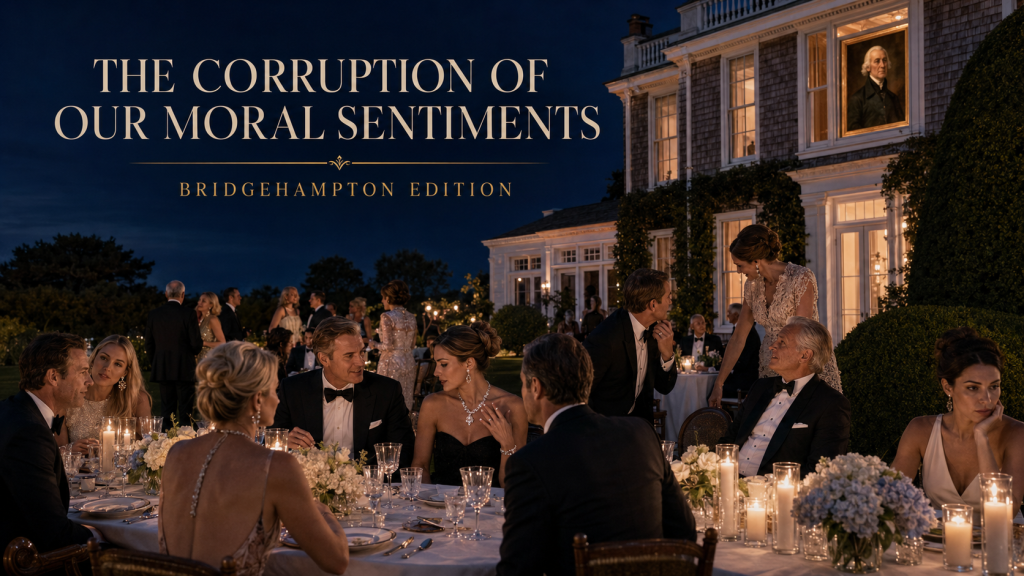
Adam Smith spent the last year of his life revising a book he had already published five times. He was 67, famous across Europe, and nearly out of time. Still, he went back in and added a chapter about the corruption of moral sentiments.
The claim in it is short enough to fit on a place card. Our habit of admiring the rich and neglecting everyone else holds society together. At the same time, that habit rots our judgment. Both are true, and Smith offers no escape clause.
He did not mean it as an attack on the rich. Smith liked prosperity, defended commerce, and believed luxury paid for roads, sciences, and cities. Yet he wanted the bill itemized, and he wanted you to read it before signing.
Drive east on Route 27 on a Friday in July and you enter the most efficient demonstration of that chapter available in America. Nothing out here is uniquely corrupt. Rather, the mechanism runs at unusually high resolution, in very good light, with better catering than Glasgow ever managed.
The Chapter He Added While He Was Dying
The Theory of Moral Sentiments appeared in 1759, when Smith was 36 and teaching moral philosophy at Glasgow. It made him famous before he had published a word about trade. He revised it repeatedly over three decades. Then, in 1790, he revised it a final time and died that summer.
That last edition is where the chapter shows up, in Part I, Section III. Smith also added a whole new Part VI on virtue while he was in there. So the man remembered for blessing self-interest spent his final working months expanding the ethics rather than the economics.
The Wealth of Nations was fourteen years behind him by then. He had watched his own argument for commerce get quoted, borrowed, and flattened into a slogan. Instead of walking it back, he sharpened the warning that had been sitting in the first book since the beginning.
The chapter itself runs about four pages. It contains no data, no policy proposal, and no villain. What it offers is one observation about how human attention distributes itself, and the observation has not stopped being accurate since.
What Smith Actually Wrote
Here is his claim, in roughly his own terms. We admire, and almost worship, the rich and the powerful. We despise, or at least neglect, persons of poor and mean condition.
That double instinct, he says, is necessary to establish and maintain the distinction of ranks and the order of society. In the same breath he calls it the great and most universal cause of the corruption of our moral sentiments. Two verdicts, one sentence, and no reconciliation offered.
Notice the word necessary. Smith is not asking anyone to abolish the instinct. Without it, ranks stop holding, coordination gets expensive, and the whole apparatus of trade and cities loses its motor.
Then notice the second verb. Despise is the loud option, and almost nobody chooses it. Neglect is the one that actually happens, since it requires no decision at all and leaves no evidence behind.
Nobody Actually Wants the Money
Smith asks a question most people skip. What is the point of wealth, once food and shelter are handled? His answer is not comfort. A rich man’s stomach is the same size as everyone else’s, so the surplus has to be buying something other than dinner.
What it buys, he writes, is to be observed, to be attended to, to be taken notice of with sympathy, complacency, and approbation. That is the entire return. Vanity, in his usage, is not a character defect. Rather, it names an appetite for one specific social good, and the good is attention.
He states the counterexample plainly. A poor man goes out and comes in unheeded, and in the middle of a crowd he sits in the same obscurity as if he were shut inside his own house. Nothing cruel is happening there. Attention simply runs uphill, which water has the decency not to do.
Once that lands, the local economy rearranges itself in front of you. It also explains the case that this entire visible structure rests on a productive deception, which is the argument the rest of this series keeps circling.
Two Roads, One Parking Lot
Smith says two roads lead to the regard people want. One runs through the study of wisdom and the practice of virtue. The other runs through the acquisition of wealth and greatness.
Both arrive, and that is the part readers miss. He is not claiming the second road fails. Because it works, and works quickly, it draws traffic away from the first one.
The real trouble is legibility. Virtue is slow, private, and nearly impossible to read from across a lawn. Wealth is fast, public, and legible at forty feet, especially under a tent with decent lighting. So the crowd, which is not wicked but is busy, follows whichever signal it can actually see.
That gap between deserving regard and collecting it is the subject of the difference between being praised and being worth praising. Smith treated it as the only honest test a person can run on himself, and he ran it constantly.
Saturday Night Runs the Experiment
Take a Saturday in Bridgehampton during the second week of July. A tent on a lawn off Ocean Road. Two hundred guests, a step and repeat nobody admits to caring about, and a bar where the line moves by recognition rather than by order of arrival.
Nothing about the evening is sinister. People are warm, the food is genuinely good, and the cause is real. Still, hold Smith’s chapter over the room and the architecture surfaces immediately.
Attention is not distributed evenly, and it is not distributed randomly either. It concentrates. It finds the fund, the exit, the second house on Further Lane, the name that ran in a story last month. Merit collects attention too, although generally only after somebody explains what the merit was.
Watch the entrance for twenty minutes and the sorting happens in front of you. A guest arrives, the room runs a fast unconscious appraisal, and warmth gets allocated accordingly. Nobody decides to do this. Everyone does it anyway, and by midnight the seating chart has been proved right or wrong.
Rank Is Cheapest to Read at the Beach
Smith says the instinct exists to establish and maintain the distinction of ranks. Nowhere on the South Fork is that machinery easier to watch than in a beach parking lot at ten on a Sunday in August.
A permit on the windshield encodes residency, village, and roughly how long the family has been coming. Its cost is trivial next to the house it attaches to, so money is not really the mechanism. Scarcity is, and every driver in the lot can read the sticker at a glance without appearing to look.
Sagg Main sorts differently from Georgica, which sorts differently again from Napeague, and the sorting finishes before anybody opens a chair. No sign explains any of it. Nobody teaches it. Still, a newcomer absorbs the entire hierarchy in about three weekends, mostly by noticing where people decline to park.
Smith would find nothing shocking in the arrangement. Ranks need markers, markers have to be legible, and legible markers get used because they save everyone time. What he would ask, gently, is what the marker starts doing to the person reading it.
A sticker reports where a car may legally park. It carries no information whatsoever about the driver, although by early July it will be treated as if it does.
The Neglect Is the Quiet Part
Smith’s second verb is the one that lands out here. Nobody in the Hamptons despises anybody. Contempt is loud, and loud has been out of fashion since roughly 2008. Neglect, though, is the local dialect, and it operates without friction.
Consider who is awake at five thirty on a Saturday in August. Landscape crews stage on the shoulder of Montauk Highway while the road is still empty. Bakers in Sag Harbor have been working since four. A captain checks lines in Montauk before a charter that boards at ten.
These are not background figures. An irrigation tech who knows which zone fails first in a dry August holds information the homeowner cannot buy on short notice. Expertise is stacked all over the East End, particularly in the trades, and much of it goes unremarked because attention is aimed elsewhere.
That early shift is the subject of the piece about who is already working before the coffee gets made. Smith’s most famous phrase, as it happens, first appeared as a description of exactly that arrangement.
What Admiration Costs the Admirer
Admiration behaves like currency because it converts. It converts into a table on a Friday, a contractor who reshuffles a July calendar, a call returned in nine minutes instead of nine days.
None of that is scandalous. Every market allocates by signal, and status is a signal that clears fast. Still, Smith wants the ledger visible, since the conversion runs in both directions and only one side gets an invoice.
What the admirer pays is judgment. You defer a little, then a little more, and eventually you take a man’s read on a school, a surgeon, or a manager because his house is larger than yours. A house is not evidence. It has simply been mistaken for evidence by people in a hurry.
Picture a founder who sold his company in 2021 and closed on eleven acres in Sagaponack the following spring. His opinions improved overnight. Nothing about the opinions had changed, of course. The weighting did, and he was the last person in the room positioned to notice.
The Case Against Smith, Made Fairly
Smith is less bleak about this than the chapter’s reputation suggests. He thought the damage concentrated at the top and thinned out fast below it.
In the middling and inferior stations of life, he writes, the road to virtue and the road to fortune are in most cases very nearly the same. Your neighbors know you. Reputation gets built in daily view, so honesty pays, because dishonesty gets noticed by people who can price it accurately.
Higher up he turns pessimistic. Among the great, flattery and falsehood too often prevail over merit, since the audience sits further away and is easier to fool from a distance.
Whether that split survives contact with the modern East End is a fair argument, and the honest answer is partly. Plenty of people out here got rich by being extraordinary at something difficult, and their merit is visible the moment you look at the work instead of the tent. Smith described a tendency rather than a law, and he would have said so himself.
The Correction Is Smaller Than You Expect
Smith never asks anybody to sell the house. There is no renunciation in the chapter, no fasting, no vow of anything. He was a Scottish professor who liked good wine and better company, and he wrote for people living ordinary social lives.
What he proposes instead is smaller and considerably harder. Notice who you have stopped seeing. That is the whole assignment.
It sounds soft until you try it for one weekend. Count the people whose names you know at the club, then count the ones whose names you have quietly decided not to need. The gap between those two numbers is the audit, and running it takes about four minutes.
His ranking of the virtues is the working version of the same idea, which is why the ordering old money follows without ever explaining it reads as etiquette and functions as ethics. Justice comes first. A society survives without generosity, yet it collapses without fairness, and Smith put that in writing before anyone asked him to.
Where The Conversation Continues
Social Life Magazine has covered this place from inside the tent rather than from the parking lot. That is a different vantage, and it produces a different sentence.
The print edition reaches 25,000 readers each summer, delivered where the season actually happens. Our email list runs to 82,000. Polo Hamptons in Bridgehampton gathers several thousand of them onto one lawn in July, which is as close as the East End gets to a census of its own attention.
Brands come to us wanting that audience. The ones who do best want the argument too, because a page sitting next to writing like this reads as a point of view instead of an interruption. Readers out here register the difference in under a second, whether or not they could explain it.
The July book closes earlier than most people expect, and the placements that matter go to whoever asked first. If a competitor is reading this paragraph, that is not an accident. Editorial partnerships, event presence at the field, and the Sag Harbor guest house all sit inside the same conversation, so start it while the room is still filling.
Author

Written by
Recent Posts

The New York Women’s Foundation’s 2026 Neighborhood Dinner

Marco Maranghello

The Baker House 1650

MvVO ART Show

Casita Maria Center for Arts and Education
Categories
- Art
- Articles
- Business of Luxury
- Celebrities
- Culture
- Entertainment
- Events
- Faces of Summer 2026
- Fashion
- Fashion & Style
- Featured
- Finance
- Food, Spirits, Wine
- Hamptons
- Hamptons Celebrities
- Health
- Health & Beauty
- Lifestyle
- Luxury Lifestyle
- Press
- Profiles
- Real Estate
- Technology
- The Chronicles
- Travel
- Uncategorized
- Weddings