
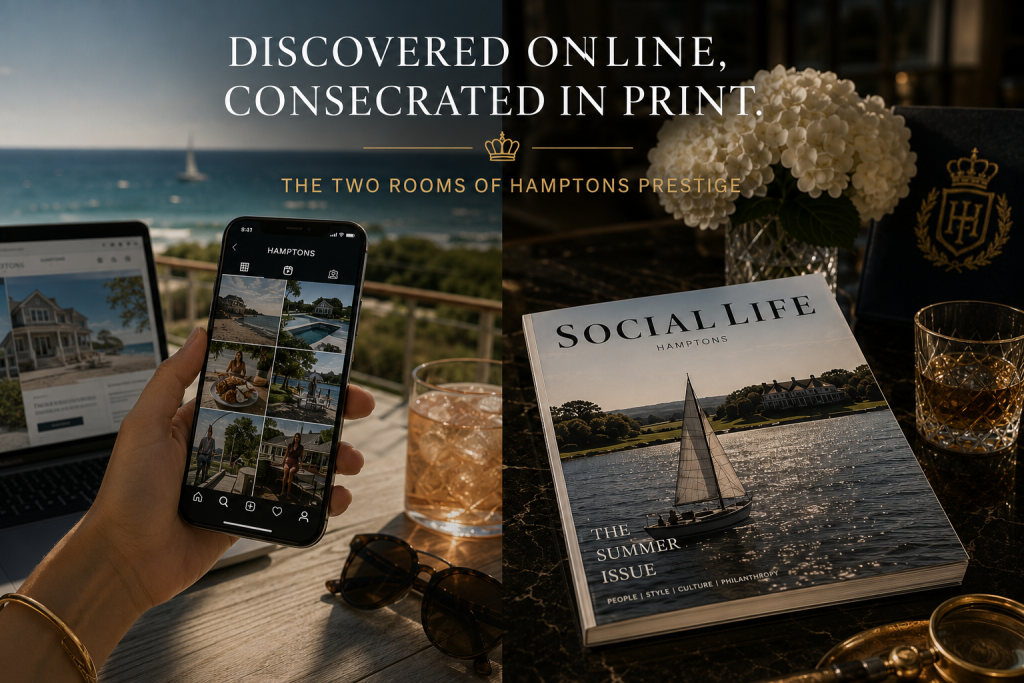
Two rooms exist in Hamptons media, and most brands only know about the first one. The first room is digital, loud, infinite, and open all night, where being seen is easy and being remembered is nearly impossible. The second room is print, quiet, finite, and guarded, where a single page can settle a brand’s standing for a season. Getting featured in Social Life Magazine means passing through both rooms in the correct order, and the order is the entire strategy. Online discovers. Print consecrates. Confuse the two and the budget evaporates into impressions.
Camille Paglia would have recognized the split instantly, since it maps onto the oldest division in her work. Our series hub develops the framework in how taste becomes power in the Hamptons. This spoke is the applied version. It maps how brands actually climb from the feed to the coffee table, and why the second surface still outranks the first.
The Dionysian Scroll
Paglia’s Dionysus stands for flood, appetite, and abundance without edges, which is a clinical description of the feed. Digital media accepts everything, ranks nothing durably, and replaces itself hourly. Its gift is discovery, because the flood reaches everywhere, and a brand unknown on Monday can be everywhere by Friday.
Yet the same physics caps the ceiling. Whatever the flood delivers, the flood also carries away, so digital presence must be re-earned perpetually, like renting standing by the week. Nothing wrong with rent. Every brand pays some. The error is mistaking a lease for a deed, and the East End keeps its deeds on paper.
The Apollonian Page
Print is Apollo’s medium, form with edges, a made object that had to be chosen. A magazine holds finite pages, so every page granted is a page denied to someone else. Readers feel the exclusion even when they cannot articulate it. Scarcity is built into the format at the level of physics, which is why no digital surface can counterfeit it.
An object also behaves differently than a signal. The issue sits on a console in a Southampton living room for a month. It gets encountered repeatedly, at rest, by exactly the households a luxury brand exists to reach. It cannot be scrolled past, since it is already past scrolling. Permanence, in a medium of floods, reads as rank.
What the Distribution Actually Is
Specifics matter here, because print’s power is a function of placement rather than tonnage. Social Life prints 25,000 copies per summer issue across five issues. Distribution runs by hand from Westhampton to Montauk, through the boutiques, clubs, and estates where the season actually happens. After Labor Day, 15,000 additional copies enter Upper East Side doorman buildings, following the readership home for the winter.
Read that distribution as a media buyer and the numbers look modest. Read it as a status strategist and the picture inverts. This is a guided missile disguised as a circulation figure, reaching the roughly forty thousand households whose approval constitutes the East End’s actual market. Density of the correct reader beats volume of any reader, and print is the only format sold by density out here.
The Sequence That Works
Now assemble the two rooms into a campaign, because the sequence is where brands win or lose. Phase one runs digital, editorial coverage online, the 82,000-subscriber list, organic search presence, all of it building recognition so the name arrives pre-loaded. Discovery is digital’s job, and digital does it brilliantly.
Phase two converts recognition into standing through the page. A print feature or a correct print adjacency lands after the audience already half-knows the name. Then the page performs the consecration, the institutional signal that the brand has been chosen rather than merely seen. Skipping phase one wastes the page on strangers. Skipping phase two leaves the brand permanently in the rented room. The ladder only works climbed in order.
Why the Page Converts Differently
Consider what each surface does to the reader’s skepticism. Online coverage arrives surrounded by everything else online, including the ads that chase the reader across the internet, so the reader’s guard stays up by default. A print page in a 23-year masthead arrives pre-filtered, vouched for by every feature the institution ever declined to run. The guard drops, because the gatekeeping already happened upstream.
Conversion of this kind rarely shows up in an attribution dashboard, and that invisibility misleads a generation of marketers. The print page converts in February phone calls, in retail buyers who suddenly return emails, in invitations that arrive without explanation. Deeds appreciate quietly. Leases send monthly statements. Both are real. Only one compounds.
The Coffee Table Is a Ranking Algorithm
One more mechanism deserves naming, because it multiplies everything above. A magazine in a great house is not private media. Guests see it, pick it up, and register what the household chose to display. So every coffee table becomes a small broadcasting station, aimed at the exact audience money cannot reach directly. Appearing in the issue means appearing in a thousand such living rooms simultaneously, endorsed by the display itself.
Digital has no equivalent surface. Nobody’s phone sits open on a console for guests to browse. Besides, a screen displays whatever the algorithm chose rather than whatever the household did. The coffee table is a human ranking algorithm, curated by the most credible editors available, the residents themselves. Print is the only format admitted to it.
The Aspirants and the Arrived
The two rooms also sort the advertisers themselves, and the sorting is worth watching. Emerging luxury brands, the new fashion houses, the beauty labels, the founder-led spirits, buy the digital room first, because discovery is their bottleneck and reach is their math. Correct move. A name nobody knows has no business buying consecration yet, since the page would land on strangers.
Established prestige houses run the opposite play. Heritage champagne, private banking, the great jewelers, none of them needs discovering, so they buy the print room almost exclusively out here. Their page is not an ad in the ordinary sense. It is a proximity purchase, a paid seat beside the editorial judgment of the masthead, renewing a standing the household already recognizes. Watch which room a brand buys and you can read its own opinion of where it sits on the ladder. The media plan is a confession.
A Season in Two Purchases
For a brand entering this market cold, the honest twelve-month plan is short enough to memorize. Before Memorial Day, begin the digital phase, earned coverage online, presence on the list, search visibility built early, so the name rides the whole season. During the summer, show up in the correct rooms, at least once at the polo field, because pages land harder on names the reader has met in person.
Then, once the name tests as familiar, take the page. One correct print feature or placement in a late-summer issue, timed so the object sits on consoles through the densest weeks of the calendar. After Labor Day, the doorman-building distribution carries the same page into the city, and the brand winters inside the readership’s apartments. Twelve months, two rooms, one ladder, climbed in order.
Pricing the Two Rooms Honestly
None of this argues for abandoning digital, which would be malpractice. The argument is for pricing each room by what it actually sells. Digital sells reach, speed, and recall, and should be bought whenever those are the job. Print sells scarcity, permanence, and institutional endorsement, and should be bought when standing is the job, which on the East End it usually is.
The blended strategy costs less than most brands’ current confusion. After all, half of typical luxury digital spend out here is attempting, expensively, to fake what a single correct page delivers outright. Buy discovery where discovery is cheap. Buy consecration where consecration is real. Above all, stop asking either room to do the other one’s work.
What Survives the Machines
One modern wrinkle strengthens the old room further. Search engines now summarize the web into single answers, and the summaries cite authority rather than volume. Archives win that contest. A masthead with two decades of East End record gets quoted. A feed gets averaged. So the digital value of a brand’s presence increasingly flows through the same institutional gate that print always ran, which is a quiet irony the media planners have not fully priced.
Print itself, of course, remains beyond the machines entirely. No crawler reads a console in Water Mill. No model summarizes an August living room. The page does its work in the one channel that cannot be scraped, compressed, or reranked, and that immunity is now a feature rather than a limitation. The most defensible media buy of 2026 turns out to be the oldest one on the rate card.
The Paglia Close
Paglia’s career-long argument was that form confers meaning, that the frame around a thing is part of the thing. The feed is a frameless medium, which is its power and its ceiling. A page is nothing but frame, edges, sequence, and the accumulated judgment of whoever assembled it. Brands climb here by moving from the frameless room to the framed one, in that order, at the pace the second room permits.
The pace is slower than a quarter and faster than a decade. In the middle sits a season much like this one. Two polo Saturdays, five issues, and a finite number of pages that will outlast every post published against them. Choose the surface that survives August. The East End already has.
Where The Conversation Continues
This piece is a spoke in our series on East End status machinery, anchored by the Paglia hub on taste and rank. For the institution holding the gate, read why editorial authority beats influencer noise, and for the rooms where the pages get read aloud, see the activation house piece. Feature and advertising inquiries for the remaining summer issues reach Social Life Magazine now. Pages, unlike posts, run out.
Author

Written by
Recent Posts

Camille Paglia and the Hamptons: How Taste Becomes Power
The Influencer Illusion: Why You Can’t Perform Prestige in the Hamptons

Old Money Wins: Why Heritage Taste Still Rules the Hamptons
The Arbiter: Why Editorial Authority Beats Influencer Noise
Discovered Online, Consecrated in Print: The Two Rooms of Hamptons Prestige
Categories
- Art
- Articles
- Business of Luxury
- Celebrities
- Entertainment
- Events
- Faces of Summer 2026
- Fashion
- Fashion & Style
- Featured
- Finance
- Food, Spirits, Wine
- Hamptons
- Hamptons Celebrities
- Health
- Health & Beauty
- Lifestyle
- Luxury Lifestyle
- Press
- Profiles
- Real Estate
- Technology
- The Chronicles
- Travel
- Uncategorized
- Weddings