
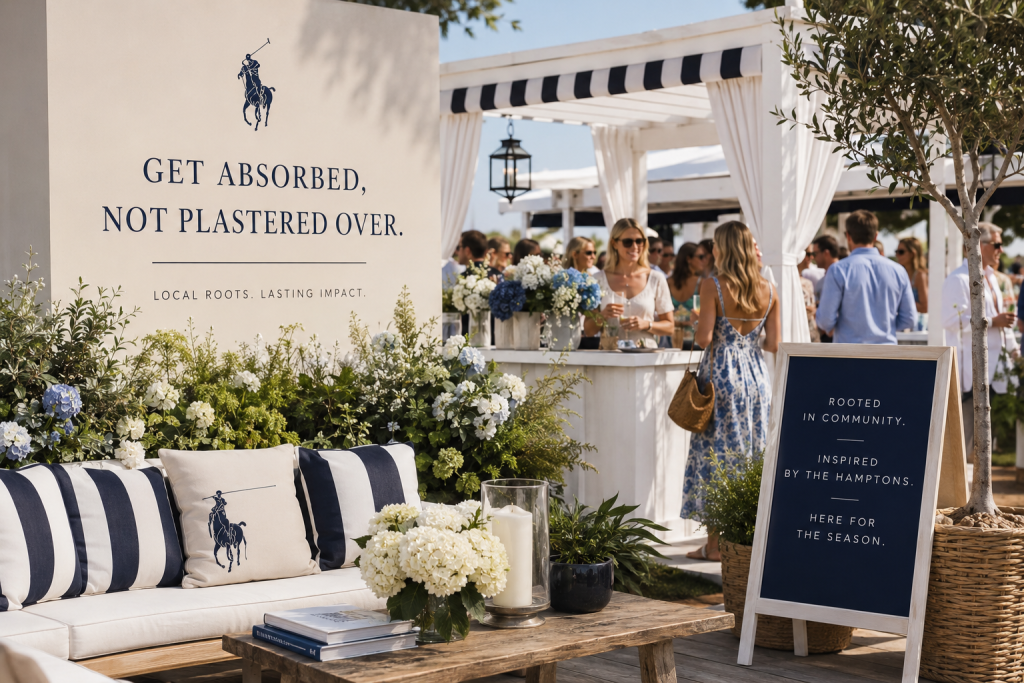
Two summers ago, a skincare brand spent a fortune wrapping a Hamptons gallery in its own logo for a single weekend. Nobody remembered the name by Monday. That same weekend, a tequila brand quietly stocked one Sag Harbor house party and owned every photo that came out of it. The gap between those two outcomes is the entire subject of Hamptons brand activations.
Relevance out here cannot be bought like ad space, since this audience reads obvious advertising as a status tell. The brands that win get absorbed into the weekend. By contrast, the brands that lose get scrolled past, even after spending more money to do it.
The Plastered-Over Problem
Most brands arrive in the Hamptons with the wrong instinct. They want their name large, their logo everywhere, and their presence impossible to miss. So they buy the biggest, loudest tile they can afford and call it a strategy.
The audience punishes exactly this. Wealth out here signals through restraint, not volume, because anyone can shout and only the secure can whisper. A brand that plasters itself over the weekend reads as desperate, and desperation is the one quality this crowd will never reward.
The fix is not a smaller logo. Instead, it is a different theory of what an activation is for. You are not renting attention. Rather, you are earning a place inside a picture the audience is already assembling for itself, which our guide to the Hamptons summer social scene lays out in full.
What Absorption Actually Looks Like
Absorption means your brand becomes part of the weekend people would have had anyway. The tequila brand did not interrupt the party. Instead, it became the reason the party felt a little more premium. Guests never felt sold to, yet every one of them left associating the night with that bottle.
This is the difference between a tile people enjoy standing near and a banner they resent. Of course, absorption is harder than plastering, since it requires you to actually improve the moment rather than hijack it. But the payoff compounds in a way paid reach never does.
When a brand gets absorbed, the audience does your marketing for you. They post, they tag, and they fold your name into their own status signaling. Specifically, they treat your brand as evidence of their taste, which is the most valuable real estate a company can hold.
The Five-Surface Activation
A real activation does not live on one surface. It threads through several, so the brand shows up in fragments that add up to a coherent presence. Think of it as placing tiles across the whole board rather than betting everything on one square.
The strongest programs touch the polo tent, a private estate dinner, a beach moment, and the right house, all in one weekend. Each surface catches a slightly different mood, yet they reinforce the same association. A guest sees the brand at Polo Hamptons on Saturday and again at a private estate event on Sunday.
By the third sighting, the brand stops feeling like an advertiser and starts feeling like a local. That repetition across surfaces is the actual mechanism. Our breakdown of brands that did the Hamptons right shows the pattern in detail.
Pricing the Vibe, Not the Banner
Here is where most brands misread the math entirely. They price an activation like a media buy, asking how many impressions a dollar buys. So they end up overpaying for reach and underpaying for the thing that actually moves this audience.
The better question is different. What favorable association can you own for a season, and what is that worth to a brand starved for relevance? A single absorbed weekend can reset how the right thousand people see you, which no banner campaign can match at any price.
This is exactly why a feature plus a field presence beats a straight ad buy nearly every time. The feature gives you the durable record. The field presence gives you the live proof. Together they make a case no standalone ad can, as our piece on why activations beat ad buys argues.
The Sag Harbor Activation House
The most underrated tile in any activation is the house itself. A brand that controls the right address controls the weekend that happens inside it. Suddenly you are not a sponsor at someone else’s party. Instead, you are the host, and hosts get remembered.
Social Life works with Sag Harbor properties built for exactly this kind of takeover. The brand gets a real home base, the guests get a reason to gather, and the photos all carry the same setting. So the association locks in across every post from the weekend.
This is the cleanest version of absorption money can arrange. You do not interrupt the season. Rather, you become a fixed point inside it. Our walkthrough of a real Sag Harbor activation shows one house, one weekend, and one brand doing it correctly.
The Trap of Doing It Yourself
Plenty of brands try to run all of this alone. They hire a production company, book a venue, and hope the right people show up. Usually they do not, because access here is social rather than transactional.
You cannot buy your way into the rooms that matter. You have to be brought in by someone the rooms already trust. That trust is the actual product a publication like this one sells, built over twenty-three summers of being the surface the season runs through.
So the smartest brands stop trying to force entry. Instead, they partner with the people who already hold the keys. The cost of going alone is usually a wasted budget and a weekend nobody remembers, which is the most expensive outcome of all.
How to Tell If It Actually Worked
Brands trained on digital metrics want to measure an activation by impressions. That instinct fails here, because the Hamptons does not move on reach. It moves on sentiment, the same way a crowded room has a mood you can feel without reading any single conversation.
So the real scorecard is different. Did the right people post without being asked? Did your brand show up in their captions as a flex rather than a tag? These signals matter far more than raw view counts, since they prove absorption instead of mere exposure.
Watch the second-order effects too. A brand that lands well gets invited back, name-checked at the next dinner, and folded into the season’s vocabulary. That kind of organic pull is the clearest proof you bought a place in the picture rather than a spot on a banner.
The Brands This Works Best For
Not every company needs the Hamptons, but three types need it badly. Emerging fashion labels come first, because relevance here can reset how the entire industry sees a young brand overnight. One absorbed summer can do what a year of paid placement cannot.
Wellness and medspa founders are the second type. They sell prestige as much as product, so proximity to this audience is the asset itself. A well-placed activation tells their market that the right people already trust them, which shortcuts years of credibility building.
Spirits and hospitality brands round out the list, since the season runs on what people drink and where they gather. For all three, the logic is identical. Get absorbed into the weekend the audience already wants, and let the association do the rest.
The Two Kinds of Activation Spend
Every activation budget splits into two very different kinds of spending, and brands routinely get the ratio wrong. The first is experience spend, the money that makes the weekend genuinely better. The second is branding spend, the money that makes your logo bigger. So the smartest brands tilt hard toward the first.
Experience spend buys the things guests actually feel. Better hospitality, a more beautiful setting, a moment worth remembering. By contrast, branding spend buys visibility this audience has trained itself to ignore. One earns goodwill while the other burns budget.
The plastered brands invert this without realizing it. They pour money into signage and skimp on the experience, so they end up loud and forgettable at once. The absorbed brands do the opposite, spending where the guest feels it and almost nothing where they do not.
So audit your own ratio before you commit. If most of the budget is going to logos rather than the night itself, you are funding the wrong half. Specifically, you are paying to be ignored.
Timing Your Activation to the Season
When you activate matters nearly as much as how. The season has a tempo, and a brand that ignores it spends into dead air. Arrive in early June and the crowd is thin. Arrive in late August and the verdicts are already set.
The two July polo weekends pull the largest crowds into one frame, so they anchor the calendar for brands too. Building toward those dates concentrates your spend where the audience actually is. By contrast, scattering activations across quiet weeks dilutes everything.
Still, the loud peak is not the only option. A quieter early-season moment can plant a seed that the July peak then harvests, so sequencing across the summer often beats a single big swing. The brands that think in arcs outperform the ones that think in single events.
So map your activation to the season’s rhythm before you book anything. The right moment doubles the weight of the same spend, the way our pillar on the Hamptons summer social scene describes.
Why Exclusivity Beats Reach Out Here
Most marketing chases reach, the raw number of people who see you. The Hamptons rewards the opposite instinct. Here, being the only brand in a small space beats being one of many in a large one. So exclusivity is the metric that actually moves this audience.
The reason is simple. This crowd values what feels rare, and a brand that is everywhere stops feeling rare almost immediately. By contrast, a brand that owns one moment completely borrows that moment’s scarcity. Restraint reads as confidence, and confidence reads as quality.
This is why the title-sponsor logic at polo works so well, and why it scales down to any budget. Own the after-party, the gifting suite, or a single beautiful corner, and you hold something no competitor shares. Specifically, you trade reach for depth, and depth is what sticks.
So resist the urge to be seen everywhere. Pick one thing, own it completely, and let the scarcity do the work volume never could.
Start Small, Then Scale the Tile
Brands new to the Hamptons often assume they must arrive with a giant gesture. The opposite usually works better. A small, perfectly executed first activation earns more trust than a sprawling one that misses the codes. So the wise entry is modest and precise.
A focused debut lets you learn the room before you bet big. You see what lands, who responds, and where the real attention sits. By contrast, a huge first swing risks an expensive, public miss in front of exactly the crowd you wanted to impress.
Once the first tile lands, you scale with confidence. The next season you own more, because you have earned the standing to do so. Specifically, you grow into the room rather than crashing into it.
Where The Conversation Continues
You already know what it feels like to be the brand nobody quite places, the way a fish forgets it is surrounded by water. Most companies never notice the gap. You just did.
If you want your brand absorbed into the season instead of pasted over it, the door is open. Tell us what you are launching at sociallifemagazine.com/contact.
Ready to claim the durable half of the equation? A paid feature is the record that outlasts the weekend, so secure one at sociallifemagazine.com/submit-a-paid-feature.
The brands that move first also read first. Our weekly dispatch lands before the season does, and you can join it here at our weekly signup.
Polo Hamptons is the single loudest activation surface on the board, July 18 and 25 in Bridgehampton. See the field at polohamptons.com.
Print is the tile that does not scroll away by Monday morning. Subscribe and put your brand in the room that lasts at sociallifemagazine.com/subscription.
Independent media still runs the old way, on readers who actually care. If this was useful, you can fuel the next one at our donate page.
Author

Written by
Recent Posts

A Night of Fashion and Film: My Night at the Hamptons Film Festival Closing Celebration at Baker House 1650

Verde New York Celebrates Meatpacking District Grand Opening With Mojave Grey Performance

He’s the Richest Man in the Room, but He’s Still Bad at Making Friends
Legal Options for Investment Fraud Claims

How Custom DTF Printing Adds Ease and Color to Your Boutique
Categories
- Art
- Articles
- Business of Luxury
- Celebrities
- Culture
- Entertainment
- Events
- Faces of Summer 2026
- Fashion
- Fashion & Style
- Featured
- Finance
- Food, Spirits, Wine
- Hamptons
- Hamptons Celebrities
- Health
- Health & Beauty
- Lifestyle
- Luxury Lifestyle
- Press
- Profiles
- Real Estate
- Technology
- The Chronicles
- Travel
- Uncategorized
- Weddings