
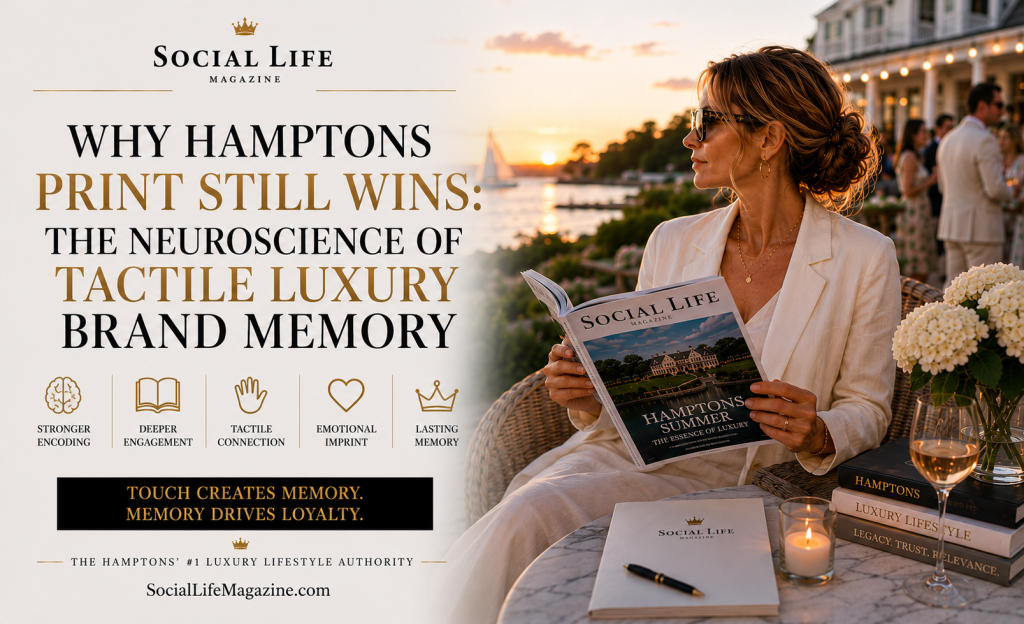
The woman who picks up a copy of Social Life Magazine at a boutique in Southampton on a Saturday morning in July is performing a physical action that digital media cannot replicate. Her hand makes contact with a specific weight of paper. Her fingers navigate the slight resistance of a well-produced page. She is holding, in the specific way that print produces, the editorial institution she is about to consume.
That physical contact is doing neurological work before she has read a single word.
Haptic cognition research is consistent in its findings: people who physically hold objects assign them higher value and retain information more reliably than people who view identical content on screens. The mechanism is neurological. The mechanism is neurological. Physical contact activates the sensorimotor cortex and the premotor cortex simultaneously, creating a richer memory encoding than purely visual processing produces.
For luxury brands invested in Hamptons print advertising, this neuroscience is not academic. Because of this, brands with consistent Social Life print presence consistently report higher unaided brand awareness among the Hamptons audience than brands relying exclusively on digital channels — even when digital campaigns reach larger raw audiences.
Hamptons print advertising and luxury brand memory are, in the research literature, not just correlated. The physical format is a causal mechanism in the quality of the brand memory it produces.
The Encoding Advantage
Brand memories are not equal. Some are shallow: a fleeting encounter leaves a surface impression, the encounter is not reliably retrievable without a cue. Others are deep: the brand name retrieves a rich associative network — a feeling, a context, a recommendation, a specific aesthetic. The deep brand memory is the one that influences purchase decisions. The shallow one contributes to awareness statistics but rarely to sales.
Print advertising in a trusted editorial context systematically produces deeper brand memories than digital advertising in non-editorial contexts. The research explains why. Physical handling activates haptic encoding. A trusted editorial environment activates credibility-associated memory pathways. Leisure context activates emotional encoding systems. Together, these produce a convergence of signals that creates a more retrievable memory trace.
A reader who spent forty minutes with a Social Life summer issue in a Bridgehampton beach house has encoded the brands she encountered with multiple associative anchors. The physical sensation of the paper. Editorial quality of the surrounding content. The specific emotional state of a summer Saturday. Any one of these anchors can retrieve the brand memory in the months that follow.
The digital ad she received that same weekend has one anchor: a visual impression in a social media feed. If the brain encoded it at all, the memory sits shallow and decays quickly.
The Seasonal Amplifier
There is a specific mechanism that amplifies the print memory advantage in the Hamptons context and that does not operate in other print markets. It is the seasonal identity effect: memories formed during a distinct seasonal experience are encoded with the emotional and sensory qualities of that season. They are more vivid and more durable than memories formed in neutral contexts.
The Hamptons summer is one of the strongest seasonal identity experiences available in the continental United States. Specifically, the quality of light in East Hampton in August. Sound of a polo match in Bridgehampton. The smell of the farm stand off Scuttle Hole Road. These are sensory anchors of unusual specificity. They attach to every memory formed in their presence.
A brand met inside Social Life Magazine during a Hamptons summer carries all these anchors. When the reader returns to her apartment in Manhattan in September, the brand memory she carries from the summer issue is connected to the emotional register of the summer itself. Encountering the brand later — in a New York boutique, in an online search, in a retargeting ad — retrieves not just the brand but the feeling of the summer. That retrieval is a form of positive affect transfer that no September campaign can manufacture from scratch.
This is the full case for why Hamptons print advertising for luxury brands is not just a media channel decision. It is a memory engineering decision. The brand that invests in print during the Hamptons summer is investing in the most associatively rich memory encoding environment available in the American luxury market.
Submit a paid feature at sociallifemagazine.com/submit-a-paid-feature.
Where The Conversation Continues
The print memory advantage is one dimension of Social Life Magazine’s irreplaceable position in the Hamptons market. Full hub: The Irreplaceable Asset: Why 23 Summers of Hamptons Trust Cannot Be Bought on a Media Plan.
Sibling spokes: The Legacy Luxury Paradox and The Compound Interest of Hamptons Brand Presence (FUTURE).
Pillar: Why Luxury Brands That Ignore Psychology Lose the Hamptons Every Summer.
Author

Written by
Recent Posts
The Hidden Work Behind a Seamless Hotel Weekend
Choosing Scratching Furniture for a British Shorthair
Bile Reflux vs. Acid Reflux: Why Your Antacid Isn’t Working
Annie Watt Photography Agency 20th Anniversary Celebration and Exhibition in NYC | New York, NY

Denise Fraile: Connecting People, Inspiring Purpose
Categories
- Art
- Articles
- Business of Luxury
- Celebrities
- Culture
- Entertainment
- Events
- Faces of Summer 2026
- Fashion
- Fashion & Style
- Featured
- Finance
- Food, Spirits, Wine
- Hamptons
- Hamptons Celebrities
- Health
- Health & Beauty
- Lifestyle
- Luxury Lifestyle
- Press
- Profiles
- Real Estate
- Technology
- The Chronicles
- Travel
- Uncategorized
- Weddings