
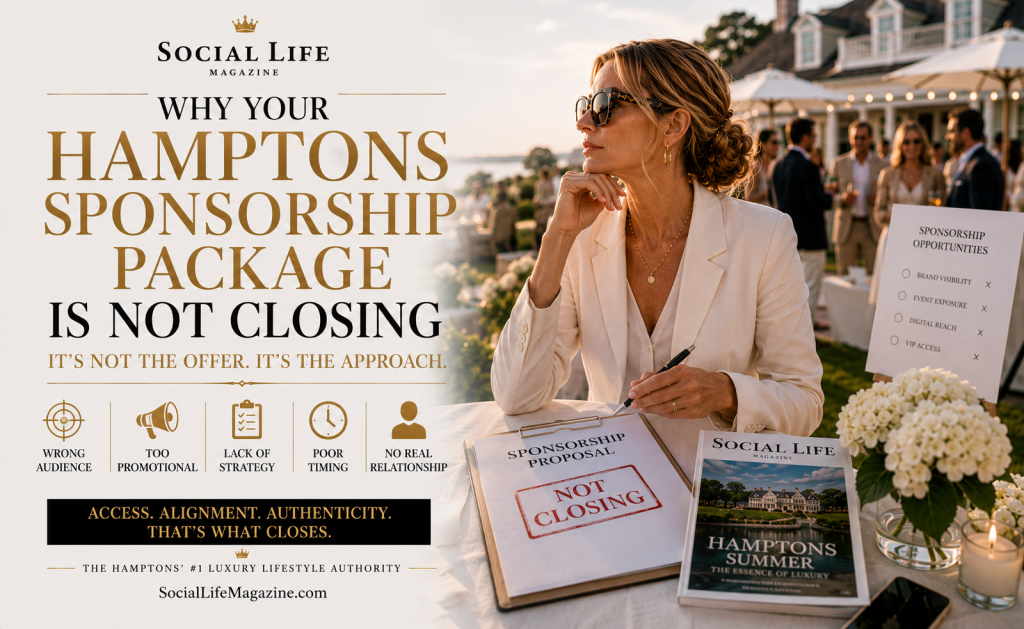
The deal looked good. Marketing director interest was genuine. The first call went well. She said she would discuss it with her events team and circle back the following week.
She did not circle back the following week. A follow-up email went out. She responded, apologized for the delay, and said the team was reviewing. Another week passed. A second follow-up was sent. She responded saying they were interested but needed to confirm the Q3 budget allocation. That confirmation required a conversation with her finance lead. The finance lead was on vacation. When the finance lead returned, the activation timeline was no longer viable.
As a result, the deal died. Not because the price was wrong. The brand was a perfect fit. And not because the marketing director lost interest. It died because the path from her initial interest to a completed commitment contained more steps than the interest could sustain.
Specifically, this is the most common failure mode in Hamptons sponsorship sales, and it is almost never diagnosed correctly. The seller concludes that the timing wasn’t right, or the brand wasn’t ready, or the budget wasn’t there. The real diagnosis is simpler and more actionable: Hamptons sponsorship package friction killed a deal that the brand actually wanted to make.
The Friction Audit
There is a diagnostic that every brand selling Hamptons sponsorship packages should run on their current process. It has five questions.
How many separate conversations does a prospect need to have before they can say yes? How many different documents do they need to review? What is the internal stakeholder count that needs to sign off? How many weeks does the standard close cycle run? And critically: at which step in that cycle do most deals go silent?
In fact, for most luxury event and publication sales operations, the answers to these questions reveal a process designed for due diligence rather than for closing. The process is thorough. It covers all the information a brand might need. It includes all the stakeholders who should weigh in. And it is exactly as long as necessary to outlast the initial interest that generated the opportunity.
Specifically, the interest that a marketing director has in the first forty-eight hours after encountering a compelling Hamptons sponsorship opportunity is at its highest point. Every subsequent step in the decision process consumes some of that interest. Each unanswered question creates a cognitive weight that attaches to the opportunity and makes the next step heavier. Every week that passes allows competing priorities to accumulate.
The process that takes four weeks to complete is, in other words, not completing four weeks of necessary work. is not completing four weeks of necessary work. Instead, it is burning four weeks of initial interest and replacing it with a decision that now requires more energy to make than the original interest provided.
What a Low-Friction Yes Looks Like
Social Life Magazine’s submission process for paid editorial features was deliberately designed around the low-friction yes principle. The page at sociallifemagazine.com/submit-a-paid-feature answers, in a single reading, the questions that drive the highest-friction stages of a conventional sponsorship conversation.
What does the brand receive? Answered on the page. What does it cost? Answered on the page. How long does it take? Answered on the page. What action is required? A single form submission. What happens after that? Answered on the page.
A marketing director who encounters this page and finds the product appropriate for her brand can make a yes decision in fifteen minutes. She does not need to schedule a call to get the information she needs. No forwarding to the events team for evaluation. No waiting for a proposal draft and delivery. The cognitive load of the yes is minimal, and the path between interest and action is a single step.
This is not a simplified product. The paid feature is a complete editorial and digital package including print placement, archive publication, SEO optimization, and email distribution. It is a full-service offering. The simplicity is in the decision process, not the product.
The difference matters because the friction reduction is not achieved by offering less. It is achieved by presenting the full offering in a way that answers the decision questions before they are asked. That is the Best Buy field removal applied to luxury sponsorship: not a smaller product, but a smoother path to yes.
Where The Conversation Continues
The friction diagnostic is one application of the frictionless yes principle. Full hub: The One-Click Summer: Why Small Frictions Are Killing Luxury Brand ROI in the Hamptons.
Submit at sociallifemagazine.com/submit-a-paid-feature.
Sibling spokes: The Thank-You Card That Closes More Deals Than a Deck (FUTURE) and What Happens When You Make It Effortless to Say Yes (FUTURE).
Pillar: Why Luxury Brands That Ignore Psychology Lose the Hamptons Every Summer.
Author

Written by
Recent Posts

The Hidden Work Behind a Seamless Hotel Weekend
Choosing Scratching Furniture for a British Shorthair
Bile Reflux vs. Acid Reflux: Why Your Antacid Isn’t Working
Annie Watt Photography Agency 20th Anniversary Celebration and Exhibition in NYC | New York, NY

Denise Fraile: Connecting People, Inspiring Purpose
Categories
- Art
- Articles
- Business of Luxury
- Celebrities
- Culture
- Entertainment
- Events
- Faces of Summer 2026
- Fashion
- Fashion & Style
- Featured
- Finance
- Food, Spirits, Wine
- Hamptons
- Hamptons Celebrities
- Health
- Health & Beauty
- Lifestyle
- Luxury Lifestyle
- Press
- Profiles
- Real Estate
- Technology
- The Chronicles
- Travel
- Uncategorized
- Weddings