
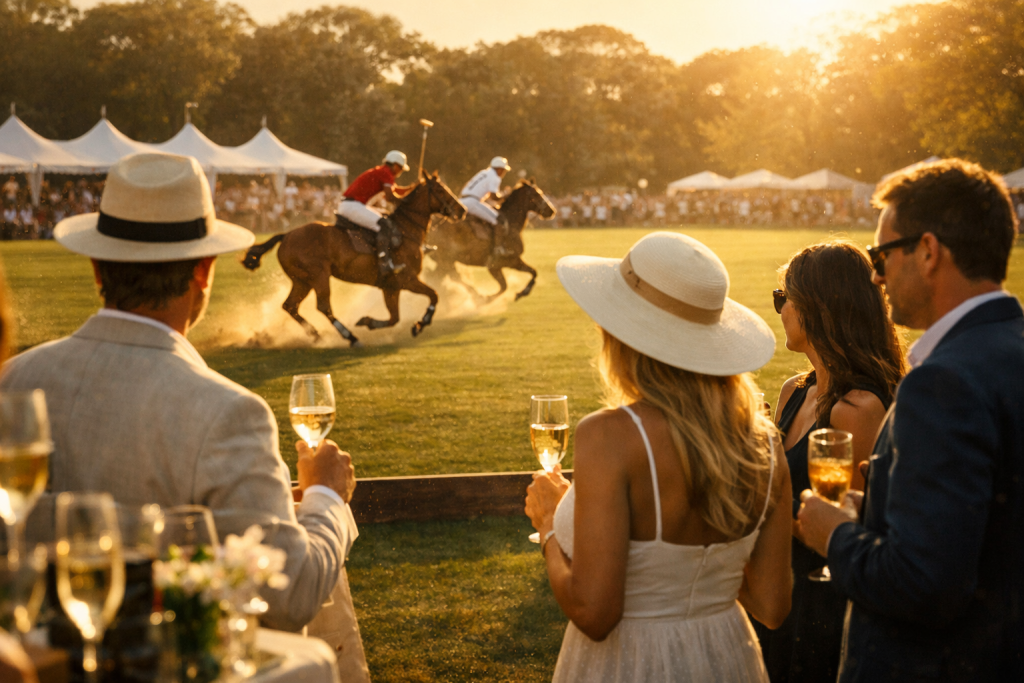
On the third Saturday of July, almost one thousand people will gather on a field in Bridgehampton. Most paid $250 to $350 a ticket to be there, depending on how early they bought in. A lucky few got in on a sponsor’s tab instead. Still, hardly any of them could name a single player on either side. They came anyway, because the Hamptons summer social scene runs on something other than the match. It runs on the quiet arithmetic of who gets to stand where, and who gets seen standing there.
Here is the part nobody explains when you first arrive with money and good intentions. The season is not a list of parties you attend. Instead, it is a structure you assemble, one surface at a time, until the whole thing finally reads as belonging. Some people crack it in a summer. Others spend a decade and never do.
The Season Is Assembled, Not Attended
Think about how you actually take in the Hamptons now. You do not sit through one long story about a summer. By contrast, you catch it in fragments. A polo tent on Saturday. A dinner on Meadow Lane you only hear about on Sunday. An activation you walked past without knowing it cost a brand six figures.
Each fragment is a tile. On its own, a single tile means almost nothing. But set enough of them side by side and a picture appears, the way a mosaic resolves only once you step back. That picture is your standing. The people around you assemble it without ever being asked to.
So the work is not landing one perfect moment. Rather, it is placing enough tiles, in enough places, that the picture becomes hard to argue with. Social Life Magazine has spent twenty-three summers as the surface where those tiles get arranged. Knowing the five that matter is where the season starts.
The Capital Nobody Names Out Loud
Underneath all five surfaces runs a single logic, and it helps to name it. What people are really trading out here is capital, and capital comes in more than one currency. Money is only the most obvious kind, and it is rarely the decisive one.
There is economic capital, the cash everyone assumes the Hamptons runs on. But there is also social capital, the web of who you know, and cultural capital, the taste that signals you belong. So the season is really a marketplace where these three currencies trade against one another.
The newly arrived usually hold plenty of the first and little of the other two. That imbalance is the whole challenge, since money alone reads as thin here. The work of a summer is converting economic capital into the social and cultural kinds that actually buy standing.
Every tile you place is a small exchange of one currency for another. A polo ticket spends money to buy a little proximity. An estate invitation converts that proximity into belonging. Of course, the people who understand the exchange rate move through the season far more efficiently than those who only spend cash.
Surface One: The Polo Field
The loudest tile sits in Bridgehampton on two Saturdays in July. Polo is the rare Hamptons event that wants to be seen, since it trades on spectacle rather than secrecy. Christie Brinkley hosts. The tent fills with people who understand that attendance is a public act.
For a newcomer, the field is the easiest tile to place first. You buy in, you show up, and you are instantly inside a frame thousands of others recognize. The trick is wearing it correctly, because the field punishes anyone who looks like they tried too hard.
Of course, polo is only one surface, and a loud one rarely carries a season alone. The reader who wants the full map can start with our guide to Polo Hamptons 2026. After that, the quieter surfaces do the heavier lifting.
Surface Two: The Private Estate
If polo is the surface that wants witnesses, the private estate is its opposite. The dinner on the ocean side of Meadow Lane does not advertise. Instead, it filters. An address becomes a guest list, and a guest list becomes a verdict on who you are.
This is where the real sorting happens. Anyone can buy a polo ticket. By contrast, almost no one can manufacture an invitation to a house that costs more than most towns. The estate is the tile that says you were chosen, not that you paid.
Newcomers tend to chase these rooms too early and too obviously. The smarter play is to earn proximity first, then let the invitation arrive on its own clock. Our breakdown of Hamptons private estate events maps how those rooms actually get filled.
Surface Three: The Beach
The beach party is the one surface that pretends to be democratic. Sand is free, after all, and the ocean does not check your net worth at the dune line. Yet the beach runs its own status game, just with softer edges and better light.
What you wear, who you arrive with, where the cooler came from. These read instantly to anyone fluent in the code. The beach replaced the nightclub for a generation that decided velvet ropes were embarrassing, so it moved the same hierarchy onto the sand.
Done right, a beach moment is the warmest tile on the board, because it looks effortless even when it took real planning. Our field notes on the Hamptons beach party decode what actually signals out there. Then the night usually drifts toward Sag Harbor.
Surface Four: The Brand Activation
Somewhere between the polo tent and the beach sits a surface most guests never consciously notice. A brand builds a moment, drops it into the season, and hopes you absorb it without resistance. The good ones feel like part of the weekend rather than an ad pasted over it.
For a brand, this surface is the whole game. Relevance in the Hamptons cannot be bought with a billboard, since the audience here is allergic to anything that looks like one. It has to be earned by becoming a tile people actually enjoy standing near.
This is the surface where Social Life does its most pointed work, because we know how to fold a brand into the vibe instead of stapling it on top. Our playbook on Hamptons brand activations shows what absorption looks like when it works.
Surface Five: The Address You Wake Up In
The final tile is the one people forget to plan, even though it frames every other tile they place. Where you stay is not logistics. Rather, it is the headquarters from which your whole weekend is read. A Sag Harbor house tells a different story than a motel near the highway.
The address sets the terms before you arrive anywhere else. It decides how easily people drop by, how late the night can run, and whether your weekend has a center of gravity at all. Smart visitors pick the house first and build the season around it.
That is why accommodations belong on this map, not beneath it. Our guide to Hamptons luxury rentals treats the address as the strategic choice it really is. Choose well, and the other four surfaces fall into place.
How the Five Surfaces Talk to Each Other
Here is the move that separates people who get it from people who keep trying. The five surfaces are not separate errands. Instead, they are one connected board, and the tiles reinforce each other when you place them on purpose.
The beach party flows to the Sag Harbor house. That house becomes the base for the estate dinner. By midweek, the estate crowd turns up at polo, where a brand activation catches them in exactly the right mood. Each surface hands you to the next, so the season compounds rather than scatters.
Miss this and you spend the summer collecting disconnected nights that never add up to a picture. Get it, and a single well-placed July turns a stranger into a fixture. The arithmetic is not complicated, but it is unforgiving to anyone who improvises it.
The Print Tile and the Digital Tile
Not every tile does the same job, and the format matters more than people think. A print feature and an online article both place your name in the mosaic, but they signal in opposite registers. So knowing which to use when is its own small skill.
Print is the permanent tile. It does not scroll away, and a physical magazine on a coffee table carries a weight no link can match. So print works as symbolic proof, the anchor that says you mattered enough to be committed to paper.
Digital is the volume tile. It travels, it ranks, and it reaches people who will never hold the issue. By contrast, an online piece works through discovery and reach rather than permanence. The two formats are partners, not rivals.
The smartest players use both on purpose. They anchor with print for the weight, then amplify with digital for the reach, so a single story works two surfaces at once. Specifically, the print tile proves your standing while the digital tile spreads it.
Timing Is the Tile Most People Drop
Where you place a tile matters, but when you place it matters almost as much. The season has a tempo, and people who ignore it always feel slightly off the beat. Arrive too early and the rooms are empty. Arrive too late and the verdicts are already in.
The two July polo Saturdays act as the season’s loud hinge, since they pull the largest crowd into one frame at once. Smart operators build toward those dates rather than treating them as just another weekend. They warm up in June, peak in mid-July, and coast on the momentum into August.
So the calendar is not a constraint to work around. Instead, it is a weapon, because a tile placed at the right moment carries twice the weight of the same tile placed at the wrong one. Read the tempo first, then move.
The Newcomer’s Most Expensive Mistake
The classic error is treating the season like a series of tickets to buy. New money tends to overpay for the loud tiles and ignore the quiet ones entirely. So they show up everywhere and still land nowhere, because volume without coherence reads as trying.
The locals know the opposite. Fewer tiles, placed with intent, beat a frantic calendar every time. A season is built like a sentence, not shouted like a slogan, and the people who matter can always hear the difference.
This is the whole reason the map exists. Social Life has watched founders crack the code in one summer and watched others flail through five. The difference was never the budget. It was whether they understood the board before they started playing on it.
How Outsiders Become Insiders
Nobody arrives in the Hamptons an insider. Even the most established names started as outsiders who learned the codes over time. So the real question is not whether you belong yet, but how quickly you can earn your way in.
The path runs through the surfaces in a rough order. You start on the loud, accessible ones like polo, where money buys entry. Then you work toward the quiet, filtered ones like the estate, where only relationships open the door. So the arc moves from buying access to being granted it.
Patience is the underrated ingredient. The people who try to rush straight to the exclusive rooms usually get read as strivers and stall. By contrast, those who place their tiles steadily, season over season, find the doors opening on their own.
This is the path from outsider to fixture, and it rewards consistency over spectacle. A few well-placed summers beat one frantic one every time, since standing here compounds slowly and then all at once.
Who This Season Is Actually For
Not everyone needs to play this game, and honesty about that saves a lot of wasted effort. The season rewards specific people with specific goals, and it quietly ignores the rest. So it helps to know whether you are one of them.
The first is the newly successful founder who has the money but not yet the standing. For them, the season is a conversion engine, a way to turn a bank balance into belonging. So the surfaces offer exactly the social proof they have been missing.
The second is the brand that needs relevance among an audience it cannot reach through ads. The third is the host who wants to become a connector, the person whose rooms everyone hopes to enter. Each of these has a clear reason to assemble the mosaic.
If you recognize yourself in one of these, the season is built for you. If you do not, there is no shame in sitting it out, since the game only pays the people who actually need what it offers.
Where the New Money Comes From
The faces in the tent change with the economy, and lately they have changed fast. A decade ago, finance dominated the newly arrived. Now tech founders, crypto winners, and a wave of first-generation wealth fill the same tents. So the crowd is younger and less sure of the codes than it used to be.
This shift matters because new money behaves differently from old. It tends to spend loudly and signal eagerly, since it has not yet learned that restraint reads better here. By contrast, the established names have nothing to prove and show it through what they leave off.
The opportunity hides in that gap. Anyone willing to learn the quiet codes can leapfrog peers who are still shouting, because the codes reward fluency over wealth. So a thoughtful newcomer often outpaces a richer but clumsier one.
The season has always absorbed new money and slowly taught it manners. That process is just running faster now, with more arrivals and a steeper curve. The ones who study the board adapt quickest, while the rest keep paying tuition in wasted summers.
Reading a Room Before You Enter It
The most useful skill out here is also the least taught. Before you walk into any room, you should be able to read what kind of room it is. Who set it, what currency it trades in, and what the unspoken rules are. So the first move is observation, not performance.
Every surface has its own register, and a misread is costly. The behavior that wins on the beach reads as sloppy at an estate dinner. By contrast, the formality that suits the estate looks stiff on the sand. The room tells you how to behave if you watch it first.
Start by clocking the host’s intent. A party built to be seen rewards a different presence than one built to filter, so match your energy to the purpose. Then read the crowd, since the people already inside reveal what the room actually values.
This habit separates the fluent from the frantic. The fluent pause and read, then move with the room. The frantic burst in performing a version of themselves the room never asked for, and everyone notices.
Being Seen Versus Being Remembered
Most people chase visibility and stop there. They want to be seen at the right events, in the right photos, near the right names. But being seen is the easy half, and on its own it fades by the next weekend.
Being remembered is the harder and more valuable goal. It comes from contributing something to a room rather than just appearing in it, whether that is warmth, taste, a great introduction, or a genuinely good party. So the memorable people give, while the merely visible only take up frame.
This is why the loud tiles alone never build a reputation. You can be photographed at every event all summer and still be forgotten, since presence without contribution leaves no trace. By contrast, one well-hosted dinner can make you unforgettable.
So aim past visibility. Place your tiles to be remembered, not just seen, because the season rewards the people who leave a room better than they found it. That is the difference between a busy summer and a season that actually changes your standing.
What Twenty-Three Summers Taught Us
Social Life Magazine did not invent this board, but we have watched it longer than almost anyone. Over twenty-three summers, the names on the tents changed while the game stayed constant. The capital gets new faces every few years. The structure does not.
What we learned is simple to say and hard to live. The people who win the season treat it as a craft, not a sprint. They study the surfaces, respect the tempo, and place fewer tiles with more intent than the crowd burning cash around them.
That patient approach is exactly what this magazine exists to support. We are the surface where the tiles get arranged, and the map for anyone serious about being read correctly. Of course, the map only helps the people who use it.
Where The Conversation Continues
You have been swimming in this season the whole time you have been here, the way a fish forgets it is in water. Most people never notice the current that moves them. You just did.
If you want to stop drifting and start placing tiles with intent, the door is open. Tell us what you are building this summer at sociallifemagazine.com/contact.
Ready to put your name on a surface that lasts past Labor Day? A paid feature is the fastest tile to place, so claim one at sociallifemagazine.com/submit-a-paid-feature.
The people who move first also read first. Our weekly dispatch lands before the season does, and you can get on the list right here at our weekly signup.
Polo Hamptons is the loudest tile on the board, July 18 and 25 in Bridgehampton. See the field and the lineup at polohamptons.com.
Print is the one tile that does not scroll away by morning. Subscribe and hold the whole season in your hands at sociallifemagazine.com/subscription.
Independent media keeps the lights on the old way, with readers who care. If this was useful, you can fuel the next one at our donate page.
Author

Written by
Recent Posts

A Night of Fashion and Film: My Night at the Hamptons Film Festival Closing Celebration at Baker House 1650

Verde New York Celebrates Meatpacking District Grand Opening With Mojave Grey Performance

He’s the Richest Man in the Room, but He’s Still Bad at Making Friends
Legal Options for Investment Fraud Claims

How Custom DTF Printing Adds Ease and Color to Your Boutique
Categories
- Art
- Articles
- Business of Luxury
- Celebrities
- Culture
- Entertainment
- Events
- Faces of Summer 2026
- Fashion
- Fashion & Style
- Featured
- Finance
- Food, Spirits, Wine
- Hamptons
- Hamptons Celebrities
- Health
- Health & Beauty
- Lifestyle
- Luxury Lifestyle
- Press
- Profiles
- Real Estate
- Technology
- The Chronicles
- Travel
- Uncategorized
- Weddings